Tourism

India, the largest democracy in the world, is making great strides and placing great importance on tourism. Tourism is already the country’s 3rd largest foreign exchange earner, bringing in Rs 46 billion in 1993-1994. Recognizing the socio-economic importance of tourism, the Indian government is giving high priority to the development of the tourism industry. The Indian government acknowledges the beneficial characteristics of tourism in the following words:
“Tourism is now recognized as an activity generating a number of social and economic benefits. It promotes national integration and international understanding, create employment opportunities and augments for foreign exchange earnings. Tourism also gives support to local handicrafts and cultural activities. Expenditure by tourists has a multiplier effect and also generates considerable tax revenue. All these benefits can be achieved with a relatively low level of investment (Seventh 5-year Plan).
Arguably, there are few countries in the world that can match the geographical, cultural, traditional and religious diversity of India. From the lush green vales of the south, to the ice-capped Himalayan peaks, from the wettest spots on the earth in the dense forest in the north-east, to the deserts in the north-west, there is good reason to label India as the “land of all seasons and for all reasons”. It is a land of climate, rarely found in any other single country in the world. The diversity is amazingly attractive, especially with the geography wrapped around the world’s oldest civilization. International chess was invented in India and the oldest language Sanskrit, which is still spoken today, goes back to the dawn of history of India. The caste system, the Maharajas and the convolution of ethnicities and religions are all contained in the melting pot of India.


· Dissemination of Information to Tourists
The Department of Tourism under the Ministry of Civil Aviation and Tourism is responsible for the formulation and implementation of the policies and programmes for the development of tourism within the country. It also deals with attracting tourists to India by way of publicity and promotions overseas. It disseminates information for tourist interests as well. It operates through 20 tourist offices in India and 18 overseas offices.
Besides the dissemination of information, the projection of an attractive image is also important. In this respect, India is perceived as an unsafe and dirty destination. As S. Ramachandran, a senior executive at Thomas Cook said “Our major hurdle is the image of India. Because of a few troublemakers, our image is spoiled”.

· Dissemination of Information to Potential Tourism Investors
The dissemination of information about potential areas for tourism investment for foreigners is complicated by the fact that India possess a federal structure which divides the vast subcontinent into 32 states and union territories, each with its own local government. Tourism is a state subject which means that the national centre cannot legislate on tourism for an all-India application. Thus, each state and union territory sets their own incentives and guidelines for tourism investments.
· Inconsistent Tourism Policies
The tourism industry is susceptible to the vagaries of political instability and change, resulting in inconsistency in the efforts by the 3 former governments headed by 3 different prime ministers (Rajiv Gandhi, 1989; Vishwnanath Singh, 1990; Chandra Shekhar, 1991). In 1989, Gandhi’s government drafted the concept of the “Visit India Year” to be launched in 1991. Vishwnanath Singh’s government ordered the slashing of the tourism department budget in 1990 as part of the austerity measures. When Chandra Shekhar’s government took office, it directed that some of the 20 overseas tourism offices be closed. These inconsistent actions have created uncertainty for potential investors.
· International Access
There are about 43 international airlines, which fly to India with an estimated 90,000 seats per week or about 4.68 million seats per year. Figures for 1993 indicate that Indian nationals travelling abroad exceeded the 2.2 million mark while the corresponding inbound tourism figure was around 1.7 million. To realize the target of 5 million arrivals set by the National Committee on Tourism in 1989amd subsequently by the Tourism Minister, Madhavrao Scindia, an estimated 10 million international air seats need to be available annually. This target was initially planned for year 1997 but it has been pushed back to year 2000 because of the 1994 plague and delays in implementing the plans.

In theory, the Indian government appears to support the concept of an “open-sky” policy in order to increase the number of air seats into India. Implementation of such a concept has not been smooth. For instance, Lufthansa German Airlines struggled for almost 2 years before winning approval late in 1994 to serve the southern city of Madras, a bustling leather and electronics centre. Only one carrier, Air India connects New Delhi and Hong Kong, though Hong Kong-based Cathay Pacific Airways has been negotiating for more than 5 years to serve the Indian capital.
India has only 4 major international gateway cities: namely Bombay, New Delhi, Madras and Calcutta. The percentages of international tourists that use these cities as ports of entries are Bombay 42.2%, Delhi 39.7%, Madras 7.4% and Calcutta 3.2% in 1991. Other geographically vast countries like Australia, China and Japan has at least 6 gateway cities each.
In addition, India lacks the frequent and convenient air connections to key international points. As an illustration, India is connected by only 7 weekly flights from USA, 6 from Japan and none from Australia. In contrast, Singapore has 48 weekly flight connections with USA, 66 with Japan and 75 with Australia.

· Domestic Access
Domestic air services are operated by Indian Airlines and Vayudoot, with a network connecting more than 70 major cities. However, this network can be further improved to link key cities of interest to tourists. For example, Agra has the country’s top tourist attraction, the Taj Mahal but it still lacks the air links with the cultural city of Jaipur in Rajasthan, the next biggest tourist draw.Instead, it takes 5 tiring hours of driving or sitting in a coach along 190km of dusty, pot-holed roads to connect the 2 cities.

· Ground Transport
Train travel is operated by the Indian Railway System, which is Asia’a largest and the world’s second largest railway system. More than 11 million commuters a day use the railway service in 11,000 trains, criss-crossing 62,000km of railway lines which connect 7,021 stations. The Indrail pass ticket, which is available to foreigners can offer unlimited rail travel with substantial savings. Next to railways, motor transport is the chief means of travel on paved roads and highways. There is a growing need for expansion, particularly of the interstate highways.


The most important functional components of tourism from an economic perspective are facilities and services such as hotels, motels, restaurants, bars, retail outlets and other services. Tourist spending on these facilities and services accounts for the largest share of economic input in most destination regions.
· 3-Star and 4-Star Hotels
Currently in India, there are about 45,000 rooms in approved hotels and about 45,000 rooms in hotels outside the approved category. The breakdown of the 45,000 rooms in the approved category are: 33% (15,000 rooms) in 5-star deluxe hotels, 9% (4,000 rooms) in 4-star hotels, 13% (6,000 rooms) in 3-star hotels and 45% (20,000 rooms) in 2-star and 1-star hotels.
From the figures above, it can be seen that the fewest number of rooms in approved hotels are in the 4-star and 3-star categories. Tourist officials and hotel consultants see a considerable demand for 4-star and 3-star hotels. They offer price categories that are affordable to both international tourists and middle-income domestic tourists.
Non-resident investment in India’s hotle industry is encouraged on an attractive non-repatriable as well as repatriable basis. In the non-repatriable scheme, non-resident Indians (NRIs) can invest up to 100% equity without obligations to include resident Indians participation. Capital investment and profits can be fully repatriated under the 2 schemes for 40% or 74% equity as in the case of hotel projects in the 3,4 and 5-star categories.
To attract more foreign collaboration with Indian hotels and convention centres, liberalized guidelines are identified as both for franchises and management contract operations. A foreign collaborator can invest foreign equity capital in hotels and convention centres for up to 51% of the equity. The investor is allowed to repatriate dividends freely. Moreover, hotels are given priority consideration in the allocation of essential facilities such as connections for telephones, telex and cooking gas.


· Heritage Hotels
As a means of preserving old buildings, particularly palaces, forts and havelis, the Indian government has encouraged the conversion of such privately owned properties into heritage hotels. The incentives offered by the State governments are 20% of the eligible capital up to Rs 2 million. Apart from this, investors would also be eligible for the other incentives given by the central government such as a cah subsidy up to Rs 500,000. Investors are also eligible for income tax benefits under the Section 80-HHD and 80-IA of the Income Tax Act in which 50% of the income in foreign exchange is exempted from tax. The balance 50% can also be exempted from tax if it is reinvested in the tourism industry.
· Beach Resorts
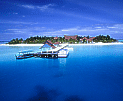
Peninsular India, bounded by the Arabian Sea, Bay of Bengal and the Indian Ocean has a long coastline of around 7,500km. Opportunities for resort development exist along various beaches for example, at the Bekal Beach in Kerala and Diu in Western India. Sinhudurg, in Maharashtra has been identified as a special tourism area due to its many beautiful beaches and its proximity to the internationally known beach of Goa.
- Camps
The tented camps set up by the India Tourism Development Corporation’s Tourism Task Force have been a success. More camps are being planned at Diu, in Goa and the Andamans after the success of Narwar, Bir and Jaisalmer.