Leonid A. Gavrilov
August 2002
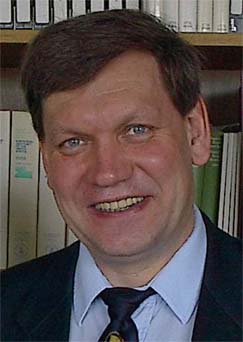
Current status: Permanent resident of the United States.
Education:
Ph.D. 1980 Moscow State University, Moscow, Russia. Genetics.
M.Sc. 1976 Moscow State University, Moscow, Russia. Chemistry, with
specialization in
mathematical modeling and chemical kinetics.
Areas of Specialization:
Biodemography of Human Longevity/ Analysis of Human Mortality and Aging
Mathematical Modeling of Aging and Mortality
Genetics of Aging and Longevity
Professional Positions:
Research Support (as PI or Co-PI only):
Current Funding:
In the United States (since 1998):
Professional Activities:
Professional Societies: International Union for the Scientific Study of Population (IUSSP), Population Association of America (PAA), Gerontological Society of America (GSA), Social Science History Association (SSHA), European Association for Population Studies (EAPS), 1995-98, American Association for the Advancement of Science (AAAS), 1994-95, New York Academy of Science (NYAS), 1994-95, Demographic Section of Moscow House of Scientists (Scientific Secretary, 1984-1991).Teaching Experience:Editorial Board Member:
Journal of Anti-Aging Medicine, Mary Ann Liebert Inc. Publishers, USA;
The ScientificWorldJOURNAL (http://www.thescientificworld.com/);
Health Care in Later Life, Arnold Publishers, UK (1996-1998);Expert (Peer Reviewer): Journal of Gerontology, Journal of Theoretical Biology, Annals of Human Genetics, Experimental Gerontology, Biogerontology, Demography, Population, Social Biology, Genus, Mathematical Population Studies, Population and Development Review, Age and Ageing, Ageing and Society, Journal of Anti-Aging Medicine, Journal of the American Aging Association (AGE), electronic journal "TheScientificWorld", BioMed Central.
Book reviewer for journals Population and Development Review, Age and Ageing, Ageing and Society.
Consultant for the National Institute on Aging: National Institutes of Health Professional Service Contract #263 SDN74858 "Inventory of data resources on familial aggregation of human longevity that can be used in secondary analysis in biodemography of aging", 35pp. Submitted to NIA on 05/29/98.
Consultant (ad hoc reviewer) for the National Research Council at the National Academy of Sciences of the United States.
Member of the Science Advisory Board (http://www.scienceboard.net/)
Special advisor for The American Society for Healthy Aging.
Member of the Academy of The American Society for Healthy Aging.
Member of the Scientific Advisory Council for Maximum Life Foundation.
Invited presentations: IPSEN Foundation, Paris, France (1999, 1995); INSERM, Montpellier, France (1999); Max Planck Institute for Demographic Research, Rostock, Germany (1999); Bowling Green State University, Ohio (1999); Department of Demography at the Rome University, Italy [Dipartrimento di Scienze Demografiche, Roma, Universitа "La Sapienza"] (1998); Universite Catholique de Louvain, Louvain-la-Neuve, Belgium, (1998, 1997, 1995), Gerontology Research Center, National Institute on Aging, Baltimore, MA (1998); Department of Biology, Universite Catholique de Louvain, Belgium (1997); Center for Gerontology Research, Allegheny University of the Health Sciences, Philadelphia, PA (1997); University of Washington, Seattle, WA (1997); Aeiveos Sciences Group, Seattle, WA (1997); Institute on Aging, University of Wisconsin, Madison, WI (1997); Center on Aging, NORC/University of Chicago, IL (1997); Iowa State University, Ames (1997); Gerontology Center of the University of Georgia, Athens, GA (1997); Institute of HeartMath, Boulder Creek, CA (1997); Netherlands Interdisciplinary Demographic Institute (NIDI), The Hague, The Netherlands (1995); Sussex University, Brighton, UK (1995); Faculty of Social Sciences, Utrecht University, The Netherlands (1995).
Awards and Honors:
Cited by “Who’sWho in America” in Marquis Who’sWho, 2002 Edition.
Cited by Encyclopedia Britannica as the author of recommended book "The Biology of Life Span." http://www.britannica.com/eb/article?eu=128852
Featured in Science(6 June 1997, p.1503), The Scientist (May 13, 2002, p.20), Sunday Times London (June 15, 1997), and NORC News (October 26, 2001).
Invited author for Macmillan Encyclopedia of Aging (3 articles), Journal of Theoretical Biology special issue (2001, vol. 213), Population special issue (2001, vol.13), and Springer-Verlag monograph "Sex and Longevity" (2000).
Independent Scientist Award (K02 award) from the National Institute on Aging (2001).
Gordon Research Conference on the Biology of Aging. Travel award from the Organizing Committee (Il Ciocco, Italy, 10-15 May, 1998).
REVES10 International Meeting on Health Expectancy (Tokyo, October 9-12, 1997). Travel award from the Organizing Committee.
Gordon Research Conference on the Biology of Aging. Travel award from the Organizing Committee (Ventura, CA, 5-10 January, 1997)
U.S. Civilian Research and Development Foundation (CRDF), Proposal Development Program Award (grant #PDP48), 1996.
International Science Foundation (ISF), 1994. Emergency Grant for Russian Scientists of the Top Category.
International Science Foundation (ISF), 1993. Emergency Grant Award.
The Certificate from the International Association of Gerontology (1993) signed by the President and the Secretary General of the International Association of Gerontology in connection with his entry to the 1993 Sandoz Prize for the Gerontological Research: "This work testifies to his efforts to improve understanding of the aging process and to advance scientific knowledge for the benefit of the elderly throughout the world".
A. N. Belozersky Institute, 1991. Award for the best scientific research at the Institute in 1990-1991.
European Population Conference (Paris, October 1991). Travel award from the Organizing Committee.
Trinity College, Cambridge University, UK. (Cambridge, December 1991). Travel award.
Moscow Society of Naturalists, 1989. Award for the best scientific research
in natural science in 1986-1988.
Books:PUBLICATIONS
1. Gavrilov L.A., Gavrilova N.S. The Biology of Life Span: A Quantitative Approach, NY: Harwood Academic Publisher, 1991, 385p.
This book is selected and cited by Encyclopedia Britannica as recommended reference.
The book was also reviewed by Nature (1991, 352: 767), British Medical Journal (1992, 305: 431), Population and Development Review (1992, 18: 555 and 1998, 24: 381), Population Studies (1992, 46: 366), Am. J. Epidemiology (1994, 139: 231), Experimental Gerontology (1992, 27: 251), Gerontologist (1991, 31: 707), Human Biology (1992, 64: 630), J. Epidemiology & Community Health (1992, 46: 630), J. Institute of Actuaries (1992, 119: 379),BioEssays (1993, 15: 359), Quarterly Review of Biology (1993, 68: 92), Age and Ageing (1992, 21: 386), Ageing and Society (1991, 11: 509), Archives of Gerontology and Geriatrics (1992, 15: 192), Educational Gerontology (1993, 19: 92), Free Radical Biology & Medicine (1992, 12: 331).2. Gavrilov, L. A. (1990). Podra Prolongarse la Vida del Hombre? (In Spanish). Moscow: Mir, 200p.
Book Chapters (Recent):
Gavrilov, L.A., Gavrilova, N.S. Genetics. In: David J. Ekerdt (ed.) Macmillan Encyclopedia of Aging, New York, Macmillan Reference USA, 2002.
Gavrilova, N.S., Gavrilov, L.A. Evolution of Aging. In: David J. Ekerdt (ed.) Macmillan Encyclopedia of Aging, New York, Macmillan Reference USA, 2002.
Gavrilov, L.A., Gavrilova, N.S. Human longevity and parental age
at conception. In: J.-M.Robine et al. (eds.) Sex and Longevity: Sexuality,
Gender, Reproduction, Parenthood, Berlin, Heidelberg: Springer-Verlag,
2000, 7-31.
Other Publications:
2002
De Grey, Aubrey D. N., Leonid Gavrilov, S. Jay Olshansky, L. Stephen
Coles, Richard G. Cutler, Michael Fossel, and S. Mitchell Harman. Antiaging
technology and pseudoscience. Letter. Science, 2002, 296:
656-656. Available:
http://www.sciencemag.org/cgi/content/full/296/5568/656a
Gavrilov L.A., Gavrilova N.S. The quest for the theory of human longevity. The Actuary, 2002, 36(5): 10-13.
Gavrilov L.A. Scientific legitimacy of the term "Anti-Aging." Journal of Anti-Aging Medicine, 2002, 5(2): 239-240.
Gavrilov L.A., Gavrilova N.S., Olshansky S.J., Carnes B.A. Genealogical data and biodemography of human longevity. Social Biology, 49(1-2), 2002 (in press).
Gavrilova, N.S., Gavrilov, L.A. Genetics: Ethnicity. In: David J. Ekerdt (ed.) Macmillan Encyclopedia of Aging, New York, Macmillan Reference USA, 2002.
Gavrilov L.A., Gavrilova N.S., Evdokushkina, G.N., Semyonova, V.G. Early-life predictors of human longevity. under review.
Semenova V.G., Ivanova A.E., Gavrilova N.S., Evdokushkina G.N., Gavrilov L.A., Devichenskaya M.N. Medico-demographic conditions in urban and rural areas – similarity and differences. Disease Prevention and Health Promotion, 2002 (in press).
Semenova V.G., Ivanova A.E., Gavrilova N.S., Evdokushkina G.N., Gavrilov L.A. Regional variation of mortality as an indicator of health decline in Russian population. Disease Prevention and Health Promotion, 2002 (in press).
Ivanova A.E., Semenova V.G., Gavrilova N.S., Evdokushkina G.N., Gavrilov L.A., Demchenko T.A. Mortality patterns of Russian population in the 1990s and the potential of mortality decline: dynamics and prognosis. Disease Prevention and Health Promotion, 2002 (in press).
Ivanova A.E., Semenova V.G., Gavrilova N.S., Evdokushkina G.N., Gavrilov L.A., Devyachinskaya M.N. Age patterns of mortality in Russian urban and rural population in the 90s years of the 20th century. Disease Prevention and Health Promotion, 2002 (in press).
2001
Gavrilov L.A., Gavrilova N.S. Epidemiology of human longevity: The search for appropriate methodology. Journal of Anti-Aging Medicine, 2001, 4(1): 13-30.
Gavrilov, L.A., Gavrilova, N.S. Biodemographic study of familial determinants of human longevity. Population: An English Selection, 2001, 13(1): 197-222.
Gavrilova, N.S., Gavrilov, L.A. When does human longevity start?: Demarcation of the boundaries for human longevity. Journal of Anti-Aging Medicine, 2001, 4(2): 115-124.
Gavrilov, L.A., Gavrilova, N.S. Etude biodemographique des determinants familiaux de la longevite humaine. Population, 2001, 56(1-2): 225-252 (in French).
Gavrilov L.A., Gavrilova N.S., Evdokushkina, G.N., Semyonova, V.G. Parental age effects on human longevity. Abstract. Gerontology, 2001,47(Suppl.1): 611-611.
Gavrilova, N.S., Gavrilov, L.A., Evdokushkina, G.N., Semyonova, V.G. Study of the inheritance of human longevity. Abstract. Gerontology, 2001, 47(Suppl.1): 611-611.
Gavrilova, N.S., Gavrilov, L.A. Consanguinity and human longevity: Findings from the International Centenarian Study. Gerontologist, 2001, 41 (Sp. issue): 87-87.
Gavrilov L.A., Gavrilova N.S. The effects of early-life events on adult lifespan are sex-specific. Gerontologist, 2001, 41 (Sp. issue): 163-163..
2000
Gavrilova, N.S., Semyonova, V.G., Evdokushkina G.N., Gavrilov, L.A. The response of violent mortality to economic crisis in Russia. Population Research and Policy Review, 2000, 19: 397-419.
Gavrilov L.A., Gavrilova N.S., Evdokushkina, G.N., Semyonova, V.G. Mutations, parental age, and offspring longevity: New ideas and findings. Abstract. Am. J. Phys. Anthropol., 2000, Suppl.30: 156.
Gavrilova N.S., Gavrilov L.A., Semyonova V.G., Evdokushkina G.N. Mechanisms of familial transmission of human longevity. Abstract. Am. J. Phys. Anthropol., 2000, Suppl.30: 156-157.
Semenova V.G., Gavrilova N.S., Varavikova Ye.A., Gavrilov L.A., Yevdokushkina G.N. Rise in violent death rates in Russia as a consequence of the economic crisis. Diseases Prevention and Health Promotion, 2000, 4: 3-10.
Semenova V.G., Varavikova Ye.A., Gavrilova N.S., Evdokushkina G.N., Gavrilov L.A., Evolution of female mortality due to injuries and intoxications in some regions of Russia in the period of economic reforms. Diseases Prevention and Health Promotion, 2000, 3: 29-31.
1999
Gavrilova, N.S., Gavrilov, L.A. Data resources for biodemographic studies on familial clustering of human longevity. Demographic Research [Online], 1999, vol.1(4): 1-48. Available: http://www.demographic-research.org/Volumes/Vol1/4/
Gavrilov, L.A., Gavrilova, N.S. Is there a reproductive cost for human longevity? Journal of Anti-Aging Medicine, 1999, 2(2): 121-123.
Carnes, B.A., Olshansky, S.J., Gavrilov, L.A., Gavrilova, N.S., Grahn, D. Human longevity: Nature vs. Nurture - fact or fiction. Perspectives in Biology and Medicine, 1999, 42(3): 422-441.
Gavrilov, L.A., Gavrilova, N.S. How human longevity and species survival could be compatible with high mutation rates. Journal of Anti-Aging Medicine, 1999, 2(2): 153-154.
Gavrilov, L.A., Gavrilova, N.S., Evdokushkina, G.N., Semyonova, V.G. Familial transmission of human longevity is a function of parental age at reproduction. Abstract. The Gerontologist, 1999. 39(1): 146.
Gavrilova, N.S., Gavrilov, L.A., Evdokushkina, G.N., Semyonova, V.G. Demarcation of the boundaries for human longevity. Abstract. The Gerontologist, 1999. 39(1): 146-147.
Gavrilova, N.S., Gavrilov, L.A., Evdokushkina, G.N., Semyonova, V.G. The future of human longevity: A more realistic approach for life expectancy forecasting. Abstract. AGE (Journal of the American Aging Association), 1999. 22(3): 22-22..
Gavrilov, L.A., Gavrilova, N.S., Evdokushkina, G.N., Semyonova, V.G. Children born to older mothers do not inherit maternal lifespan. Abstract. AGE (Journal of the American Aging Association), 1999. 22(3): 22-23.
1998
Gavrilov L.A., Gavrilova N.S., Semyonova V.G., Evdokushkina G.N., Kroutko V.N., Gavrilova A.L., Evdokushkina N.N., Lapshin E.V. Evolutionary theory, mutations and human life span. Proc. Russian Acad. Sci. [Doklady Akademii Nauk], 1998, 359(3): 426-427. English translation published in Doklady Biological Sciences, 1998, 359(3): 159-160.
Gavrilov L.A., Gavrilova N.S., Semyonova V.G., Evdokushkina G.N., Kroutko V.N., Gavrilova A.L., Evdokushkina N.N., Kushnareva Yu.E. The regularities of inheritance of human life span: contribution of paternal and maternal longevity to the offspring life span. Proc. Russian Acad. Sci. [Doklady Akademii Nauk], 1998, 360(2): 281-283. English translation published in Doklady Biological Sciences, 1998, 360: 250-252
Gavrilov, L.A., Gavrilova, N.S., Evdokushkina, G.N., Semyonova, V.G. Human longevity, spontaneous mutations and paternal age. Abstract. The Gerontologist, 1998, 38(1): 8.
Gavrilova N.S., Gavrilov L.A., Evdokushkina G.N., Semyonova V.G. Non-linear transmission of human longevity from mother to daughter. Abstract. The Gerontologist, 1998, 38(1): 8.
Gavrilov, L.A., Gavrilova, N.S. The future of long life. Letter. Science, 1998, 281(5383): 1611-1612.
1997
Gavrilov L.A., Gavrilova, N.S., Kroutko, V.N., Evdokushkina, G.N., Semyonova, V.G., Gavrilova, A.L., Lapshin, E.V., Evdokushkina N.N., Kushnareva, Yu.E. Mutation load and human longevity. Mutation Research, 1997, 377(1): 61-62.
Gavrilov L.A., Gavrilova N.S., Semyonova V.G., Evdokushkina G.N., Kroutko V.N., Gavrilova A.L., Evdokushkina N.N., Lapshin E.V. Maternal age and offspring longevity, Proc. Russian Acad. Sci. [Doklady Akademii Nauk], 1997, 354(4): 569-572. English translation published in Doklady Biological Sciences, 1997, 354(4): 287-289.
Gavrilov, L.A., Gavrilova, N.S. Human reproduction in later life: a research project. Health Care in Later Life, 1997, 2(4): 275-276.
Gavrilova N.S., Evdokushkina G.N., Ermakov, S.P., Gavrilov L.A. An analysis of the health and mortality data for the provinces of Russia. In: International Population Conference. Beijing, 1997. Liege: IUSSP, 1997, vol.3, 1245-1257.
Gavrilov, L.A., Gavrilova, N.S. When Fatherhood Should Stop? Letter. Science, 1997, 277(5322): 17-18.
1995
Gavrilov L.A., Gavrilova N.S., Snarskaya N.P., Semyonova V.G., Evdokushkina G.N., Gavrilova A.L., Lapshin E.V., Evdokushkina N.N. Paternal age and the life span of descendants. Proc. Russian Acad. Sci. [Doklady Akademii Nauk], 1995, 341(4): 566-568. English translation published in Doklady Biological Sciences, 1995, 341(4): 196-198.
Gavrilov L.A., Gavrilova N.S., Semyonova V.G., Evdokushkina G.N., Gavrilova A.L., Evdokushkina N.N., Lapshin E.V. (1995b). Human longevity genes are located in X-chromosome. In: Knook D.L., Dittman-Kohli F., Duursma S.A. et al. (eds.) Ageing in a Changing Europe. III European Congress of Gerontology: 30 August 30 - September 1, 1995. Utrecht: Netherlands Institute of Gerontology, Abstract No. 020.0027.
Gavrilova N.S., Semyonova V.G., Gavrilov L.A., Evdokushkina G.N., Gavrilova A.L., Lapshin E.V., Evdokushkina N.N. (1995). Biomedical basis of sex differential in human life span. In: Knook D.L., Dittman-Kohli F., Duursma S.A. et al. (eds.) Ageing in a Changing Europe. III European Congress of Gerontology: August 30 - September 1, 1995. Utrecht: Netherlands Institute of Gerontology, Abstract No. 020.0028.
1994
Gavrilov, L.A., Gavrilova, N.S. Sex and longevity. Letter. Nature, 1994, 367(6463): 520-520.
1993
Gavrilov, L.A., Gavrilova, N.S. When your time's up. Letter. British Medical Journal, 1993, 306(6880): 796-796.
Gavrilov, L.A., Gavrilova, N.S. How many cell divisions in 'old' cells? Int. J. Geriatric Psychiatry, 1993, 8(6): 528-528.
Gavrilov, L.A., Gavrilova, N.S. Common sense and the limits to life. Int. J. Geriatric Psychiatry, 1993, 8(8): 695-695.
1992
1989
Gavrilov, L.A. 5th All Union Congress of Gerontologists and Geriatricians. Letter. Problems of Medical Chemistry [Vop.Med.Khim.], 1989, 35(4): 137-138.
Gavrilov, L.A. “The paradox of superfluous causes of death” and its significance for the biology of life span. In: Proceedings of the Moscow Society of Naturalists. General Biology [Doklady MOIP. Obshchaya Biologiya 1987]. Nauka, Moscow, 1989, 116-119.
1988
Gavrilov, L.A. Reliability and aging of biological systems. Book review. Journal of General Biology [Zhurn.Obshch.Biol.], 1988, 49: 571-572.
Gavrilov, L.A. The biology of life span: the subject, methods and prospects for research. In: Biological problems of aging and life extension. Nauka, Moscow, 1988, 106-110.
Gavrilov, L.A. Bio-demographic aspects of life span research. In: Demographic Studies. Moscow State University Press, Moscow, 1988, 105-121.
Gavrilov, L.A. What determines the rate of human aging?
In: Proc. 5th All-Union Congress of Gerontologists and Geriatricians. Institute
of Gerontology, Kiev, 1988, 136-136.
1987
1986
Gavrilov, L.A., Semyonova, V.G., Gavrilova, N.S. Methods of analysis of the life tables. In: A.G. Vishnevskii (ed.) Research Methods, Moscow: Mysl', 1986, 96-110.
Gavrilov, L.A., Gavrilova, N.S., and Semyonova, V.G. The life span. A system analysis. In: Demographic processes and their regularities, Moscow: Mysl', 1986, 89-109.
1985
Gavrilov, L.A. Can humans live longer?, Moscow: Mysl, 1985.
Gavrilov, L.A., Nosov, V.N. A new trend in human mortality decline: derectangularization of the survival curve. Age, 1985, 8(3): 93-93.
Gavrilov L.A., Gavrilova N.S., Semyonova V.G. Epidemiologic approach to the biology of human life span. Geographia Medica, 1985, 15: 40-64.
Semyonova, V.G., Gavrilov, L.A. and Gofman, A.M. Investigation of the age dynamics of human mortality: Analysis of deviations from the Gompertz-Makeham equation. In: Investigation of the primary mechanisms of biological systems. Moscow: Nauka, 1985, 57-60.
1984
Gavrilov, L.A. Population-statistical approaches to the study of life span. In Biological problems of aging [Biologicheskije problemy starenija], Moscow: VINITI, 1984, 135-171.
Gavrilov, L.A. Quantitative regularities of the human and laboratory animals' life span [Kolichestvennye zakonomernosti prodolzhitel'nosti zhizni cheloveka i laboratornych zhivotnykh]. Puschino, Scientific Center for Biological Studies, USSR Academy of Sciences, 1984.
Gavrilov, L.A., Gavrilova, N.S. Historically stable indices of mortality and their use for medical geography. Geographia medica, 1984, 14: 305-306.
Gavrilov, L.A., Mazurkevich, Z.B. and Gavrilova, N.S. Testing aging hypotheses on the basis of long-livers' survival data. In: Long-livers [Dolgozhiteli]. Metzniereba, Tbilisi, 1984, 67-68.
1983
Kozlovsky, V.S., Gavrilov, L.A. The multistage nature of destruction as the basis of aging (the hypothesis of random sequential transitions). In: Problems of the Biology of Aging [Problemy biologii stareniya], 1983, Moscow: Nauka, 19-23.
Gavrilova, N.S., Semyonova, V.G. and Gavrilov, L.A. The Card-Index of data on human life span. In: Problems of the Biology of Aging [Problemy biologii stareniya], 1983, Moscow: Nauka, 71-76.
1982
Gavrilov, L.A., Semyonova, V.G., Gavrilova, N.S. On the feasibility of mortality forecasting by the methods of biological kinetics. In: Issues on population reproduction and demographic policy, Moscow: Institute of Sociological Studies of the USSR Academy of Sciences, 1982, 108-123.
Gavrilova, N.S. and Gavrilov, L.A. A new method of evaluating the prospects of influence, which extend life-duration. Rejuvenation, 1982, 310: 14-15.
Gavrilova, N.S. and Gavrilov, L.A. Kinetic studies of survival in the elderly. In: Current issues in gerontology and geriatrics. Metsniereba, Tbilisi, 1982.
1980
1979
Gavrilova, N.S., Semyonova, V.G., Gavrilov, L.A. A new principle for testing the mathematical theories of aging, mortality and lifespan. In Gerontology and Geriatrics. Life extension: forecasts, mechanisms, control, Kiev: Institute of Gerontology, 1979, 30-34.
Gavrilov, L.A., Gavrilova, N.S. Determination of the speicies-specific duration of life. Proc. Acad. Sci. USSR [Doklady Akademii Nauk SSSR], 1979, 246(2): 465-469.
1978
Gavrilov, L.A., Yaguzhinsky, L.S. The kinetics of the growth of a human fibroblast culture. Biophysics [Biofizika], 1978, 23(6): 1041-1045.
Gavrilov, L.A., Gavrilova, N.S., Yaguzhinsky, L.S. The main regularities of animal aging and death viewed in terms of reliability theory. J. General Biology [Zhurnal Obschey Biologii], 1978, 39(5): 734-742.
Gavrilov, L.A., Gavrilova, N.S. The culture of diploid cells as an object
for studying the molecular mechanisms of aging. Achievements in Modern
Biology [Uspekhi Sovremennoy Biologii], 1978, 85(2): 267-283.
Presented Papers at Professional Meetings within the Past Five Years
2002
Gavrilova N.S., Gavrilov L.A., Evdokushkina G.N., Semyonova V.G. "Early
life conditions and later sex differences in adult lifespan." Paper
presented at the Annual Meeting of the Population Association of America,
Atlanta, May 9-11, 2002. Abstract published in: Population Association
of America. 2002 Annual Meeting. Final Program and Abstracts, p.288.
2001
Gavrilova N.S., Gavrilov L.A. “Early-life predictors of human longevity.” Paper presented at the 26th annual meeting of the Social Science History Association, Chicago, November 15-18, 2001.
Gavrilova N.S., Gavrilov L.A. "Consanguinity and human longevity: findings from the International Centenarian Study." Poster presented at the Annual meeting of the Gerontological Society of America, Chicago, November 15-18, 2001.
Gavrilov L.A., Gavrilova N.S., Evdokushkina G.N., Semyonova V.G. 2001. "Parental age effects on human longevity". Paper presented at the 17th Congress of the International Association of Gerontology, Vancouver, Canada, July 1-6, 2001.
Gavrilova N.S., Gavrilov L.A., Semyonova V.G., Evdokushkina G.N. 2001. "Study of the inheritance of human longevity". Paper presented at the 17th Congress of the International Association of Gerontology, Vancouver, Canada, July 1-6, 2001.
Gavrilov L.A., Gavrilova N.S., Evdokushkina G.N., Semyonova V.G. 2001. "Inbreeding and human longevity: first findings from the International Centenarian Study." Paper presented at the 13th Meeting of the International Network on Health Expectancy (REVES-13), Vancouver, Canada.
Gavrilova, N.S., Semyonova, V.G., Evdokushkina, G.N., Gavrilov, L.A. 2001. "Mortality crisis in Russia: New health threats". Paper presented at the 13th Meeting of the International Network on Health Expectancy (REVES-13), Vancouver, Canada.
Gavrilov L.A., Gavrilova N.S., Evdokushkina G.N., Semyonova V.G. 2001. "Gender-specific effects of early life events on adult lifespan". Paper presented at the Annual Meeting of the Population Association of America (Washington, DC, March 23-25, 2001). Abstract published in: Population Association of America. 2001 Annual Meeting. Final Program and Abstracts. p.233.
Gavrilova, N.S., Evdokushkina, G.N., Semyonova, V.G., Gavrilov, L.A. 2001. "Economic crises, stress and mortality in Russia". Paper presented at the Annual Meeting of the Population Association of America (Washington, DC, March 23-25, 2001). Abstract published in: Population Association of America. 2001 Annual Meeting. Final Program and Abstracts. p.220-221.
2000
Gavrilova N.S., Gavrilov L.A., Evdokushkina G.N., Semyonova V.G. 2000. "Heritability of human lifespan is affected by parental age at childbirth". Paper presented at the Annual Meeting of the Population Association of America (Los Angeles, CA, March 23-25, 2000). Abstract published in: Population Association of America. 2000 Annual Meeting. Final Program and Abstracts. p.220.
Gavrilov L.A., Gavrilova N.S. 2000. "Life expectancy and the month of birth." Paper presented at the 12th Meeting of the International Network on Health Expectancy (REVES-12), Los Angeles, CA.
Gavrilova, N.S., Semyonova, V.G., Evdokushkina, G.N., Gavrilov, L.A. 2000. "Health responses to economic changes in Russia". Paper presented at the 12th Meeting of the International Network on Health Expectancy (REVES-12), Los Angeles, CA.
1999
Gavrilova, N.S., Semyonova, V.G., Evdokushkina, G.N., Gavrilov, L.A. 1999. "The response of violent mortality to economic crisis in Russia". Paper presented at the Annual Meeting of the Population Association of America (New York, March 25-27, 1999). Abstract published in: Population Association of America. 1999 Annual Meeting. Final Program and Abstracts. 1999, p.169.
1998
Gavrilova N.S., Gavrilov L.A., Evdokushkina G.N., Semyonova V.G. 1998. "Mechanisms of familial transmission of human longevity: comparison of maternal and paternal contributions into offspring lifespan". Paper presented at the Annual Meeting of the Population Association of America (Chicago, IL, April 2-4, 1998). Abstract published in: Population Association of America. 1998 Annual Meeting. Final Program and Abstracts. p.142.
1997
Gavrilova N.S., Gavrilov L.A. 1997. Gavrilov L.A., Gavrilova N.S. 1997. "New estimates for the heritability of human life expectancy", Paper presented at the Tenth Meeting of the International Network on Health Expectancy (REVES-10), Nihon University, Population Research Center, Tokyo, Japan.
Response of the Scientific Community to the Scientific Research and the Book "The Biology of Life Span" by L.A. Gavrilov:
"Gavrilov makes the best attempt I know of to distinguish how long people could live from how long they actually live - one of the more difficult tasks for both biology and statistics... Gavrilov's scholarship is impressive". - Professor Nathan Keyfitz, International IInstitute for Applied Systems Analysis, Laxenburg, Austria. Mathematical Population Studies, 1991, vol.3, No.2, p.161.
"... This book is a highly valuable contribution to the discipline. ...This book should make scientists take notice of research on aging and longevity ... in the former Soviet Union" - Dr. S. Jay Olshansky, Ph.D., University of Chicago, USA. Population and Development Review, 1992, vol.18, No.3, pp.555-558.
"... The birth of modern biodemography in a book published by Gavrilov and Gavrilova (1991) …" - Dr. S. Jay Olshansky, Ph.D., University of Chicago, USA. Population and Development Review, 1998, vol.24, No.2, p.384.
"Highly recommended for stimulating fresh approaches ... " - Professor Roy L. Walford, M.D., UCLA School of Medicine, USA. The Gerontologist, 1991, vol.31, No.5, p.707.
"... Many will find an excursion into it stimulating". - Dr. Emily Grundy, Lecturer in Gerontology, Age Concern Institute of Gerontology, King's College, London, UK. British Medical Journal, 1992, vol.305, No.6850, p.431.
"The Gavrilovs have made a valuable contribution to the study of life span, and any future work on the subject will have to take account of the rich contents of this book". - Dr. Vaino Kannisto, Former United Nations Adviser on Demography. Population Studies, 1992, vol.46, No.2, pp. 366-367.
"This book should be read by all members of the profession interested in mortality - which should be all members of the profession" - Dr. H.A.R.Barnett, Institute of Actuaries, UK. J.of The Institute of Actuaries, 1992, vol.119, Part II, pp.379-381.
"Good new book on ageing". - Dr. Thomas B.L.Kirkwood, Ph.D. Head of the Laboratory of Mathematical Biology, National Institute for Medical Research, London, United Kingdom. Nature, 1991, vol.352, 29 August, pp.767-768.
"... The reader will benefit enormously from the broadening of perspective as a result of exposure to the Gavrilovs' theories on the biology of life span" - Dr. Michael Akiyama, University of Michigan, Dearborn, USA. Human Biology, 1992, vol.64, No.4, pp.630-632.
"The book features quite a bit of demographic theory and analysis. It is refreshing" - Professor Michael R.Rose, University of California, Irvine, USA. Annals of Human Biology, 1992, vol.19, No.3, pp.320-321.
"A general theory of lifespan is thus created." - Dr. Norman Vetter, University Hospital of Wales, Cardiff, UK. J.of Epidemiology & Community Health, 1992, vol.46, No.6, p.630.
"I found it to be highly rewarding reading." - Dr. Edward J.Masoro, University of Texas Health Science Center.Quarterly Review of Biology, 1993, vol.68, p.92.
"It raises lots of interesting questions, … clarifies many methodological issues, and lays the groundwork in an entertaining way for future research." - Dr. Kenneth Hill, The Johns Hopkins Univeersity School of Hygiene and Public Health, Baltimore, USA. American Journal of Epidemiology., 1994, vol.139, No.2, p.231-232.
"Clearly, this is a very interesting, provocative and thought-provoking book" - Dr. Ward Dean, M.D., The Center for Bio-Gerontology, Pencasola, Florida, USA. Experimental Gerontology, 1992, vol.27, No.2, pp.251-253.
"This is an interesting book, full of tables and data and polemical in its approach." - Professor William A.Pryor, Director of Biodynamic Institute, Louisiana State University, Baton Rouge, LA,USA. Free Radical Biology & Medicine, 1992, vol.12, pp.331-332.
"It brings to bear a fresh approach whose ideas are logically presented and developed". - Dr. Brian Merry, Ph.D., Institute of Human Aging, University of Liverpool, United Kingdom. Ageing and Society, 1991, vol.11, No.4, pp.509-510.
"... Should be read by anyone seriously interested in ageing. ... You will find this a surprisingly good 'read', and a must for every library". - Dr.D.Sebastian Fairweather, Physician, Deepartment of Geriatric Medicine, Oxford, United Kingdom. Age and Ageing, 1992, vol.21, No.5, pp.386-387.
"Ein aktuelles buch, das sicherlich die internationale diskussion des problems befordern kann." - Prof. Dr. Ingeborg Falck, Berlin, Germany. Zeitschrift fur Gerontologie, 1991, Band 25, Heft 1, S.56.
"The book is well written, easy to read, and should be of interest to a wide spectrum of readers including physicians, biologists, biochemists, gerontologists..." - Prof. Robert W.Gracy, University of North Texas, USA. Educational Gerontology, 1993, vol.19, No.1, pp.92-93.
"Leonid Gavrilov is a top-flight statistical population biologist... The area is important well beyond the confines of biological gerontology and extends into politics and social planning. Gavrilov is very good on just this sort of thing. He has a fresh approach, new ideas, a great deal of data not readily available elsewhere." - Dr. Roy. L. Walford, Professor of Pathology, UCLA School of Medicine, USA. Mathematical Population Studies, 1991, vol.3, No.2, p.161.
"This book is directed toward researchers interested in statistical patterns and mathematical models of human life span. For students within this defined area of research, this text offers a good historical perspective, insight into the Russian literature, and insight into the quantitative analysis of life span" - Dr.Deborah A.Roach, Department of Zoology, Duke University, Durham, USA. Ecology, 1992, vol.73, No.1, pp.379-381.
"This book is in essence a biostatistical analysis of the problems of lifespan, human and animal. ... The literature in many languages had clearly been well covered, and much has been made of national and other mortality statistics in this century. ... A useful source book." - Dr. F.I.Caird, D.M., F.R.C.P., Professor of Geriatric Medicine, Southern General Hospital, Glasgow, UK. J.of Clinical and Experimental Gerontology, 1992, vol.14, No. 3 & 4, p.309.
"This intelligent and thought provoking book should be read widely" - Dr. Suresh I.S.Rattan, Ph.D., Laboratory of Cellular Ageing, Aarhus University, Denmark. Indian Journal of Experimental Biology, 1993, vol.31, p.499-500.
"This is a provocative and refreshing book" - Dr.Alan R.Hipkiss, Age Concern Institute of Gerontology, King's College London, UK. International Journal of Geriatric Psychiatry, 1992, vol.7, No.8, p.614.
"To sum up, the book is substantial, interesting and brings fresh air. We can confidently commend its study to all scientists ... " - Dr. Janos Izsak, Department of Zoology, Berzsenyi Teachers' College, Szombathely, Hungary. Archives of Gerontology and Geriatrics, 1992, vol.15, No.2,pp.192-194.
"This ... is an excellent book. ... Nobody interested in aging should fail to read". - Dr. C.S.Downes, Department of Zoology, University of Cambridge, UK. BioEssays, 1993, vol.15, No.5, pp.359-362.
"...Provocative and entertaining reading and can be recommended to anyone with an interest in biological aging." - Dr. Douglas E. Crews, Department of Anthropology, Ohio State University, USA. Journal of Cross-Cultural Gerontology, 1993, vol.8, No.3, pp.281-290.
"It deserves to be read widely. Scientists and physicians who are interested in the aging of populations or of individuals will be much more effective in their work if they become familiar with the subject matter of this book." - Journal of Orthomolecular Medicine, 1993, vol.8, No.1, pp.59-60.