

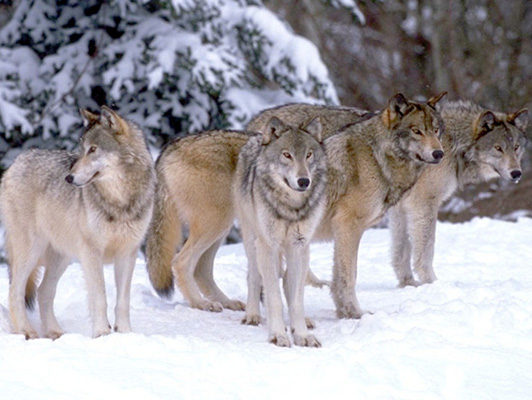
As Native Americans and later observers have learned, Wolves can teach us a great deal about cooperation, sharing, hunting and family.

CANUS LUPIS AKA THE GREY WOLF
Most often traveling in packs consisting of a pair and their offspring, the Gray Wolf is a mis-understood animal. They are persecuted because of their plundering of livestock and alleged attacks on humans, proven attacks on people in fact are extremely rare. They feed mostly on large mammals such as deer and elk. Once extensively trapped for furs the Gray Wolf's range is considerably depleted from their formerly widespread population across the Northern hemisphere.
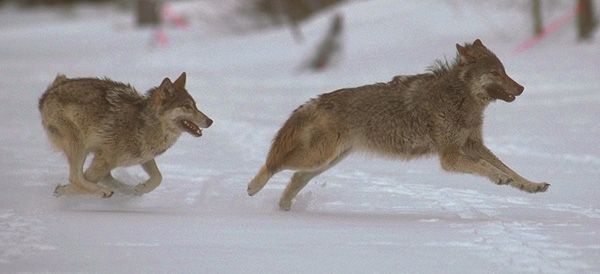
Wolves are very well adapted to extreme winter and snow conditions. Deep narrow chests act as keels through the snow while their large feet are built like snowshoes for travel on top of crusted snow or ice. Their thick coats keep them warm through nights that may be 60 or 70 degrees below zero.
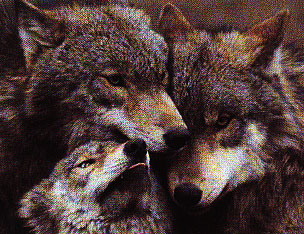
Chasing, sparring, wrestling, reassurance, dominance, submission and face-licking are all part of the daily dynamics of a wolf pack. Here 3 Wolves greet each other.
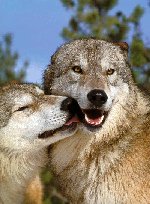
A Wolf Pack is a tightly knit family unit, and wolves are usually in contact with other members of the pack. Males and Females however do have distict and separate social hierarchies but are still relaxed and playful together no matter what their rank.
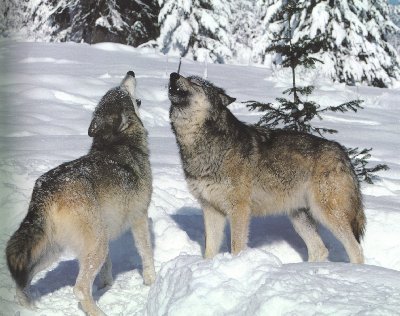
The howl of the wolf is legendary. For centuries it has stirred us passionately. Wolves howl for more reasons then we will ever know. Howling will bring the pack together, communicate to a distant pack member, defend a territory and rally the pack for a hunt. Beyond these reasons, wolves undoubtedly howl for the pure pleasure of it.
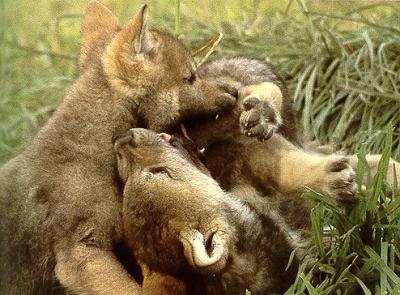
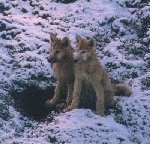
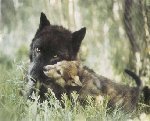
Wolf pups are usually born in the spring when the snow begins to melt and the ground begins to thaw. Once a litter is born, the entire pack helps bring food to the mother at the den. Later, when the pups are older and weaned, the pack will start leaving them at a rendezvous site to wait for the pack to return from the hunt. The puppies form and maintain their own hierarchy until they are mature. Their personalities, more than size, determine their status.
Historical disbelief! In 1972 the Department of Defense ordered 277,502 parka hoods trimmed with wolf fur. Conservationists and elected officials protested like crazy. The Department cancelled the order. The Department of the Interior pointed out the amount of fur involved would affect all the gray wolves of the continent!
