Menu
 For More Information
(Also check the Modern Biology Textbook for more, or study your notes from Mr. Greenberg)
Cell Web

|
Cell Membrane
Cell Membranes -- without them a cell could never function properly. They are truly one of the most important organelles in the cell... Read below to learn more!
Functions Of the Membrane
 |
Membranes function both in order to take materials in from their environment, and as a protective coating for their organelles. Like an igloo, they keep warmth and nutrients, such as water, inside both. Each of them contain a center for instruction and function in the cell (known in cells as a nucleus). They contain a source for energy, a transport system, and food storage in order to keep the cell running.
Another function of the cell membrane is to take in needed materials, and keep out harmful or unneeded materials. With the igloo, the "membrane" would allow air to enter, but keep out harmful animals such as polar bears. Cell membranes are specially designed to take in water, glucose, and other such materials, without letting "xeno-chemicals" into the cell.
|
The membranes of organelles may be points for Ribosomes to attach. They also seperate from other organelles, such as the Endoplasmic Reticulum, and most of the other organelles. The Golgi Complex is made completely of membrane material. They are also located inside the Cell Wall of a plant cell.
Back to Top
Sturcture
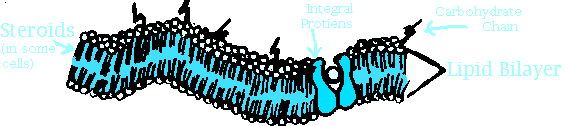
A cell membrane is construted in layers -- the innermost and outermost layers both being made from lipids, and the middle layer in some cells is made from steroids. Extensions grow from the membrane to help it communicate with other cells. In come cells, hair-like flagella also extend to help it move around in its environment.
|
Each phospholipid molicule has a polar "head", and two non-polar "tails". It is hydrolipic, so it will move toward water molecules, as well as attracting them. The tails; however, are hydrophobic, so they wil move away from water as well as repel it. Both sides of the membrane are surrounded my water molecules, forming the two layers of the membrane. These two layers are called a lipid bilayer. Eukaryotic membranes also contain steriods, which fit between the tails of phospholipids. | 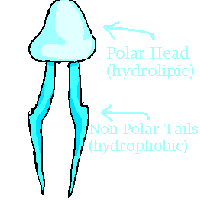
|
The membrane also contains some kinds of protiens. Peripheral protiens are in both the interior and exterior surfaces of the cell membrane, held by a weak bond to other protiens in the lipid bilayer. Integral protiens are embedded in the bilayer. Some integral protiens extend through the entire membrane and are exposed to substances on both the interior and exterior of the membrane.
Someimtes, hair like particles called Flagella or Cillia may extend from the membrane. These help the cell move around in its environment.
 | Integral protiens on the exterior of the cell often have chains of carbohydrates attached to them. These carbohydrates serve either to hold joining cells together, or may be sites for viruses or mesenger hormones to attach. |
Back to Top
Selective Permeability
The cell membrane is selectively permeable, so the membrane must have means for transporting larger materials through the lipid bilayer. Membrane protiens help with this process. Some integral protiens form channels or pores that allow certain substances to pass. Other protiens bind with the substance when they come in contact with it on one side of the membrane, so they can carry it to the other.
Another method for active transport is used my many one-celled organisms, such as amoebas. It is called pinocytosis, and happens when the membrane surrounds the particle to take in, and seals itself, forming a food Vacuole. This is also used to take in whole cells.
Receptor-mediated permeability happens when receptors are chemically targeted to a particular type of molecule. The receptor bonds to the molecule, and carries it to a specified receptor site. The receptors are then taken into the cell using a process that is similar to pinocytosis.
Back to Top
Fluid Mosaic Model
The membrane is often represented by a model called the Fluid Mosaic Model. For a long time, scientists believed that the attachments between the molecules were fairly static. With the develop ment of the electron microscope, they have discovered the dynamicness of cell membranes. Now scientists have adopted the Fluid Mosaic model to describe the cell membrane. In the model, the bilayer behaves much like a liquid, instead of like a solid. Because of this, the lipids and protiens move laterally within the lipid bilayer. Because of this, the "mosaic" of molecules is constantly changing. Below is a very crude animation of the membrane's liquid movement:

This movement is due to the constant switching of the Phospholipid molesules. Since they are always changing places, they can allow small molecules to pass through.
Back to Top
|