Leather Costrel
Lady Sveva Lucciola
Materials-
6 oz. Vegetable tanned leather (flexible and historically accurate)
Carpet knife (to cut the leather) and scissors
Waxed linen thread and harness needles
A metal awl
"V gouger, and basic tooling stamps
Brewer's Pitch and Beeswax
Leather Dye
Wooden dowel rod & nails
Why …
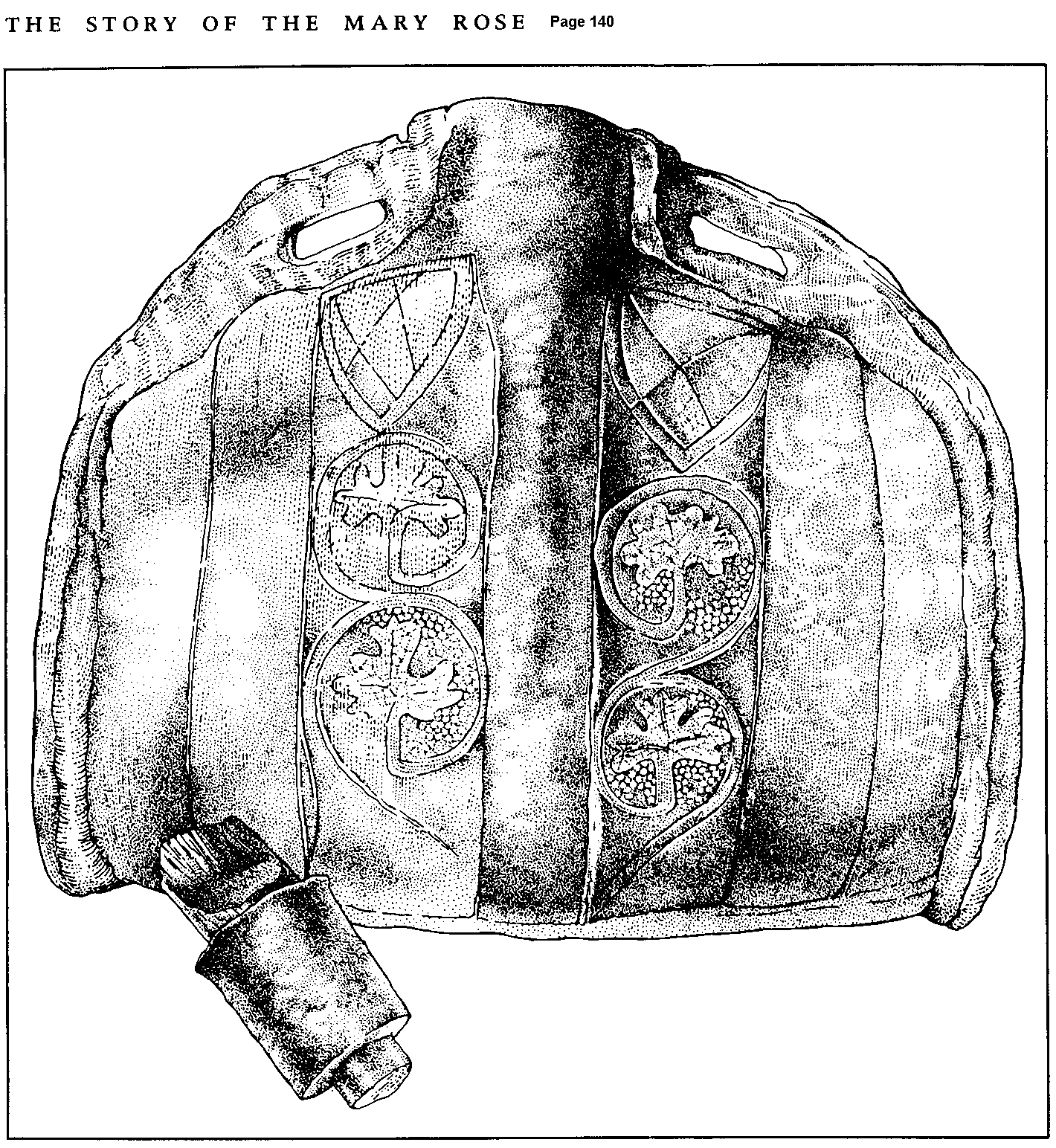
My goal was to have something for carrying water around at events. This costrel is based upon one found on the wreck of the Mary Rose, a warship of King Henry VIII of England, which sank suddenly in 1545. When I first set out on this project several years ago, I had not seen a leather bottle of this specific shape used in the SCA, most people sporting the 2 piece gourd shaped ones instead. I thought it would be a fun challenge and different to do. The first bottle I made was based upon a (front view only) sketch of the bottle recovered from the Mary Rose (Bradford, 1982) and the recommendations of Percy Aldridge, who had made leather bottles before. After completing this effort, I found a side view of the Mary Rose costrel and the Complete Anachronist article detailing how to make a similar style, both using the additional side pieces, which allows it to bloom outward, without the sharp indentations along the bottom side. As many people in my local area were interested in acquiring bottles of their own, I spent a summer teaching workshops at 2 local cantons. In teaching others how to make leather bottles I researched and learned more about them and found several images of this style of bottle. Two of my more advanced students wanted to attempt this more complicated style with the end pieces (the rest of the class was doing the gourd 2 piece style of bottle). We played around with the pattern from the Complete Anachronist #8, (which had some flaws in the pattern dimensions) and resulted in a huge bottle. It held 1½ gallons of liquid and was much too heavy to carry around at events. I decided to go back to my original source and try to take the measurements from the actual artifact, as I had copies of the archaeological drawings from the Merry Rose Trust (courtesy of Gawain of Kilgore). This was a much more reasonably sized bottle. (It holds just short of 3 cups)
Process
Draft Pattern- As mentioned I had the archaeological drawings of the bottle found on the wreck of the Mary Rose. I drafted a pattern based upon my measuring of the bottle in the drawings and converting to the scale printed on them (notes in pencil on drawing).
Cut- I then cut the long front to back piece from a piece of side leather and cut the end pieces from a piece of belly leather. This is because the long piece needs to keep a fairly consistent shape and the end pieces need to be able to stretch and compress as needed to fit in tightly on the ends. Next I gouged out a little where the seams would be on the flesh side. I had seem this in a modern leather working book and that it allows the needle to go through fewer layers and the stitching to compress down in these channels. I did this on the flesh side so that it would not weaken the structure of the leather as much as cutting through the face side would have. I also took an awl and poked holes where my stitches were going to be.
Tool- I dampened the leather with a wet rag and tooled some designs in the front face of the bottle. The original bottle had three columns with a circling flower vine/stem repeating on it. I choose instead to create my personal arms, a dragonfly volant in chief with a demi sun in base. I used a combination of the little stamping tools from the Leather Factory basic tooling kit, and the handle end of one of them to create the solid line at the top of the wings.
Stitch – Using waxed linen thread and 2 harness needles, I sewed a double line of stitching around the ends of the bottle. The double rows create a better seal, with the section of leather between the stitches pinched together, although they make for a lot more work. As this was such a small bottle, the corners were quite tight and difficult to maneuver. I dampened the leather while sewing so that it would be able to stretch or compress the way I needed it to. The interior row diverts in at the shoulder, creating the flaps to suspend the bottle by.
Stretch - Once sewn, the bottle was soaked for a few minutes to make it malleable. I did not need it to stretch very much, as dimension was added by the side pieces, but I did want it to round out some. I was also afraid that too much soaking and stretching would completely erase my earlier tooled design. Once wet I filled the bottle with clean sand to distribute the pressure evenly from the inside out, and pushed at it with the end of a wooden rod through the mouth. This had the desired effect of rounding it out, but unfortunately the leather did not stretch completely evenly. This is often caused by subtle changes in the thickness of the leather or it’s internal texture/stretchiness. Also, it is possible I did not press as hard in some areas as in others. When I had achieved the desired shape, I hung the bottle from its tabs and let it dry. (See notes at bottom on "Alternate Methods")
Dye- I dyed the leather with a modern commercial dye (. I don’t know if this color was used for bottles (most of the examples I have seen have been brown or black), but I have seen burgundy leather on boxes or books. When the dye had dried, I rubbed Mink Oil in all over the surface to help seal and condition the leather and the give it a nice sheen.
Pitch- To make it waterproof I coated the inside with a heated brewer’s pitch (pine resin) & beeswax mixture (ideally 3:1or 2). The pitch is softer at room temperature, but actually has a higher liquefying point than the beeswax. The beeswax gives it more rigidity at normal room temperatures, but too much can make it too brittle or too easy to melt in the sun. The pitch and wax was heated in a pan in boiling water until molten and then pouring in and swirling around and then out again, trying to coat all interior surfaces. As it was a cooler night, the coating set up very quickly and I have a very thick coating.
Stopper- At this point the bottle is done, but needed a stopper. I took a section of wooden dowel and drilled a hole in it so that I could attach a lanyard to it and attach it to the bottle. I then wrapped it in a piece of leather so that it would fit snugly. This is like the one found on the Mary Rose and other places.
Problems and Discoveries along the way-
I think a wider bottom on the end piece would make for a much more stable bottle that could be left sitting on the table on it’s own better. I know that a rounder end piece would be much easier to sew, as would a larger bottle.
Alternate methods I didn't use-
Other ways suggested to make one of these bottles, and very probable in the time period, would be to make a form the shaped of the interior that the leather is then stretched around, as some of the leather jacks and bombards were done. This could either be done by stitching it in place, or arranging the leather in a sort of double frame mold. These would be more consistent for multiple bottle making than the sand pounding method, however, it really was the stitching that was time consuming. The sand technique was mentioned by Cennini, not for bottles, but as a method for stretching out and rounding leather crests. As an additional note, on an individual bottle basis, this is the fastest method.
One source recommends boil curing the leather while it still is filled with sand. This would make for an even harder bottle, but I fear the layers of leather would pull away from each other more on the outside the seams as the leather shrinks.
Another method suggested of sealing the bottle was filling it with a beeswax/ paraffin mix. This is to permeate the leather with the wax. I would try just the beeswax (paraffin not being period!), but I fear the bottle would be too brittle and prone to cracking the seal. It would however produce less of the piney taste that is picked up from the pitch.
Resources Consulted:
Bradford, Enle, The Story of the Mary Rose, (Norton, 1982)
Canton, Mary Anne, Fooles and Fricassees: Food in Shakespeare’s England (Folger Library, 1999)
Cennino d'Andrea Cennini trans. Daniel V. Thompson Jr. The Craftman's Handbook "Il Libro dell' Arte" (Dover, 1960)
Dorne, David, Easy-to-do Leathercraft Projects (Dover, 1976)
Mize, Robert (Ld. Trobere Oakseed), Complete Anachronist: Leathercraft for Common Usage, Number 8, (Society for Creative Anachronishm, 1983)
Mize, Robert (Ld. Trobere Oakseed), Leatherworking II, Number 18, (Society for Creative Anachronishm, 1985)
Redknap, Mark, ed., Artifacts from Wrecks, (Oxbow, 1997)
Stapleton, Gregory (Lord Gawain Kilgore): On Making Medieval Bottles, (Handout- University Atlantia # 46, February 27, 1999)
Waterer, John W., A Catalogue of Leather in Life, Art and Industry, (The Museum Of Leathercraft, Northhampton)
Waterer, John W. Leather and The Warrior (extract) (The Museum Of Leathercraft, Northhampton, 1981)
Zignon, Frank, Making Medieval & Colonial American Leather Bottles, (Zignon Press)
Websites
The Mary Rose - (Built between 1509 and 1511, sunk in 1545) www.maryrose.org/lcity/cook/men3.htm
Stefan's Florilegium article on leather bottles www.florilegium.org/files/BEVERAGES/lea-bottles-msg.html
Lord Gawain Kilgore’s website www.medievallife.com/
A very nice IN PERSONA description on "The Making of a bottle of Leather, for thy Pilgrimage" www.florilegium.org/files/MEDIEVAL-LIFE/Gram-Letter3-art.html
David Kroup's email to the Merry Rose, May 19, 2000
Image from "The Story of the Mary Rose
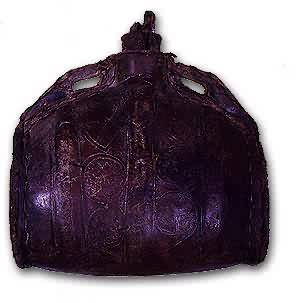
Photograph of the actual bottle found on the wreck. Coutesy of the Mary Rose Trust website.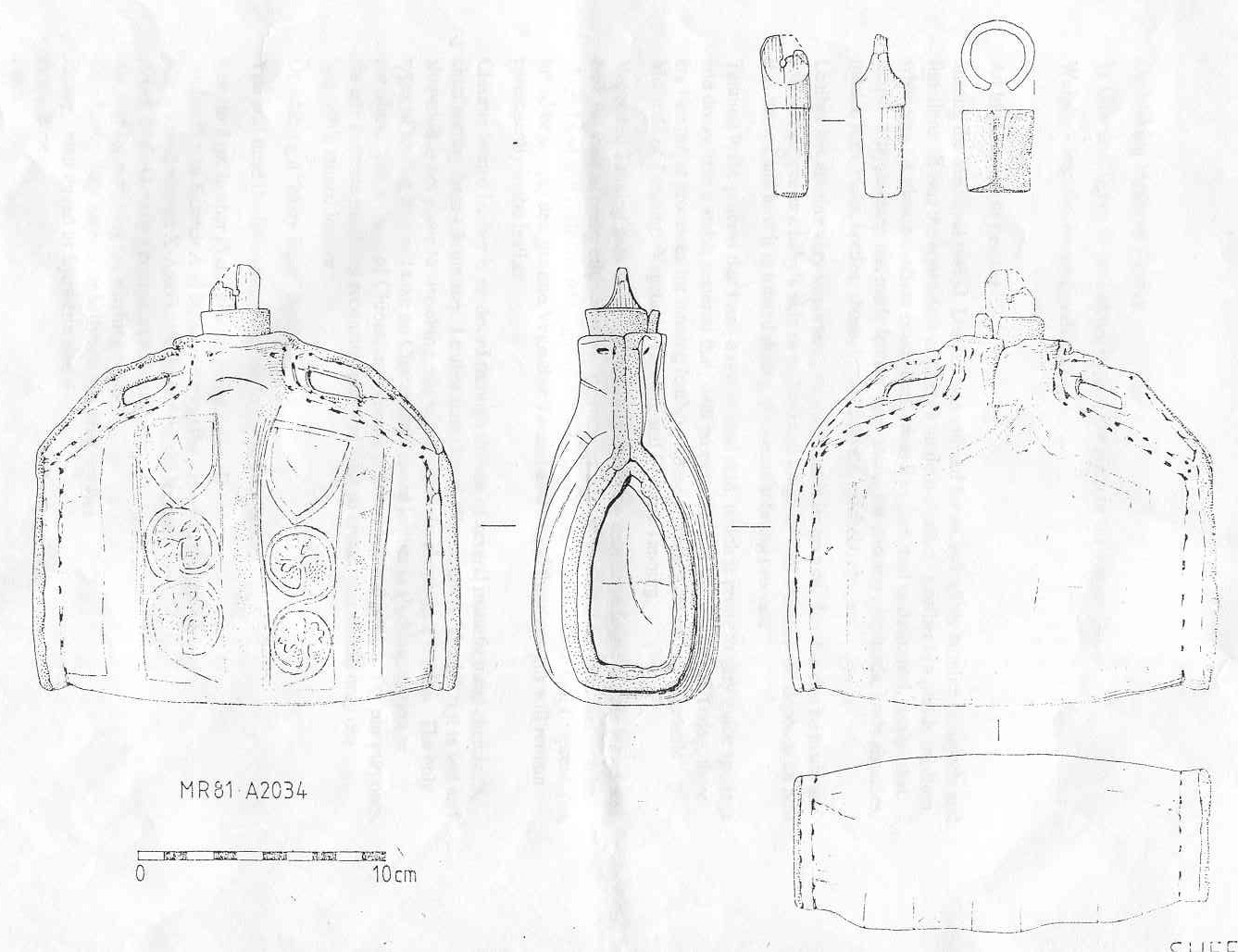
Archeological drawings of the artifact courtesy of the Mary Rose Trust (special thanks to Lord Gwain of Kilgore for getting them!)
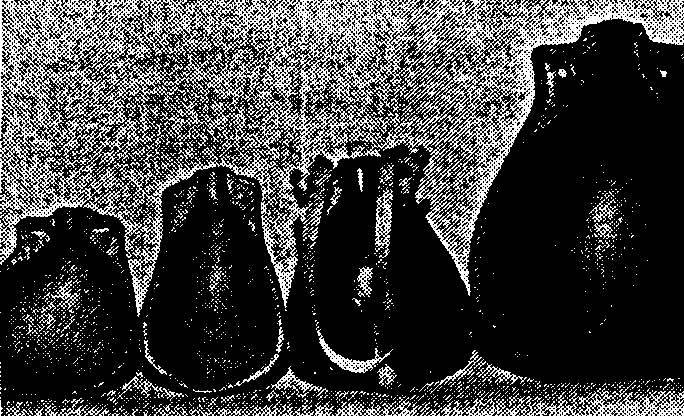
Images demonstrating the differences in stretch. The two bottles on the left were both cut from the same pattern and sewn exactly the same. However, due to the leather they stretched into different shapes. (Courtesy Frank Zignon)