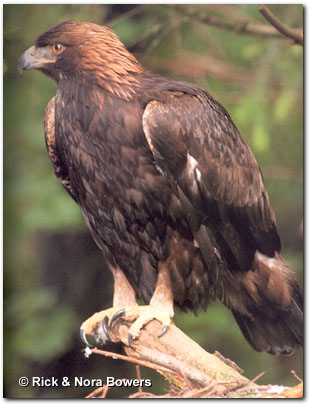
Throughout this paper we will focus on the Golden Eagle. This eagle
has been the symbol of divinity in the history of hundreds of different
cultures. The Golden eagle is one of the world’s largest and most splendid
birds of prey. And God said “.... let birds fly over the earth in the
open expanse of the heavens...and God saw that it was good" (Genesis 1:
20-21). For centuries many nations, kingdoms and empires have recognized
the eagle as the "King of Birds". The eagle has been, and is today, an
international sign of freedom, strength, immortality, and authority. Men
have reproduced the image of the eagle on coins, emblems, seals, and flags.
They have used such names as Eagle Corner, New Eagle, Bald Eagle, Black
Eagle, Red Eagle, White Eagle, Golden Eagle, War Eagle, Eagleville, Eagleton,
and Eaglette to identify villages, cites, bridges, mills, groves, stations,
and squares. There is Eagle lakes, Eagle Mountains, Eagle Rivers, Eagle
islands, and Eagle forks. Even in the Holy Bible there are scriptures concerning
the eagle. Something is special about this bird because the educated and
uneducated, the civilized and the uncivilized, honor the eagle as the king
of birds. Eagle is a common name for a number of diurnal birds of
prey, some of which are the largest members of their family. This also
includes kites, hawks, buzzards, and certain vultures. The name eagle is
loosely applied, with several of the groups but is not particularly closely
related to one another. Some hawks are larger than some eagles. Which are
the members of the Falconiforms family.1
Special Feature
Let me introduce you to the Golden Eagle. The golden eagle spends
much time soaring. Its wings are long and have well-spread primary feathers,
which allow it to adjust its movements while gliding in the air currents.
Its size is 30-35 inches in length, wingspan 6-7 feet, and weigh 6-13 lbs.2
Female golden eagles are far larger than the male eagle, as is true for
most of the birds of prey. A characteristic of this bird is its leg and
feet are large and thick with long, sharp talons that enable it to grasp
and crush its prey. They have feathering of the legs down to the toes;
in other eagles the lower part of the leg is bare and scaled, as in most
birds. The body plumage is dark brown, with a distinct golden wash over
the back of the head and neck, giving the species its name. The tail of
the adult is brown with several indistinct pale bands; that of an immature
bird is white with a dark brown terminal band. The golden eagle also has
a particularly large and powerful hooked beak. It is used to dismember
prey, which the eagle carries back to the nest in pieces.
Food & Hunting 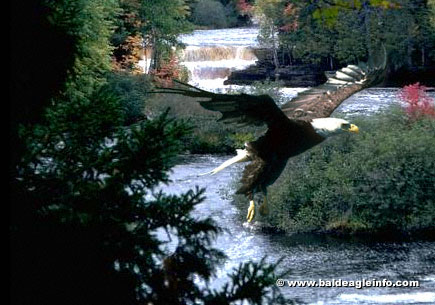
The golden eagle preys mainly on small animals also they are finicky.
While other birds are willing to eat worms, berries, insects and the carcasses
of highway tragedies, this is not true with eagles. The eagle picks his
diet: fish today, squirrel tomorrow, lamb the next day, and so on. Because
the eagle does not rely on what he finds, he finds what he wants. The eagle
actually chooses his diet for the day and then goes to find it. Once finding
his meal, he dives down and lays hold of it, crushing the life from it
with his strong claws.3. The hunting abilities of the eagles actually
start during the juvenile period of their lives. This is between one and
four years old. Golden eagles swoop down on their prey at speeds of up
to 95 miles per hour. He then ascends to his nest and pulls the prey apart
while it is still warm. These birds will have very little to do with decomposing
meat of any sort. The golden eagle catches most of its prey on the ground,
but it will catch some birds in midair. The eagle, in all of his strength,
could not attain this kind of speed without the use of gravity.
Habitat 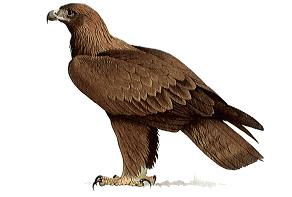
A large bird that hunts from the air, the golden eagle is most at home
in wide, open spaces. They live either solitary or paired. Today, a lot
eagles are found among forests and wetlands of eastern Asia, Europe, and
North America. It mostly inhabits mountains and moors where there is little
cover for its prey. In the winter, it is possible to spot the eagle in
the southwest United States and in Mexico, where some eagles migrate to
escape the harsh northern winters. In spring and summer, the golden eagle
can be seen soaring on the air currents emanating from the sun-warmed ground.4
The
eagle is not like other birds that fly from tree to tree or hop around
on the ground in search of worms. For the eagle has experienced what other
birds will never know-the power and swiftness of the jet airflows that
he alone likes. No other bird nests where the eagle nests and after the
first year (of fledgling) the eagle will not mate for at least three years
until he becomes a skilled hunter and is capable of reproduction. He will
live alone with no nest of his own.
Skills 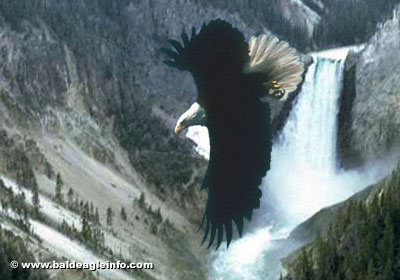
He will fly at altitudes where no other birds flies and observe the
earth from afar. The eagle is not a sociable (or group) bird and does not
attempt to be. However, this isolation does not seem to bother the eagle.
In fact, I think he enjoys it. His goal is to fly where the air is thin
and the sun is bright. While other birds sit and chatter among themselves,
the eagle flies alone. He must without exception, pursue what is instinctively
in his heart. It is during this time that the eagle becomes a master of
the wind, utilizing currents not available at lower altitudes. From a distance,
the golden eagle looks like a common buzzard. However, an adult eagle is
larger than a buzzard, and its wings are folded to its body in a more parallel
fashion. When it soars, the golden eagle holds its wings in the characteristic
“V” shape
Eagle and Man 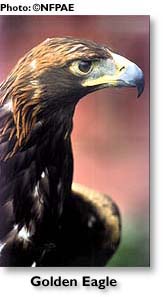
The golden eagle is one of the world’s largest and most majestic
birds of prey. But some farmers, who hold the mistaken belief that
the eagle kills farm animals and poultry, have long persecuted it. The
golden eagle was once widespread\read throughout the Great Plains .Its
numbers have declined due to harassment from hunters and farmers. The eagle’s
habitat is now threatened as well. Reforestation is reducing the open areas
in which it hunts. Insecticides, such as DDT and dieldrin, have adversely
affected the eagle’s breeding success. Despite bans on these chemicals,
poisoning remains the greatest threat to eagle today. Ban together with
me and other eagle lovers and help save the “King of Birds”.5

1 William Beebe, D. Sc., LL.D. Late Director of Tropical Research, New
York Zoological Society
2 Wildlife Fact Fileä International Masters Publishers AB.
3 Kenneth Price (Eagle Christian page 9).
4 William Beebe, D. Sc., LL.D. Late Director of Tropical Research,
New York Zoological Society
5 “ Eagle “ Microsoftâ Encarta Online Encyclopedia 2000
http://encarta.msn.com
http://baldeagleinfo.com
http://www.eagles.org/
http://www.mothersea.com/birds/goldeneagle.html
http://www.adventurevalley.com/wings/index.html
