Sailing Stories
and a Surprise!


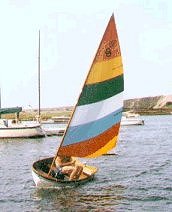
Dyer Dhow, 'Bugoff'

This colorful sail had a grand old time on "Bugoff" plying the waters of Long Island Sound. She sailed or was towed more miles than I can tell you. The investment in a nine-foot Dyer Dhow was a little dear at the time we bought her, but a great investment. Mike sailed with the local frostbiters all winter in Milford harbor in Connecticut for many years.

Photos by J. Clark
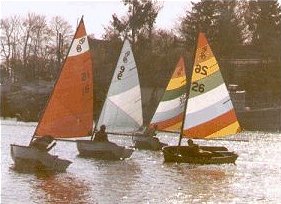


Frostbiting, Milford, CT

The men went out in work boats to break up any ice in the harbor so the races could be run. Can you picture these grown men, bundled up in heavy clothing, sailing in little nine foot dinghies?

Mike heads the pack,
      in the third boat from the left! =>

One eighty-year-old sailed in spite of having had a hip replaced. He would hobble down the dock. He never complained, even when a gust of wind knocked over the boat he was sailing. The rescue crew plucked him out of the water within the allotted three minutes before hypothermia could set in and Dave was fine!

Pete, a senior airline pilot, told how he bid his trips so that he would have Sundays free. He told us, "The other pilots think I'm a football freak. If I ever told them I was sailing around in a nine-foot boat in the middle of an icy harbor, they wouldn't let me fly. Let �em think it's football!"

If Bugoff could have talked, she would have told you she preferred sailing forward to sailing backward. Yes, on summer cruises, the fellows ran "backward races." They even ran races for the women sometimes. It's called, "How to survive a large hematoma on the forehead and live to tell about it." You had to hold the boom amidships to capture the wind and force the boat to go backward.
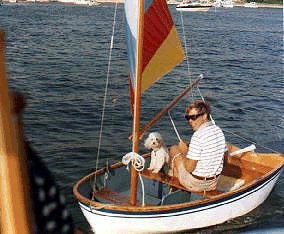
Marmalade in Bugoff

If a gust came along or your hand slipped and you couldn't duck quickly enough, the boom crashed into your head. Spoken from experience, can you tell? Bugoff would also tell you about being used as a launch to transport Marmalade back and forth to shore. That little poodle would hold it for eight hours. He wouldn't use a piece of turf brought on board for his use, but the minute he heard anchor chain going across the bow, he headed for the stern. He'd whine, asking to be put into the dinghy . . . NOW!

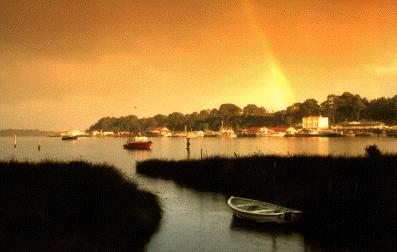
Harbor This picture to the right is so similar to Stonington Harbor, I had to use it. Sunsets are so beautiful there.
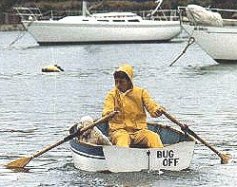
Once, in Stonington harbor, I was awakened by a sound I couldn't distinguish. It was a quiet cadence. Realize that your ear is at the water level when on your bunk, so sounds carry right through the hull. Finally, Marmalade and I got up to see what it was. A light misty rain was falling. In the fog was a dinghy, a man in his traditional yellow slicker and the tiniest of dogs on all fours in the bow. It stood rigid, as if a miniature pointer headed for the bird. He knew exactly where the shore was and didn't take his eyes off it even when Marmalade growled as they passed our stern. The cadence you ask?   Under his breath, the "captain" was muttering with each pull on his oars. " G - d   d - - n   dog!   G - d   d - - n   dog!   I muffled my chuckle!

Rowing Home Here is a picture of our youngest son, Curt, bringing Marmalade "home" from a similar trip.
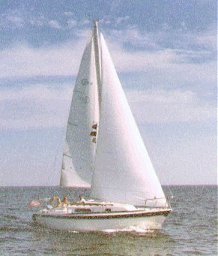
Ultimately we were bitten by the "bigger disease," so contagious in boating circles. We started with a nineteen-foot O'Day Mariner - a great boat for beginners. Mike named her, "Ladybug" (which was also his nickname for me). Mike learned to sail with cousins on Cape Cod in the 1940s - he remembers sailing in the Edgartown Regatta at age twelve. Now he had the opportunity to teach his family to sail. We all had delightful times on board. The kids could sail, swim or troll for fish off the stern. Anchored in quiet water behind Charles Island later in the day, we cooked the catch!

A twenty-three foot Ranger was next - another "Ladybug" - a beautifully balanced boat. She could handle eight to ten-foot waves and never lose her "cool." One time we sailed from Block Island to Newport in those heavy waters--never tacked once as the wind never changed direction. Newport harbor looked so inviting once we rounded Fort Adams. That was the year we saw Ted Turner come "steaming" up the ramp after his mast broke in an Americas Cup trials race.

Our last boat was a Cal 25 II, a super boat. Yes, she was "Ladybug" too, no three!   Once, leaving Shelter Island, Ladybug III heading north toward CT, we were a bit late on the tide change and hit rip tide water. The boat rose on the crest of a wave, spun 180 degrees and settled into the next trough headed in the opposite direction. Mike hollered to/at me, "What are you doing?" I was at the helm when this happened!   Yes, it was scary! I earned a sweatshirt with the words, "Don't Shout At Me" on the back after that trip! (grin)
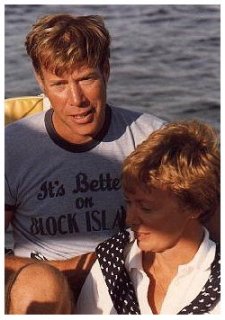
Photo by R. Lorimer

Block Island

We sailed from Milford west to Oyster Bay and east to Fisher's Island, Shelter Island, Newport and Block Island many times. It is possible to set sail from Fisher's Island on a course of 270 degrees and right into Milford harbor (approx. 50 miles) without ever changing your course -- if -- the wind is right! We have done it! It is also possible to sail from Port Jefferson, LI, to Milford, only 15 miles, and struggle to get there! When 50 knot winds are clocked and all you want is to get home, it's not fun. Marmalade was so good with his leash looped over the tiller. He simply waited. We could sail east, south or west but the wind came right out of the north. We tacked repeatedly and made little headway. When I suggested I might swim home, Mike feared I might be serious.

Sometimes our daughter and I took the boat out alone. Mike had taught us well. From the firehouse, he once spotted his boat leaving the harbor; ambivalent feelings for sure. When we returned, the wind direction was perfect to sail into the slip. Sailors know that takes some doing, but Mike and I had done it so many times, it was a sensory thing. I could feel the wind was right, the water traffic light, so we did it. It felt good.

Sunsets from the water can be magnificent. On Shelter Island we saw a most beautiful red, mackerel sky which has never been surpassed in our memories! The fellowship of sailing with a group of boats was marvelous, educational and a safety factor. We all helped when someone needed it. One time at Block Island, our hand-held compass was used in a dingy for clamming in the fog. The wives then pitched in putting together a clam chowder for thirty people with "stuff" we had on board. We walked to town for a Barbershop singing contest and did some "wood shedding" with the quartets -- what a time we had!

Sailing ~ Page Two

E-mail Bug   . . . Email

Visit some of my other pages.


(Click for Main Index Page)

The Nature Coast - West Central Florida

ALL RIGHTS RESERVED �
COPYRIGHT � 1997 - 2003
Page updated 012503

Hosted by www.Geocities.ws

1
