
select a cover to learn more:
select a cover to learn more:
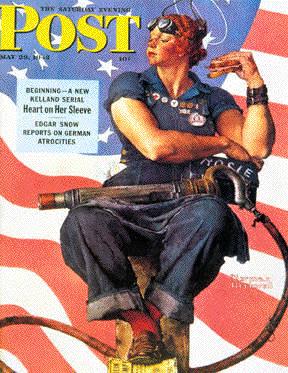 |
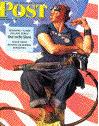
Rosie the Riveter May, 29, 1943 As some critics put it, Norman Rockwell painted World War took "as if he had discovered it". Rockwell saw soldiers as 'civilians in uniform', and throughout the war he tried to portray these soldiers as ordinary people, no different than you or me. The pictures set out to display what war really about. Here, Rockwell has created a strong looking women, sitting proudly against a patriotic background. Rockwell's intent was to once again enhance the idea of civilians being soldiers. Anyone could make a difference and help out in the war. This new mind set is quite clear in Rockwell's picture, in which he portrays the active role of women during the war.top |
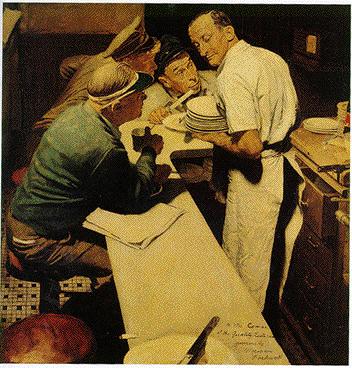 |
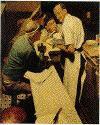
War News (unpublished) 1945 This picture was never published, yet Rockwell still addresses the effects of the war and the reactions of everyday people.�The painting brings light to the importance of the radio, each ear keenly tilted towards the speakers producing the news. Each man is focused on the news, and this aspect relays the importance of such communication to the viewer. Listening to FDR was a soothing and comforting thing for most Americans, and had the voice on the radio been Roosevelt's, the silence of the four men would be clearly explained. Regardless, the image serves as a prime example of the importance of the radio, as well as the high regards and concerns Americans possessed regarding the war.top |
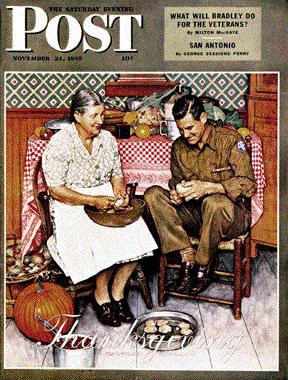 |
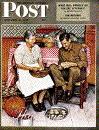
Home for Thanksgiving November 24, 1945 This simple Post cover was painted for the first Thanksgiving following the war. Again, Rockwell has painted life in America. Although words are not spoken between the mother and recently returned veteran son, the picture speaks for itself. Both characters are slightly smiling as they prepare for the family meal, and the viewer can tell that both mother and son are happy enough to simply be in each others presence. With just one cover, Rockwell painted the holiday prayer of many Americans that year: thanks that their boys had returned home safely.top |
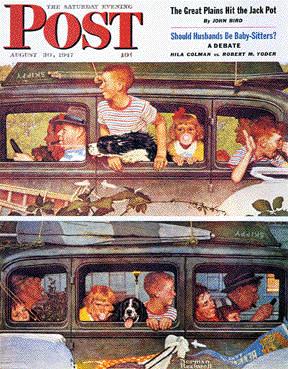 |
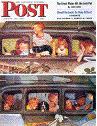
The Outing August 30, 1947 This Post cover presents a simple before and after situation. The image itself tells a distinct story. The family is packed tightly into their car, ready for a day trip to Bennington Lake. To the average family, such a trip was an exciting, and rare occasion. The anticipation is quite obvious: The children are rowdy, the driver is alert and the carload is enthusiastic. By the time the car makes is return trip home, the children are exhausted, the driver is slumped over the steering wheel, and even the dog seems to have lost energy. The image presents an important concept that is no longer present today. A day trip such as the one taken by this family was a special event, and was never taken for granted. As we look back on this painting today, we can note how our society has changed and how such trips are nearly routine.top |
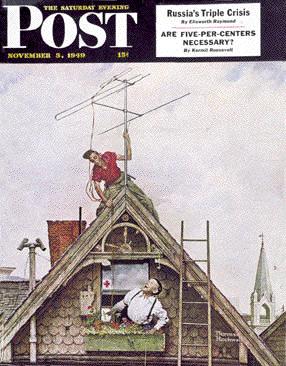 |
New TV Set November 5, 1949 By the end of the 40's, the TV had become a new craze in the US. America's introduction to television changed ways of life and the field of entertainment forever. Here, Rockwell depicts a simple installation of a new TV set in order to relate the changes in society to the viewer. It is images such as this that serve as historical references to us today. When Rockwell paint- ed the picture, he was simply portraying society as it was during the present time. Now, we can look back on such a picture and recall how society changed and how certain instances, such as the TV in this picture, influenced those changes.top |
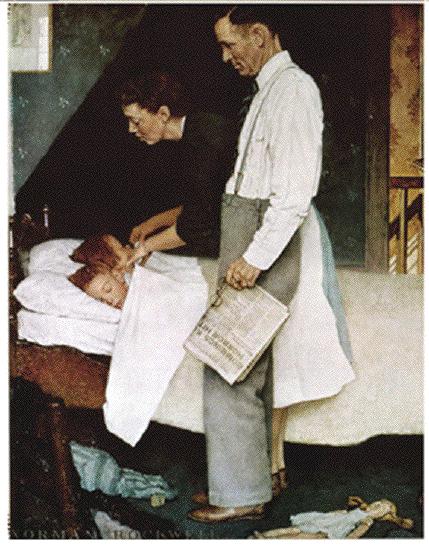 |
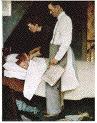
Freedom From Fear 1943 Rockwell's Four Freedoms truly depicted what the war was about. After Roosevelt gave his Four Freedoms speech in 1941, Rockwell painted this four part series clearly outlining the reasons for the war. (view speech here) In this painting, Rockwell has created a husband and wife who carefully tuck their children into bed. The newspaper in the father's hands holds headlines reading 'Bombings' and 'Horror'. We often take our own safety for granted, and Rockwell has set out to portray a feeling of security. Is this family truely safe within their own home? FDR hoped so. One of his reasons for fighting the war was based around the principle that all people, everywhere in the world, should be free from fear.top |
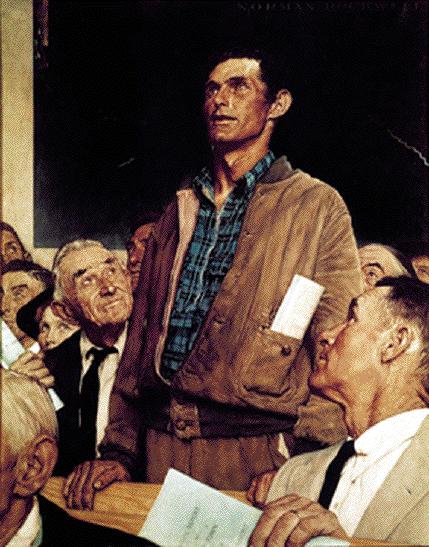 |
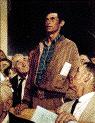
Freedom Of Speech 1943 FDR also talked about the freedom of speech. It is already in our constitution, but Roosevelt saw it as a freedom to be won for all people. When Rockwell painted this freedom, the expression on the standing man's face speaks for itself. The man stands proud, confident and unafraid. As the man speaks, the people around him respectfully listen to his view. The man is not afraid to speak his mind and opinion. Such a freedom is one which Roosevelt wanted to bring to all people. Rockwell has, without a doubt, portrayed such an instance.top |
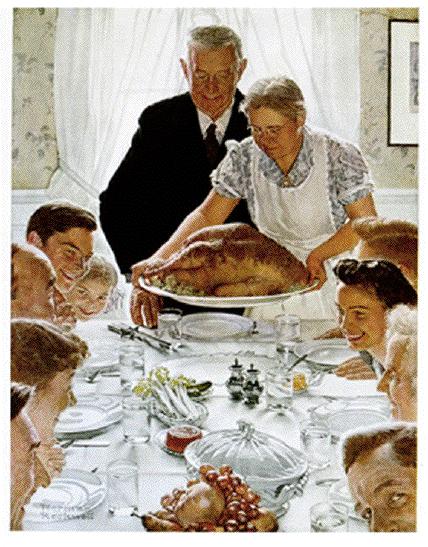 |
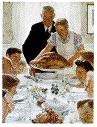
Freedom From Want 1943 Americans should not suffer from want, nor should any person. This was another aspect of Roosevelt's speech. In this painting, Rockwell clearly portrays a family that is free from want. All the faces are smiling, a meal is placed on the table, and the family is content. The Thanksgiving scene is most efficient in portraying this free- dom due to the long row of family members that line either side of the table.top |
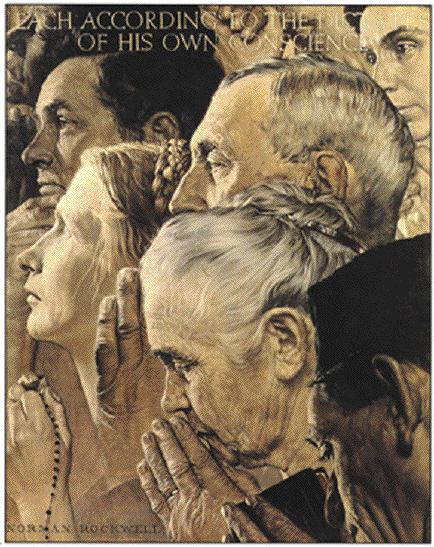 |
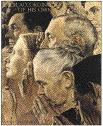
Freedom Of Worship 1943 "Each according to the dictates of his own conscience". This message, written across the top of Rockwell's painting is almost unnecessary, for the image speak for itself. Rockwell yet again addresses a freedom of Roosevelt's speech, presenting the view with a group of people all pray- ing. The group is calm and peaceful, showing that nothing dictates the religion they choose to practice or the faith they worship.top |