
select a cover to learn more:
select a cover to learn more:
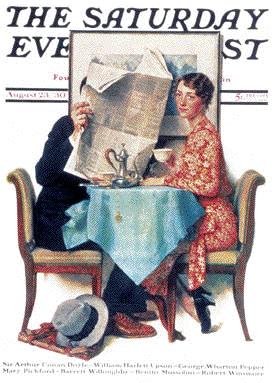 |
At The Breakfast Table August 23, 1930 The image that Rockwell creates with this Post cover is quite clear. The wife finds herself cut-off and isolated from her husband, as well as unhappy with her life. The gaze in her eyes suggests that she is hoping or wishing for something more. Such desires are similar to those expressed during the women's movement of the 60's. When Rockwell created the longing in the wife's face, he struck the same ideas that women such as Betty Friedan (author of The Feminine Mystique) would later express in novels or through demonstrations.top |
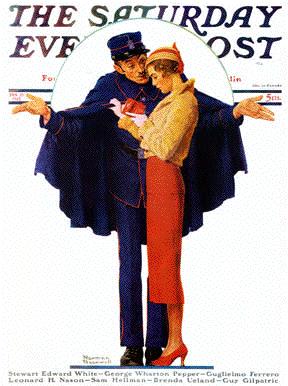 |
Boulevard Haussman January 1, 1932 Even with the Great Depression, the flapper image had survived. As Rockwell has shown in this cover, the dramatic changes in women's style were too strong to die out with the depression. Those who could afford to do so maintained the short hair and altered clothing. The woman Rockwell has painted fits the flapper image completely. Her hair is bobbed, her skirt falls slightly below the knee. Flappers were known to smoke, drink, and be outwardly flirtatious. They wanted to be different. Even in this image we can see the closeness between the two characters and the women's possibly flirtatious grasp on the mans uniform. Rockwell saw these changes of moral too drastic to leave out of his work.top |
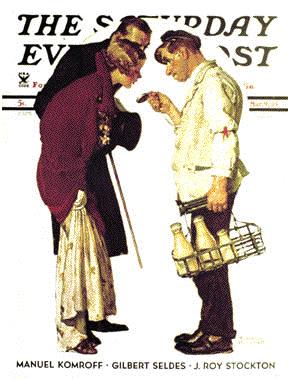 |
The Milkman and the Young Couple March 9, 1935 In this Post cover, Rockwell set out simply to portray normal life. It may be assumed that Rockwell knew a day would come when a milkman would not be needed. Today, we find our milk sitting comfortably in refrigerators at the grocery store. Yet when Rockwell painted this cover, he depicts a time in which people, such as the couple, had to stop the milkman for their milk. The image also depicts a distinction between classes. The milkman is forced to carry a flashlight, working odd hours to receive the busi- ness of those such as the couple, who are lucky enough to be able to spend entire nights out without worry.top |
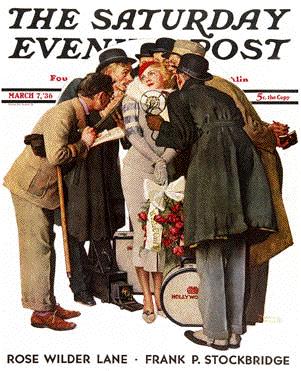 |
The Interview March 7, 1936 In the mid-thirties, America was captivated by Hollywood; everyone was interested in the people it was producing, and everyone was talking about its success. Hollywood stars were expected to be full of words of wisdom and thought provoking viewpoints. The stars were portrayed in such a wonderful light that Hollywood became the dream of many aspiring actors and actresses. The United States would fall in love with the stars of the big screen in the years to come, and Rockwell painted this simple cover portraying America's romance with Hollywood. Hollywood changed the way of life for many American's for it greatly impacted the American Dream. This new dream of 'success' often included fame and fortune through methods such as Hollywood.top |