

select a cover to learn more:
select a cover to learn more:
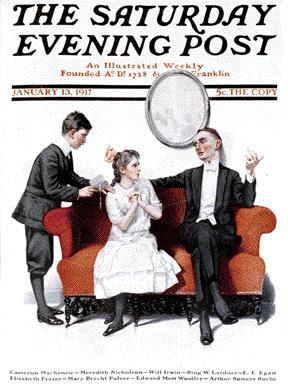 |
Shall We Dance January 13, 1917 Although not quite in the 20's, this Post cover clearly displays a changing norm in society. The young girl's attention is focused solely on the older man. Her gaze seems almost obsessive, and she refuses to acknowledge the presence of the younger boy who is asking her to dance. As the decade continues, Rockwell's development of this changing time period is evident.top |
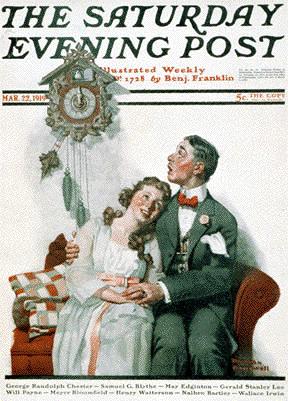 |
Courting Couple at Midnight March 22, 1919 Rockwell's development of a changing youth continues here. The boy's expressions clearly show shock due to the late midnight hour which seemingly came too fast. The girl's expression, however, shows her lack of care regarding time. She is living for the moment. These changing patterns in dating as well as personality within the female youth was effected greatly by the flapper movement, which struck the United States in the 20's.top |
 |
Fortune Teller March 12, 1921 The movement of the flapper throughout the United States created a new style among women. It is present here in Rockwell's Post cover. Note the women's short, bobbed hair- cut. The evolution of the flapper was at its peak in then 20's. The media, including advertisements and newly fashioned models, greatly impacted the female population, and changes became evident. The gestures of the woman alone, in this painting, portray this change Rockwell had seen in society. She sits delicately, leaning into the man while tracing his palm lines with her finger. She appears playful and lively, just as the flappers were portrayed through the media.top |
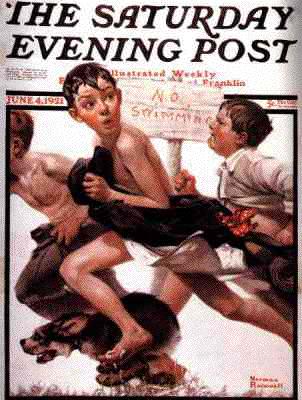 |
No Swimming May 4, 1921 Even in his earlier years, Rockwell painted boy characters like that of Tom Sawyer and/or Huck Finn. Rockwell was well aware that boys would get into any mischief possible, and this picture relays that belief to the viewer. Rockwell continued to paint children throughout his career, attempting to create pictures reflecting everyday life in America as well as the growing youth of the nation.top |
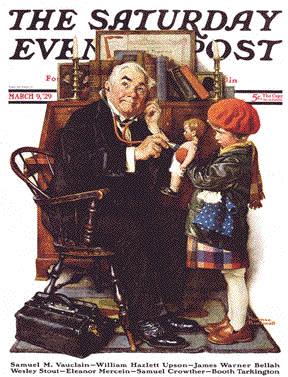 |
Doctor and Doll March 9, 1929 Rockwell's most notable talent was his ability to reach all audiences through a single picture. This Post cover serves as a prime example. The medical field was always pleased with Rockwell's work, for he always treated them sympathetically. Here, the doctor is portrayed 'breaking the ice' with a young patient. The girl represents a child-like fear or uncertainty, one to which the rest of the population could relate. The cover became a well known work, reaching people all over the nation.top |