Labor Migration


The website aims to inform primarily pre-med majors of the Loyola Schools because they are the ones who are most likely to join the health care sector in the future. Information on labor migration may influence any decisions they have about working abroad. The website also aims to give the rest of the Ateneo community general information on labor migration, in hopes that such information will be passed on to concerned parties.


Statistics

  • One nurse caters to 30 � 50 patients.
  • There is one nurse for every 16,273 Filipinos.
  • There is approximately one nurse for every nine barangays in the Philippines.
  • Average salary of nurses in 2003 9,000 pesos monthly
  • Average salary of nurses working in the province 4,000-5,000 pesos monthly
  • Salary abroad: 3,000 � 4,000 DOLLARS monthly (That�s 165,000 � 220,000 PESOS monthly!)
  • In the UK and Northern Ireland: 10,000 doctors and 20,000 nurses
  • In the United States: 1 million nurses in the next 10 years
  • In Australia: Dependency on overseas doctors
  • Every year, an average of 5,000 out of 8,000 nurses leave the country.
    2,000 of these were former doctors.
  • Out of the 178,045 nurses that are in demand:
    150,865 (84.75%) go abroad
    27,160 (15.25%) stay in the country
  • From 1995 to 2000, the POEA deployed 33,964 nurses. (In a span of 5 years)
    From January to August 2002, 7,855 nurses were deployed. (In a span of 8 years)


Nurse Sector


Reasons for taking up Nursing

  1. Nursing is in demand.
  2. It�s practical.
  3. Many opportunities.
  4. Great financial rewards and benefits.
  5. Not time-consuming.

Reasons for practicing Nursing abroad

  1. More benefits there.
  2. Higher salaries.
  3. Nurses are looked down upon here.

Advantages of Medical Profession Abroad

  1. High-tech facilities.
  2. Methods of treatment are more advanced.
  3. Benefits in government hospitals: hygiene, no hazards, client-centered.

Reasons for making them stay in the Philippines

  1. Improve the medical services.
  2. Increase the salaries.
  3. Update the facilities and procedures.


Public Sector


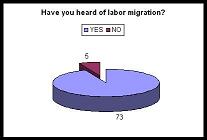
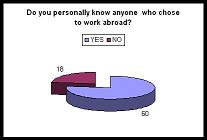
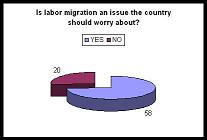
Survey Results (of 78 correspondents)


Have you heard of Labor Migration?


Through
  1. News
  2. Mass Media
  3. Friends
  4. Relatives
  5. Internet

Do you personally know anyone who chose to work abroad?

Why?
  1. Higher salaries.
  2. Better living conditions.
  3. Better compensation.
  4. Greener pastures.
  5. A better future.

Would you consider working abroad, given the chance?


Why?
  1. Higher salaries & better compensation.
  2. Higher standards of living.
  3. Chance to work in a different environment.
  4. Enough experience to acquire new knowledge.

Why would you stay in the Philippines?

  1. Still some good options here.
  2. Patriotism: be of service to ownr country and not to a foreign land.
  3. Family ties: hard to be separated from loved ones.
  4. It�s lonely abroad.

Advantages of Labor Migration

  1. Allows the individual to earn a living and support his/her family.
  2. Able to remit dollars into the country.

Disadvantages of Labor Migration

  1. Country loses efficient workers.
  2. Working abroad breaks up families.
  3. Children grow up without the love and values parents should give.
  4. Workers are not totally secure because of differences in culture and working conditions.

Is Labor Migration an issue to worry about?
  1. Lack of skilled doctors and nurses have downgraded the services of hospitals.
  2. Reflects a loss of confidence in the country, and the government�s shortcomings.
  3. Reflects a poor economy.
  4. Foreign countries benefit.

Why shouldn't the country worry about Labor Migration?

  1. Government should address graft and corruption instead.
  2. Many graduates every year that can replace those who go abroad.


Government Sector

PAST and PRESENT EFFORTS of the GOVERNMENT


Government Agencies

  1. Philippine Overseas Employment Association (POEA)
    - This agency was created in 1982 through Executive Order 797 to promote and monitor the overseas employment of Filipino workers. As the government agency responsible for optimizing the benefits of the country�s overseas employment program, the POEA�s mission is �to ensure decent and productive employment for Overseas Filipino Workers.� The agency envisions itself to be a culturally sensitive, customer-driven and business-oriented advocate of the overseas Filipino workers� well-being.
    - In 1995, Republic Act 8042 defined specific policy thrusts for POEA in the light of emerging issues. These include the guarantee of migrant workers� rights, rules on illegal recruitment, repatriation of workers and various other ways of aiding OFWs and their families.
    - The POEA also has Regional Centers and Extension Units. The Regional Centers conduct pre-departure orientation seminars and pre-employment orientation seminars, process travel documents, organize anti-illegal recruitment campaigns and assist in the conduct of jobs fairs. The Regional Extension Units are tasked to assist in provincial recruitment, provide welfare and legal assistance.

  2. Overseas Workers Welfare Association (OWWA)
    - An attached agency of the Department of Labor and Employment, the OWWA is the lead membership welfare institution that serves the interest and welfare of member-overseas Filipino workers. is the lead membership welfare institution that serves the interest and welfare of member-overseas Filipino workers. Its task is to develop and implement responsive programs and services, while ensuring fund viability, towards the protection of the interest and promotion of the welfare of its member- OFWs.
    - Membership in OWWA may be obtained in two ways. One is registration via contractor or employer, the second is by voluntary enrollment at job sites. For a US$25.00 membership contribution, an OWWA member is entitled to benefits such as health care insurance, loan guarantee funds which financially aid the OFW and their families, training programs and social welfare for the OFW and their families.


The 1987 Constitution and other laws

  1. Article XIII, Section 3
    The State shall afford full protection to labor, local and overseas, organized and unorganized, and promote full employment and equality of employment opportunities for all.

  2. Migrant Workers Act of 1995, Section 2c
    While recognizing the significant contribution of Filipino migrant workers to the national economy through their foreign exchange remittances, the State does not promote overseas employment as a means to sustain economic growth and achieve national development. The existence of the overseas employment program rests solely on the assurance that the dignity and fundamental human rights and freedoms of the Filipino citizens shall not, at any time, be compromised or violated. The State, therefore, shall continuously create local employment opportunities and promote the equitable distribution of wealth and the benefits of development.

  3. Article XIII, Section 11
    The State shall adopt an integrated and comprehensive approach to health development which shall endeavor to make essential goods, health and other social services available to all the people at affordable cost. �The State shall endeavor to provide free medical care to paupers.


      Recommendations of the Sector

      Nurses� Mobility: A Global Congress
      - An international congress
      - Participants suggested that two kinds of bodies be created to address the issues of the health care sector. The two bodies created together and implemented together would allow the government to not only address their needs and concerns through the laws and policies implemented, but they can also take care of the nurses and doctors as human resources.

      1. National Commission on Health Human Resource Development
        - A multi-sectoral body involved in nursing and medical human resources development through policy review and development.
        - Focused on developing nurses and doctors on a human resources level.

      2. Philippine National Council for Nursing Concerns
        - An oversight body for the implementation of all nursing policies, legislation, and regulations.
        - Concerned with more administrative matters.

      The congress recommended other stuff such as
      • Government should have �bilateral negotiations with Northern countries importing Filipino nurses, such as the United States, United Kingdom, Saudi Arabia, the Republic of Ireland and the Netherlands to give the Philippines the opportunity to lobby for standards that will benefit both sending and receiving countries.

      • Encouraged North-South hospital-to-hospital partnerships.


      Laws and Policies
      The implementation of a National Health Service Act was also suggested, which calls on graduates from public-run nursing schools to serve locally for a number of years equivalent to their years of study.


      Philippine Nursing Association
      - Agreed to establish nursing registries that would serve as a feedback mechanism that would help identify the specific needs and concerns of the health care sector, particularly the nurses.
      - These registries will �negotiate for better remuneration, benefits, and working conditions so that nursing welfare is high on its agenda.


      For President Arroyo
      - That she appoint an undersecretary in the Department of Labor and Employment that will specifically focus and address nursing concerns, as well as become the chairperson of the proposed Philippine National Council for Nursing Concerns.


      Recommendations of the Group

      1. The Philippines must update and standardize the medical procedures of all hospitals.
        - Standardization of procedures may remove ambiguities in the practice of medicine, which may in turn allow doctors and nurses to feel the professionalism of their practice. Such professionalism may allow them to feel at par with the professionalism of other, more developed countries.

      2. The government must also improve the medical equipment so that doctors and nurses can maximize their skills.
        - Most doctors and nurses go abroad because the Philippines does not have the equipment upon which they can actually apply the skills that they have acquired.

      3. Increase the benefits of not just the doctors and nurses, but also of the patients themselves.
        - Nurses and doctors are usually demoralized when they see the pitiful condition of their patients.

      4. The public can help by giving doctors and nurses due respect.
        - It is up to us to show the doctors and nurses that we Filipinos need their services because somebody has to take care of the Filipino.


      LINKS

home   |   statistics  |  nurse sector  |  public sector  |  government sector  |  sector recommendation  |  group recommendation  |  links
Counter
Hosted by www.Geocities.ws

1