|
Home
| Resources | Info
Archive | The End of the Barcode? 
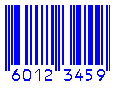 A
conventional bar code is a machine readable symbol consisting of a series
bars and spaces, with predetermined patterns used to represent actual
data in the symbol. Widely implemented in the retail marketplace since
the 1970s, bar code technology has continued to demonstrate its flexibility
in a broad range of diverse applications. A
conventional bar code is a machine readable symbol consisting of a series
bars and spaces, with predetermined patterns used to represent actual
data in the symbol. Widely implemented in the retail marketplace since
the 1970s, bar code technology has continued to demonstrate its flexibility
in a broad range of diverse applications.
But what if there was a
data capture method that offered many of the advantages of bar code technology,
but with even more benefits?
Introducing RFID
Radio Frequency Identification
(RFID) works by using tags which can be embedded into labels or other
media. A radio signal is transmitted towards the tag, and it responds
with a radio signal that contains the information stored in the tag. Because
of this, several advantages over bar codes become apparent:
Because the technology
uses radio waves, data can be read from tags that are not even optically
visible, and physical contact with the tag is not necessary. This is an
advantage over traditional bar codes where line of sight and easy access
is required for successful capture of the code.
Tags can be preprogrammed
with data, or they can allow the data to be "written" in
response to commands transmitted to them. This means that tags can be
re-used, or the data contained in them can be altered at different stages.
Because bar codes are printed onto the media, they are incapable of this
kind of re-writing.
RFID tags allow bulk
capture. This means that large quantities of tags can be read almost
simultaneously, greatly speeding auto-id applications. In contrast, try
scanning several bar codes at once!
|
Why Now?
Over the last ten
years, Radio Frequency Identification has undergone substantial
development. It has always been recognised that RFID offers many
advantages over other forms of automatic data capture, but in the
past the cost and bulky size of RF tags and readers was prohibitive.
Reductions in size and costs have now made RFID more acceptable,
and regulators such as EAN, AIM, CEN and ISO have introduced universal
standards for the use of this technology. Increasing end-user marketing
influence from blue-chip companies is creating awareness and acceptance
of RFID. Those using or planning to use RFID include Boots, BBC,
Daimler-Chrysler, Warner Brothers, Marks & Spencer, GKN Aerospace
and NATO.
|
|
How Does It Operate?
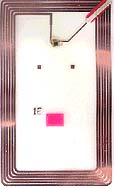
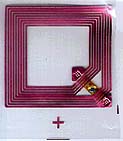
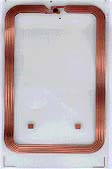
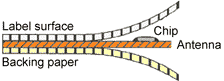 A
basic RFID tag consists of a small chip and an antenna. These components
are flat enough to be embedded in a label inconspicuously. There
are three key variables which determine how the tag functions; the
read/write capabilities, how it is powered, and the operating frequency. A
basic RFID tag consists of a small chip and an antenna. These components
are flat enough to be embedded in a label inconspicuously. There
are three key variables which determine how the tag functions; the
read/write capabilities, how it is powered, and the operating frequency.
Read/Write Capabilities - The tags can be manufactured
to be read only (data is set at manufacture, and cannot be changed
- inexpensive), WORM (data can only be written once, read many times),
or read/write (data can be changed and written repeatedly - most
expensive).
How it is Powered - Tags can be active or passive.
Active tags carry an on-board battery, and are therefore more bulky
and expensive. Passive tags have power transmitted to them via inductance
coupling, discharged by the reading device, and are less expensive
because of this.
Operating Frequency - RFID tags can operate at
different frequencies for different effects, but a common frequency
for these tags is 13.56Mhz. High-frequency systems allow longer
ranges and higher data rates, but the costs are also higher.
The tags are most
commonly embedded into labels, with the information encoded during
the print process. Thermal transfer printers are becoming available
which will allow printing and encoding in one pass.
Current tag manufacturers
include Philips and Texas Instruments. Philips market their tags
as "I-Code" tags and have a capacity of 44 full ASCII
characters. Texas Instruments market them as "Tag-It"
and have a capacity of 32 full ASCII characters.
|
|
The End of the Barcode?
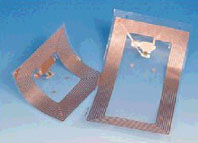 Tags
are already being successfully used in many different applications
including animal and vehicle ID, car immobilisation, automated payment,
security and access control, luggage, parcel and document tracking
in many areas such as archives, libraries, and video rental. Tags
are particularly suited to warehousing applications where the ability
to collect information in bulk is essential. It is expected that
more applications will develop as the technology becomes standardised. Tags
are already being successfully used in many different applications
including animal and vehicle ID, car immobilisation, automated payment,
security and access control, luggage, parcel and document tracking
in many areas such as archives, libraries, and video rental. Tags
are particularly suited to warehousing applications where the ability
to collect information in bulk is essential. It is expected that
more applications will develop as the technology becomes standardised.
RFID supports a higher
level of automation than most other automatic identification technologies,
reducing dependency on people to perform the task of identifying
individual items, as with traditional scanning of bar codes. The
simple structure of the tags means that it has the robustness to
withstand extremely harsh environments, and the concealed nature
of the device means more space for packaging design traditionally
taken up by bar codes.
Does this mean the
end of the barcode? Probably not. Bar codes have been in commercial
use for almost thirty years and have tremendous support in retail
and other industries. The simplicity of bar codes must not be ignored.
When a bar code fails to read, the information can be keyed manually
by referring to the human readables. Where will the fails-safe be
with RFID? The cost of RF tags, although decreasing, will remain
prohibitive unless the cost of the tags and reading systems can
be justified.
It is expected that
traditional bar codes will remain dominant until the near future,
with 2D bar codes increasing in use as more information is required
during transactions. RFID will be adopted where bar codes would
not be suitable, such as for bulk capture applications or where
there is no line of sight to the product or item.
Until RFID has proven
itself, to many users bar codes will remain top of the auto-id ladder.
Share
your opinions on the Labelgraphics Discussion Board!
|
|