Downtown L.A. (USC) High Temperatures
APRIL
4/12 94
4/13 97
4/26 94
4/27 95
4/28 96 (Record)
MAY
5/16 96
5/17 96 (Tied Record)
5/18 96 (Tied Record)
During the most recent heat wave, Death Valley reached 120 degrees on May 19th. This was a new a record for the date and the warmest temperature in the nation for the 19th. More impressive was that it was the earliest in the season that it has ever reached 120 degrees. The previous earliest 120 degree reading was May 25th, 1913.
I
had better write this up before any big February rains commence�.
The data below are concerned with the drought
conditions this season at Los Angeles and in Southern California. The first part compares our present
seasonal total of 1.50� at Los Angeles to previous seasons.
The (2006-2007) seasonal rainfall total for Los
Angeles stands at 1.50� (July 1 to Feb 6). The following is a list of seasons in which three inches or
less fell at L.A. from July to January, with the amount for the following
February given, and the ending seasonal amount.
Rain season Jul-Jan Feb Season Total
1881-82 2.62� 2.66� 10.40�
1886-87 2.02 9.25 14.05
1890-91 2.82 8.56 13.36
1891-92 2.93 3.19 11.85
1898-99 2.94 0.04 5.59
1903-04 0.57 2.68 8.72
1911-12 2.83 0.00 11.60 (6.99�
in March)
1912-13 2.95 9.16 13.42
1917-18 0.93 6.14 13.86
1923-24 1.79 0.03 6.67
1935-36 2.33 7.25 12.07
1943-44 1.43 8.65 19.22
1947-48 1.92 1.29 7.22
1958-59 1.76 3.32 5.58
1962-63 0.64 2.88 8.38
1969-70 2.79 2.58 7.74
1975-76 0.59 3.71 7.21
1980-81 2.87 1.48 8.96
1989-90 2.31 3.12 7.35
1990-91 1.90 4.13 11.99
1993-94 1.93 3.21 8.11
1999-00 1.72 5.54 11.57
2006-07 1.50
Driest Seasons
1960-61 3.84 0.15 4.85
2001-02 3.66 0.29 4.42
Recent Dry Season
2003-04 3.15 4.89 6.10
There have been 129 rain seasons since observations
began at Los Angeles in July, 1877.
The average seasonal rainfall from 1877 to 1999 was 15.06�, and the
average for July-January was 7.70�.
Number of seasons since 1877 with July-January
periods with
three inches or less 23 (about
once every 5.6 years on average)
two inches or less 12 (about
once every 11 years on average)
one inch or less 4 (about
once every 32 years on average)
The latest (2006-07) Jul-Jan amount of 1.50� is the
sixth driest at Los Angeles.
The driest Jul-Jan was 1903-04 with 0.57�.
The driest Jul-Feb was 1923-24 with 1.82�. March 1924 had 3.42�.
For the 22 seasons with three inches or less from
Jul-Jan, the following February averaged 4.04�. The median of these 22 Februarys is 3.20�. The average for February from
1878-1999 is 3.21�. Thus, based on
climatology, the chances of a wetter-than normal February following a Jul-Jan
with three inches or less is 50 percent.
Only one of these 22 Jul-Jan periods wound up with
more than average precipitation at the end of the season (19.22� in 1943-44).
Monthly rainfall at L.A. since July 2006:
Jul tr
Aug 0.00
Sep tr
Oct 0.34�
Nov 0.16
Dec 0.81
Jan 0.19
Total 1.50�
All seven months this season have been below normal
in precipitation. Only one
rainfall season has had all months with below-normal precip ---- 1993-94
(8.11�). Feb (3.21�) and May
(0.28�) were barely below normal that season. The season of 2001-02 (4.42�) was very close, with all
months below normal except for November (1.42� vs. 128-yr ave. of 1.32�). For these records, it would probably be
better to compare to monthly median precipitation amounts, which are generally
lower than the average precipitation amounts at Los Angeles. The 0.34� at L.A. this past October is
below the 128-year average of 0.51�, but above the median value, as 77 of the 128 Octobers had less than 0.34
What happened to wet Novembers? The wettest November since 1985 at Los
Angeles was 2002 with 2.43�. The
last 21 Novembers have averaged only 0.73� at L.A.
The following are seasonal precip amounts (and
percent of normal) for some Southern California stations through February 6,
taken primarily from the NWS� daily climate reports:
Los Angeles 1.50� 19%
LAX 1.36 19
Long Beach 1.10 15
Mount Wilson 1.75 08
Burbank AP 1.04 12
Woodland Hills 1.23 13
Agoura Hills 3.21
Camarillo 2.33 27
Ventura 3.89 42
Palmdale 0.33 08
Lancaster 0.47 11
Sandberg 3.48 51
Santa Barbara 3.99 44
Santa Maria 2.68 37
Paso Robles 2.27 31
Bakersfield 1.12 34
Fullerton 1.03 19
SNA (John Wayne) 1.12 16
Santa Ana FS 0.71 09
Ontario 1.25 16
Riverside Muni 0.93 17
Palm Springs 0.47 13
Thermal 0.12 05
San Diego 2.18 37
Campo 2.72 31
Most of L.A. and Orange counties are at only 10-20
percent of normal. Parts of the
San Fernando Valley have had even less rain than L.A./USC. The latest forecast charts suggest a weak-moderate
�storm� around Sunday, and perhaps another little system a couple of days later. The 6 to 10 day and 8 to 14 day
outlooks are suggesting near-to-maybe-a-little-above normal precip for
SoCal. If L.A. winds up with less
than an inch this February, then there is a decent chance that 2006-07 will be
the driest season on record. It will
have to come in below the 4.42� of 2001-02, so even three more inches will be
too much. For comparison, last
season L.A. had 4.95� to date, and the season prior (2004-05) had 33.87�
through February.
Bill Reid
Bob Gregg prepared the following for Glendale on
January 21:
Here at Glendale 3N with 51 seasons; July thru January; 1. 1962-63 0.42" 2. 1975-76 0.80" 3. 2006-07 1.38" Full season driest was 1960-61 with 7.47" (Av. 21.34") For this January it is the 6th driest with 0.30" so far. At my station in downtown Glendale (I am a observer for LA County Flood Control District. They have data for 94 seasons) July thru January; 1. 1962-63 0.35" 2. 1917-18 0.72" 3. 2006-07 0.87" Full season driest was 1960-61 with 6.17" (Av. 18.20") Second place is 2001-02 with 6.38" Bob
Well, we all know one thing for sure about the weather over the past few weeks: it cold!!! How cold you ask??�cold enough for the hills of Malibu, Catalina Island and the valleys of Santa Clarita to get snow for the first time in a dozen years. Not only has it been cold and frosty in the valleys, but bone dry!! So dry that Red Flag warnings and high fire dangers have been just as common as sunshine and the marine layer in southern California. So, what�s going on?..are we now in for Global Cooling rather than Global Warming? A weak to moderate El Ni�o developed late last year, so you ask: where�s the rain and why is it so darn cold and dry??? Good questions, yes!..lets explore..
First of all, Global Warming is still occurring and parts of the Earth, locally, can still get very cold and dry winters. A lot of natural cycles can occur such as hurricanes in the Atlantic, tornadoes in the Midwest and droughts and downpours in the western U.S. and the east respectively. And with El Ni�o, not all are associated with wet weather in southern California. The big ones, during the winters of 1982-83 and 1997-98 are rain and flood producers in southern California. But, the weaker ones don�t always mean rain and floods. The media likes to tell us these things, but in actuality, meteorologists and climatologists will tell you that the weak and moderate ones can keep us guessing. Just like this one.
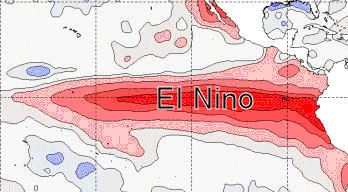
El Ni�o is a sudden warming of the central and east Pacific (see map below). This warming is due to the transport of warm waters in the western tropical Pacific eastward toward South America. Normally, it is quite cool along the coast of South America throughout the year. Winds along the Equatorial regions typically blow from east to west. Early explorers from Europe to the New World called these winds the Trade Winds. So, in the tropical Pacific, these winds help keep the waters cold off the coast of Ecuador and Peru and warm in the western Pacific. During the late 1800�s, fisherman catching anchovies and phytoplankton noticed the waters off the Peruvian and Ecuadorian coast were warmer than what they typically experienced and this warm water often resulted in these fish populations dying off or moving north or south to cooler waters. Since this warming was often noted in mid to late December of every calendar year, the fisherman called this warming �El Ni�o� meaning the little boy or �Christ Child� referring to baby Jesus. The warming was thought to just include the east Pacific, but scientists studying this current in the mid 1900�s found that the warming often extended hundred of miles west along the Equator often near the International Date Line just south of the Hawaiian Islands.
       
El Nino is marked by warmer than normal sea surface temperatures in the central and east Pacific. Normally the
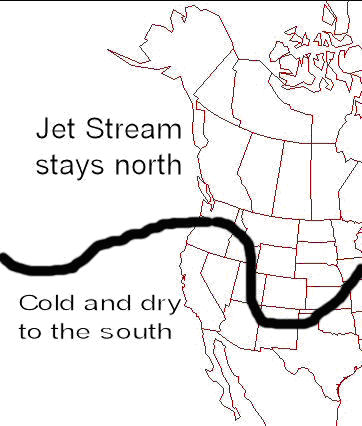
sea surface temperatures in the tropical east Pacific are cold. The jet stream has been too far north
of the state to bring any rain. Cold and dry weather is the result.
This ocean temperature fluctuation from cold to warm waters in the central and east Pacific has been linked over the past twenty years to heavy rain and flooding in central and southern California as storms from the west and south west in the Pacific often bring tropical and subtropical moisture to southern California from as far away locations as Hawaii as the jet stream moves south over the lower latitudes during these episodes. As mentioned, both strong El Nino�s of 1982-83 and 1997-98 were associated with heavy rain flooding, and tornadoes in southern California. However, this years El Ni�o, much weaker by comparison, has not altered the jet stream in the north Pacific to bring rain to the southern portion of the state. Instead, the jet stream has remained farther north this winter resembling more of a La Ni�a pattern (opposite of El Ni�o) where colder and drier storms move into southern California as the jet stream remains to the north in the middle and higher latitudes. This jet stream brought heavy rains and strong winds to the Pacific Northwest states (Washington and Oregon) and left most of California dry. Instead of storm systems moving across the state from the ocean, they have been moving across the Pacific Northwest states and then move south across northern California and then into Nevada and Utah. This has led to more frequent Santa Ana wind events that what usually happens during an El Ni�o episode. Santa Ana wind events occur when dry, desert winds move off the deserts toward the coast as high pressure develops over the Great Basin; the higher the pressure over the Great Basin, the stronger the �offshore� winds and the warmer and drier the air toward to coast. This often result in very low humidity and high fire threats across the inland mountain and passes.
The latest ocean data from mid to late January indicated that the warming across the central and equatorial Pacific has weakened and that El Ni�o conditions appear to be fading. The jet stream across the Pacific never shifted far enough south like many forecasters expected, nor has the weather pattern changed over California that many forecasters expected as well. The Hawaiian Islands are usually wetter than normal during El Ni�o. So far, the islands have been relatively dry. You may ask: why didn�t El Ni�o have such a strong impact on the west coast this time? As mentioned earlier, each one has its own personality, some wet and dry. This years El Ni�o has decided to be dry. Why?, natural climate variability-or more simply put: more needs to be learned about this warm ocean current.
So, what can we expect this winter, rain and snow wise? Well..the last time the southland was experiencing this weather pattern was back in the early 1990�s when Santa Ana�s were common throughout the months of November through February. Then, the pattern broke when southern California received record rains during the first few weeks of March (March Miracle) remember that event?..maybe so, maybe not. Climatologically speaking, January and February are the wettest months in southern California, so there is still time for the rainy season to catch up to near normal (about 15 inches). In the meantime, enjoy the sunny dry weather while it lasts.
Reminder! if you haven't paid your membership dues for this season please do at the meeting-Membership is open to anyone!
| $15 Regular | $5 Students | $10 Retirees |