The following is from this page.
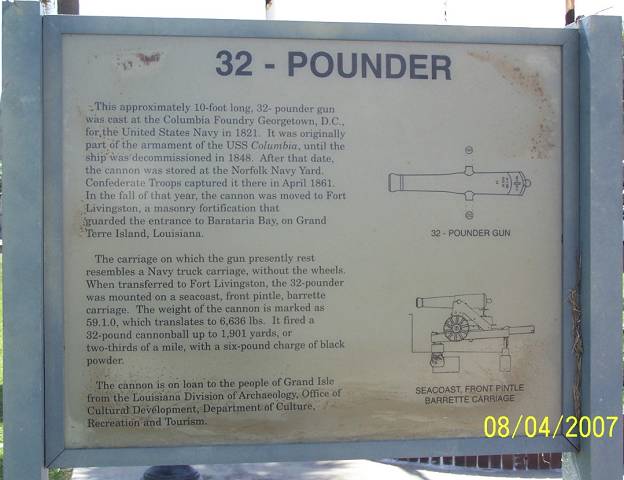
Prompted by advice from John Slidell and Judah P. Benjamin, then sitting as members of the United States Senate, the governor of Louisiana (Moore) sent expeditions from New Orleans to seize Forts Jackson and St. Philip on the Mississippi, below the city, then in charge of Major Beauregard; also Fort Pike, on Lake Pontchartrain, and the arsenal at Baton Rouge. A part of General Palfrey's division went down the river in a steam-vessel, and on the evening of Jan. 10, 1861, the commander of Fort St. Philip (Dart) surrendered it; but the commander of Fort Jackson (Sergeant Smith), which surrendered, gave up the keys under protest. State troops seized Fort Livingston, on Grand Terre Island, Barataria Bay, at the same time, and on the 20th the unfinished fort on Ship Island was seized and held by the Confederates. Troops left New Orleans, 300 in number, under Colonel Walton, on the evening of Dec. 9, in a steam- vessel, and on the following evening arrived at Baton Rouge to seize the arsenal, then in command of Major Haskin. He was compelled to surrender it on the 11th. By this act the Confederates were put in possession of 50,000 smallarms, four howitzers, twenty pieces of heavy ordnance, two field-batteries, 300 barrels of gunpowder, and a large quantity of other munitions of war. A part of this property Governor Moore turned over to Governor Pettus, of Mississippi. The barracks below New Orleans were seized on the 11th. They were used for a marine hospital. The United States collector at New Orleans was required to remove the 216 patients from the barracks immediately, as the State wanted the building for the gathering Confederates. The collector (Hatch) remonstrated, and they were allowed to remain. The authorities of Louisiana also seized the national mint and the custom-house there, with all the precious metals they contained in coin and bullion, and by order of the State convention this treasure, amounting to $536,000, was placed in the State coffers. Soon after this, a draft for $300,000 was received by the sub-treasurer at New Orleans, which that fiscal officer refused to pay, saying, " The money in my custody is no longer the property of the United States, but of the republic of Louisiana." |