
Single
ended amplifiers, and indeed single ended triode (SET) amplifiers have achieved
a cult-like status. I have tried my hands on one with RE134, wich, despite its
low power, worked quite well.
But contrary to the main trend, I have become fascinated with the single ended
PENTODE (SEP) topology. I have buildt two yet, both with EBL21, a small output
pentode found in several european tabletop radios from the late 40ies. The first
amp, wich used ECC83 as voltage amplifier, made me reject SEP as an inferior
solution.
Then, mainly as an experiment, I made one that used 6AK5/EF95 as voltage
amplifier, and lots of feedback. This is a very good amp. It plays very clean
and reproduce stereo effects (like the children in the schoolyard at the end of
Another Brick in the Wall part II) very realistic in headphones. It has low
enough noise to be used as a headphone amplifier, and enough power to be used
with high efficiency speakers.
I had a pair of RE134 old german tubes, made by Telefunken for the nazi Wehrmacht. As I had a pair of sockets I decided to try them in a linestage. It turned out quite good, but the tubes were terrible microphonic. I could hear them ring after loud passages.
Then I made an SET amplifier with them. No doubt that was better, since now I could barely hear the ringing when I tapped them. But it lacked power, 0,5W at clipping is to little even for horns, if you don't have 105dB+ sensitivity and active crossover. But for those interested, here is the shematic:
<shematic of SET>
I did not make any driver stage, since my line stage could easily provide 80Vpp before clipping. But maybe I should have done it, since RE134 needs 40Vpp drive, and this is only 6dB below maximum for the line stage. Good tubes to use here is E80CC, E88CC and ECC40.
This amp was made as a spare amplifier for my apartment when I atended "folk high school" (a norwegian shool type where the social part is most important).
<shematic of SEP1>
Compared to my OTL, this amp has a kind of electronic haze covering the music. It does not have as much detail or musicality as the OTL. Now it is canibalized for parts to the next SEP amp:
This amlplifier is inspired by an article in Audio Engineering, reprinted in Audio Anthology vol. 3. The original circuit used 6V6 as output stage, and there is a few other differing details.
Basic circuit description: The voltage amplifier is 6AK5/EF95 with a 2,2M anode load. This makes for a high gain stage, and is direct coupled into the grid of the EBL21. This tube has a 1200ohms cathode resistor, this results in high local feedback. The screengrid is powered via a 200ohms resistor.
The 6AK5 has a grid leak of 10M, to give a small bias due to grid current flow. The voltage developed across the 470ohms cathode resistor is around 0,07V and is insignificant.
The main trouble with direct-coupled amplifiers is drift of the operating point. This is couteracted by feeding the 6AK5 screen from the cathode of EBL21.
Feedback is taken from the secondary of the output transformer through 1,5k to the 6AK5 cathode. There is a 100pF+56k feedback network from the EBL21 anode to 6AK5 cathode to prevent HF instability. The response in the upper frequency range was far from ideal without this feedback. Ringing and frequency doubling was evident at some frequencies. Now the amp produce clean sinus at higher frequencies, and begins rolloff at 20kHz (-3dB). Feedback is around 20-25dB (measured), it should be 36dB acording to the original article. I guess this is because my amp has lower power due to the unbypassed cathode of EBL21 and lower Vb.
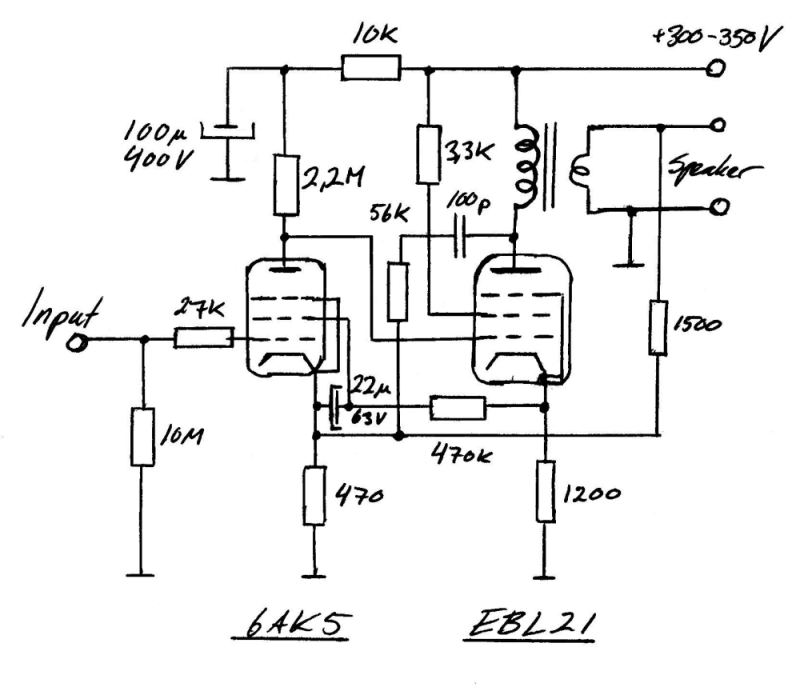
Click on the image to get a full size shematic.
Modifications: Try to bypass the screen to the cathode. This gives the amp a negative output impedance.
Frequency responce: <20Hz-20kHz
Power: 2W in 4ohm, 1,2W in 8ohm (screen bypassed), 0,8W in 8ohm (sreen unbypassed) , onset of clipping.
Output impedance: <0,09ohm (screen unbypassed), -0,05ohm (screen bypassed)
It plays very clean and reproduce soundstaging and stereo effects (like the children in the schoolyard at the end of Another Brick in the Wall part II) very realistic in headphones. It has low enough noise to be used as a headphone amplifier, and enough power to be used with high efficiency speakers. Two of my friend have listend to it, and both liked it.