Laurence O'Donnell
"Music is so naturally united with us that we cannot be free from it even if we so desired" (Boethius cited by Storr).
Music's interconnection with society can be seen throughout history. Every known culture on the earth has music. Music seems to be one of the basic actions of humans. However, early music was not handed down from generation to generation or recorded. Hence, there is no official record of "prehistoric" music. Even so, there is evidence of prehistoric music from the findings of flutes carved from bones.
The influence of music on society can be clearly seen from modern history. Music helped Thomas Jefferson write the Declaration of Independence. When he could not figure out the right wording for a certain part, he would play his violin to help him. The music helped him get the words from his brain onto the paper.
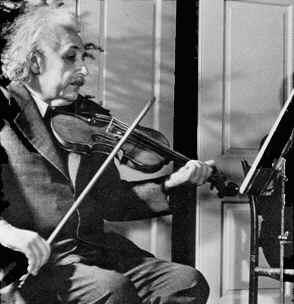
Albert Einstein is recognized as one of the smartest men who has ever lived. A little known fact about Einstein is that when he was young he did extremely poor in school. His grade school teachers told his parents to take him out of school because he was "too stupid to learn" and it would be a waste of resources for the school to invest time and energy in his education. The school suggested that his parents get Albert an easy, manual labor job as soon as they could. His mother did not think that Albert was "stupid". Instead of following the school's advice, Albert's parents bought him a violin. Albert became good at the violin. Music was the key that helped Albert Einstein become one of the smartest men who has ever lived. Einstein himself says that the reason he was so smart is because he played the violin. He loved the music of Mozart and Bach the most. A friend of Einstein, G.J. Withrow, said that the way Einstein figured out his problems and equations was by improvising on the violin.
Bodily Responses to Music
In general, responses to music are able to be observed. It has been proven that music influences humans both in good and bad ways. These effects are instant and long lasting. Music is thought to link all of the emotional, spiritual, and physical elements of the universe. Music can also be used to change a person's mood, and has been found to cause like physical responses in many people simultaneously. Music also has the ability to strengthen or weaken emotions from a particular event such as a funeral.
People perceive and respond to music in different ways. The level of musicianship of the performer and the listener as well as the manner in which a piece is performed affects the "experience" of music. An experienced and accomplished musician might hear and feel a piece of music in a totally different way than a non-musician or beginner. This is why two accounts of the same piece of music can contradict themselves.
Rhythm is also an important aspect of music to study when looking at responses to music. There are two responses to rhythm. These responses are hard to separate because they are related, and one of these responses cannot exist without the other. These responses are (1) the actual hearing of the rhythm and (2) the physical response to the rhythm. Rhythm organizes physical movements and is very much related to the human body. For example, the body contains rhythms in the heartbeat, while walking, during breathing, etc. Another example of how rhythm orders movement is an autistic boy who could not tie his shoes. He learned how on the second try when the task of tying his shoes was put to a song. The rhythm helped organize his physical movements in time.
To know more, go to... http://www.cerebromente.org.br/n15/mente/musica.html
Other Links:
"Noise." American Speech-Language-Hearing Association. 2005.
This article focuses on noise, it's definition, and the effects it can have on us. In the article noise is defined as, "a signal that interferes with the detection of or quality of another signal." Further in the article music is classified as a type of noise which can affect our physical health and well being. The ranges of different noises are discussed including loud, hazardous noise, noise in the workplace, noise in the community and many more. The article concludes with different ways to prevent the damages different noises can have on our day to day lives, and how to properly adapt to noises.
http://www.asha.org/public/hearing/disorders/noise.htm
Watkins, Terry. "Is Music Neutral?" 1995.
This article addresses the issue of whether or not music can be defined as neutral. The ïmusic' which the author is referring to is just the score and not the lyrics. The conclusion reached is that no, music is not in any way neutral and that it in fact has a way of manipulating its listeners. Music has been found to have numerous effects, both positive and negative, on the human mind and body. The article concludes with evidence dating back to the Bible confirming that music is not a neutral subject, and every type will have some type of effect on the mind and body.
http://www.av1611.org/neutral.html
Holtz, Robert Lee. Music and the Brain. 13, December. 2002.
This article focuses on music and how it literally affects the human brain. He explains this by writing that music actually rewires the brain to create new patterns of activity in different areas. It has been proven that those who are more experienced with music actually have different areas of the brain such as the cortex and the corpus callosum which are much larger than those who are inexperienced with music. The article continues to discuss the how music affects the different areas of the brain, and how beneficial music is in our daily lives.
http://www.eupsychia.com/perspectives/articles/musicbrain.html
Other helpful cites included:
http://www.neilslade.com/music/question.html
http://www.brainconnection.com/topics/?main=fa/music-education
http://www.newhorizons.org/strategies/arts/brewer.htm-
http://www.edu-cyberpg.com/Music/Music_and_Brain_Informatio.html