This is the text of the Questions and Answers that appeared in Bhutan Times.
He dominated the studies, excelled at work and had the daring to give up his respected profession as a telecommunications engineer to become a freelance consultant. Lekey Dorji is now about to take up his greatest challenge – become an MP and bring positive changes in the Upper Kheng constituency that he wants to represent.
1. Can you describe your earlier professional placements and experiences?
I began my career as a switch engineer in the then Department of Telecom and later became an area manager. When I resigned from Bhutan Telecom in 2004, I had been serving as the head of billing and international affairs, and was earmarked to head corporate business and strategy division. Working in the sector was fun and challenging but I truly believed that I could serve my country better outside of telecom. I set up the first broadband wireless Internet in Thimphu and was instrumental in making Internet services more affordable. I then took up the challenge of turning around Bhutan Post by becoming its General Manager for Business Development and Marketing. We looked at ICTising most of business operations in Bhutan Post including Epost, counter automation, EasyPay, and track and trace systems for postal deliveries. I then moved on to pursue my dream of learning new things as a consultant and have never looked back. Ever since, I have been fortunate that my service has been availed by various government, private, and non-governmental organizations.
2. Why several drastic professional moves in the last few years – from an engineer to consultant and now to MP?
I am a dreamer and for someone who started out life from a remote Kheng in Zhemgang, I believe that life has been extremely generous. When one of my own classmates from Sherubtse College walked up to me during our annual reunion and said that I was his inspiration, I was really elated. I have been very lucky to have received world-class education in US and UK, not to mention numerous opportunities to travel and experience life and cultures across the globe. I have never been pushed by any problems in any of the organizations I have been associated with rather I have always been looked up to. Everywhere I went, I made new friends, gained more experiences and enriched my life through diverse perspectives. Being a dreamer, I will never stop dreaming. At the same time, I am a doer and believe that university degrees are useless if they cannot be put into practical use in our country.
Zhemgang has been unfortunate in that most of its educated and successful citizens have almost always moved away to settle down in other towns and districts. The trickle down economic effect has been very little. If those who are doing better away and only those who are not remain, I do not see how Zhemgang can develop and catch up with other districts. There is only so much our government can do, and Zhemgang runs the risk of becoming marginalized even in post 2008 era. I have always been in touch with my village and the communities, and in my own little ways contributed to community building. At this stage, when I am neither too young nor too old to traverse the difficult terrains of my constituency, I believe that I can best serve the people and country being an MP than being anything else. A little too old and my legs would not carry me to far flung villages of the constituency.
3. Your constituency is considered quite remote. How would you describe it in terms of stage of development, community culture, social life, etc?
Zhemgang is economically one of the poorest districts in Bhutan. Last year, when I mentioned the possibility of forming a political party, one of my friends joked if it would be christened Poverty Party. That is the perception against the backdrop of reality. Bardo-Trong constituency, which I would be representing if people so wishes, consisting of Shingkhar, Bardo, Trong and Nangkor geogs comprise some 40 villages in varying stages of development. Although many of the villages of Trong and Nangkor have access to road and electricity, all villages of Shingkhar and Bardo geogs with resident population exceeding 8,500 are very remote and the people still have to walk two or more days from the nearest motor road in Buli and there is still no electricity. People are already excited of new hydro-power plant in Shingkhar and Digala in the MTI master plan, and hoping for these villages to be connected to the road network.
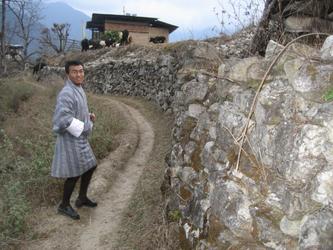
Although remote and poor, my constituency is unique - it has its own dialect, diverse traditions, and colourful festivals. It is a constituency where Bon festivals are still celebrated by the village communities. Women are greatly empowered and take major household decisions in most of these villages. Village zomdues are dominated by women and they play much greater role in the society. Although it varies, inheritance is not fixed and all children get their shares of landed properties. That leads to, I think, one of the major social problems of small land holdings in Kheng area. People are hard working and genuinely love their King and pray for his long life. I illustrate what life in remote villages of Bardo-Trong constituency is like in my blog at www.geocities.com/l_dorji.
4. Many of your friends think you have a philosophical and/or intellectual’s frame of mind rather than a politician’s. Is this assessment correct?
I would say Yes and No. Yes, because I love reading, writing, contemplating, meditating, arguing, listening and philosophizing, so I can be said to have an intellectual frame of mind. I guess it is a plus point for a politician to have that frame of mind. No, because most people start with the premise that politics is a dirty business but I truly believe that politics is one human activity, perhaps the only human activity, which can positively impact the lives of the poor, voiceless and the less fortunate. Since I am genuinely concerned with people, I think I could make a good representative for my people in the constituency.
5. Your father has had a big influence in your life. What does he have to say about your decision to join politics? Did you consult other members of your family also?
My late father indeed had a big influence in my life. A self-taught man, he taught me to read and write, and to think and appreciate the teachings of Lord Buddha even before I started school. The only son amongst six sisters, I was dearly loved but never spoilt. Early in life, he had ingrained in me the lessons of humility, hard work, lay jumdray and tha damtsi that have never failed me in life. Unfortunately, he had passed away some thirteen years ago leaving me no luxury of consulting him in my decision to join politics, but I know that he will have approved of my aspirations for the people of Kheng and I will always have his blessings. I have unconditional support of my wife, mother, in-laws, sisters, relatives, cousins, fellow villagers, and most local leaders from my constituency.
6. What can you offer as a politician, to your constituency and to the nation? What are your strengths and weaknesses?
The first set of politicians in 2008 will set precedence for future generations of politicians in Bhutan. It is, therefore, of utmost importance to have MPs who are committed and capable of making policies and enacting laws that would make our country strong and united. I could not say I am the best possible candidate from the constituency but I know that I am committed to serving the people with utmost dedication. I have always been a role model for my cousins and my fellow villagers, and I feel that I can be an inspiration to young men and women, especially those coming from humble backgrounds, always working hard and never stopping to dream.
The word politics has a negative connotation but politics itself is not bad. It is the politicians with vested interests who make the politics look bad. I think we need clean, able and committed politicians for 2008 elections so that our youths and future leaders can emulate them and follow in their footsteps. I feel that I can be one of the trend setters. I have no hidden agenda and only want to serve the people and country. My strengths are honesty, sincerity, hardworking, trustworthiness, positive attitude and commitment. My weakness is my belief in the goodness of humanity. I can only say that I am not as good as “what people say when I am winning or not as bad as what people say when I am losing.”
7. Sadly but true, quite a few people will be joining politics because of probably better salary, perks, clout, social stature, etc. If so, what potential repercussions for the country’s democratic process?
You could be right, there may be people joining politics for better salary, perks, clout, social status, etc. But let us hope that majority would join politics with good intentions. I tell my friends that if all they want is money, start a business. Politics is not an arena to make money. Our country has done so much for us and now it is our turn to do what we can. Let us ask “what we can do for Bhutan and not what Bhutan can do for us”. The onus of electing the right candidates falls on the shoulders of all of us as voters. We must be able to recognize good candidates from wolves in sheep’s clothing. If we do not, wrong people would come to power and that would be disastrous for the future of our country. That would mean flushing down the drain the great achievements of our Benevolent Kings we have been blessed with. We can not let this happen. We must not.