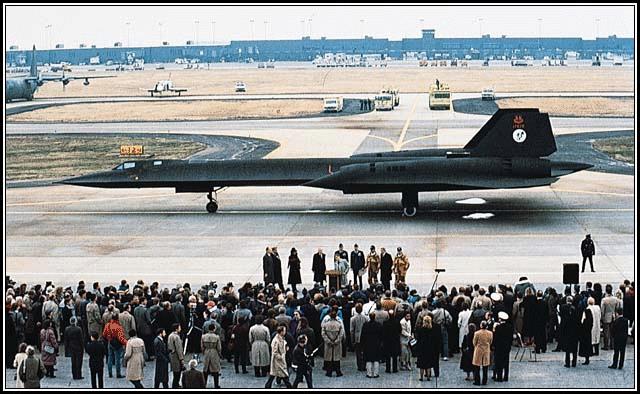
The SR-71 is immense. It's more than 30 meters long ! |
Without doubt the most awe inspiring plane ever. Shrouded in mystery, this plane is quite a legend. We have seen it in many a commercial photo, especially when high technology or high performance are the point.
This plane has been for more than 25 years now and, apparently, is still in service. Besides the B1-B, none of the modern planes matches the impressiveness of this monster. Depending on the angle, it looks either sleek or deadly. The SR-71 has a reputation of being extremely maneuverable at low altitude and subsonic speeds.
|
The SR-71 is immense. It's more than 30 meters long ! |
It is rumored a lot about this magnificent plane. For example, some say that its operating costs range upto $200,000 dollars per hour. The two most important assumptions about the SR-71 are :
 |
It can hold weapons, in the apex of one wing. The other apex is supposed to contain an EMC suite specific to the SR-71. |
|
Its very huge engines might in fact be statoreators, which would explain the incredible speed given the age of the plane. |
History
The history of the Blackbird started as a concept developed at Lockheed's famous Skunk works in California. The USAF needed a very fast, high altitude, virtually radar invisible recon aircraft. At the time the U-2 was used for such mission; however, one of them flown by Gary Francis Powers was shot down by a surface to air missile (SAM) over the Soviet Union! Although it operated at very high altitudes and great speeds, it was picked up on radar and shot down! Of course this caused a serious incident between the US and the USSR during the cold war!
But Lockheed was working on something entirely new, which could fly at 85,000, with speeds reaching Mach 3.2+. The original goal was to create a plane that no weapon could reach. This aircraft, equipped with all the latest electronic surveillance and counter measure equipment available, was called the SR-71 and affectionately known as "The Blackbird ". The SR-71 was equipped with one of the most accurate cameras of that time, able to capture details of less than one meter from high altitude. A unique characteristic of the Blackbird-which the U-2 didn't have-was "stealth" capability. The SR-71 achieved this through hypersonic flight (over Mach 3) and very high altitude. It could be sent anywhere in the world rapidly. Since being coated with radar absorbing paint, the Blackbird's radar signature was only 1% of that of a B-52, which made it virtually radar invisible. This made recon easier and safer for missions over hostile territories without being detected.
Its maiden flight was in 1959; regular recon flights started in 1964, until the advent of spy satellites and super science that created them. The SR-71's covered virtually every inch of the Earth's surface during its long reign in the skies! Its main use has been as a spy plane for the CIA and holds the speed record for crossing the Atlantic Ocean in two hours or so.
Features
The technology involved in this aircraft is amazing; it was even the world's first stealth plane! The SR-71unique stealth shape has earned it the nickname Habuafter a Japanese Cobra like snake which it resembles.It is one of the few of aircraft that can fly at sustained mach speeds.
|
The delta-wing design is well known to provide great maneuverability at high speeds. |
|
It accepts in-flight refueling. Its tires are filled with nitrogen to keep them from exploding during flight. |
|
Its engines, on full afterburner, are powerful enough to create a diamond shaped shockwave that is 125 feet long. |
|
The pilots are so high up that they must where a space suit. |
|
At altitudes upwards of 80,000 feet and a maximum speed of mach 3.5, it is the highest flying, fastest jet powered aircraft on the planet. |
|
Its navigation system is also revolutionary, because Skunkworks designed this system before there were navigation satellites.It used a stellar navigation system. In a computer is stored the location of sixty stars and it locks onto stellar formations to find its location over the earth. |
Designed in 1956-1958, the designers had to start from scratch due to its high performance requirements.
Specifications
SR-71 - A/B/C
|
Construction |
Titanium |
|
Length |
107 feet, 5 inches |
|
Wingspan |
55 feet, 7 inches |
|
Wing Area |
1,795 square feet |
|
Height |
16 feet, 6 inches |
|
Landing Weight |
68,000 pounds |
|
Maximum Gross Take-off Weight |
140,000 pounds |
|
Maximum Speed |
3.2 Mach above 75,000 feet |
|
Operational Ceiling |
Over 85,000 feet |
|
Maximum Unrefueled Range |
3,200 nautical miles |
|
Armament |
None |
|
Powerplant Data |
Pratt & Whitney J58 (JT11D-20A) High-bypass-turbojets with 34,000 pounds thrust |
|
Total number Built |
32 |
|
Still in Existence |
21 |
|
Total SR-71's lost in Accidents |
12 |
|
Total SR-71's lost in Hostile Fire |
0 |
|
Total Flight Hours |
53490 |
|
Total Air Refuellings |
25862 |
|
Total Crew Members |
284 (includes NASA and USAF Crews) |
|
SR-71 Production A B C |
29 2 1 |
YF - 12A
|
Construction |
Titanium |
|
Length |
101 feet, 8 inches |
|
Wingspan |
55 feet, 7 inches |
|
Wing Area |
1,795 square feet |
|
Height |
18 feet, 6 inches |
|
Landing Weight |
68,000 pounds |
|
Maximum Gross Take-off Weight |
124,000 pounds |
|
Maximum Speed |
3.2 Mach above 75,000 feet |
|
Operational Ceiling |
Classified, but probably over 80,000 feet |
|
Maximum Unrefueled Range |
Classified |
|
Armament |
Hughes GAR-9/ AIM-47A air to air radar guided missiles (maximum speed 4 Mach) |
|
Powerplant Data |
2 Pratt & Whitney J58 (JT11D-20A) High-bypass-ratio turbojets |
|
Total number Built |
3 |
|
Still in Existence |
1 |
Summary of YF-12A Missile Firings
|
Date |
YF-12 Altitude |
YF-12 Speed in Mach |
Target Altitude |
Result |
|
Mar 1965 |
65,000ft |
2.19 |
40,000ft | Target destroyed |
|
Mar 1965 |
64,800ft |
2.18 | 20,000ft | Missile Gyro failure |
|
Sep 1965 |
75,200ft |
3.22 | 20,000ft | Target destroyed |
|
Mar 1966 |
74,000ft |
3.16 | 1,700ft | Target destroyed |
|
Apr 1966 |
75,200ft |
3.20 | 1,100ft | Target destroyed |
|
May 1966 |
76,000ft |
3.19 | 20,000ft | Target destroyed |
|
Sep 1966 |
74,400ft |
3.21 | 500ft | Target destroyed |
Comparison
Due to the abilities of this technological aircraft, it is much more flexible than the other reconnaissance platforms available today. It only has two real rivals: the spy satellite and the U-2. Spy satellites are traceable by most enemies and these enemies can just cover up their military assets when the known time comes. Satellites are also expensive to maintain and move.The price of keeping a constant link with them once was quoted in the billions of dollars per year; where as the SR-71 cost around half of that along with the ability to be anywhere in the world within hours.The U-2, having been shot down several times in the 1950's, is vulnerable to most potential enemies defenses and it has no practical way to be stealthy.The U-2 also has the weakness of only being able to survey a fraction of the territory the SR-71 can in an hour. Along with those weaknesses, the U-2 can cost just as much to operate as the SR-71 can.The SR-71 has proven, in the past thirty years, to be one of the best available reconnaissance platforms in the world.
Conclusion
Today the SR-71 no longer flies (Well that is what has been quoted as said). However, it will always stand for its many achievements.It's the best recon aircraft the US Air Force ever had. This plane is and was a powerful and technological powerhouse that deserves to be in active duty today. Recently cut, one of the best reconnaissance platforms in the world is no longer used for its intended job.Unless action is taken soon, the unknown reasons for its premature cancellation will seal SR-71fate.In fact, using the now unconstitutional Line Item Veto power, President Clinton completely cut the SR-71 out of the budget and ending its service life permanently. Something has to be done to save these planes from becoming museum pieces.
And here's what you are waiting for - PICTURES!!Gallery 1 Gallery 2 Gallery 3 Gallery 4
If you have any comments or suggestions about this site, click below.
| Sign or Read My Guestbook! |


