|
|
|
|
|
|
|
|
|
|
|
|
|
|
|
|
|
|
|
|
|
|
|
|
|
|
|
|
|
|
|
|
|
|
|
|
|
|
|
|
|
|
|
|
|
|
|
How To Write Guitar Riffs |
|
|
|
By Spyder Blak |
|
|
|
If you want to write theory emphasized riffs here are some guidelines. Basic knowledge in theory is recomended. You can find the the best books that covers basic theory in the below links |
|
|
|
Here |
|
|
|
For Heavy Metal:
Heavy Metal riffs are mostly straight 16th notes and 8th triplet notes. It is usually in minor key and
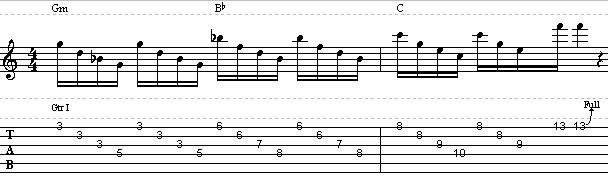
riffs are usually based on minor pentonic scale. First come up with a progression, say i-III-IV in G Dorian mode, that's Gminor-Bb-C. First you can arpeggiate the whole thing and play only the chord tones. That is the notes G,Bb,D for Gminor, Bb,D,F for Bb, and C,E,G for C. Divide all the notes evenly so that they all fit neatly in place with the chord changes (don't worry about parallel fifths, this is heavy metal). And then bend in to the G note to come to a finish Like this: |
|
|
|
 |
|
|
|
Click here to hear it |
|
|
|
The example above sounds very nice but you might find that it's difficult for your fingers to make the big leaps. Therefore another technique would be to play the chord tones in one position. This time in Triplets: |
|
|
|
 |
|
|
|
Click here to hear |
|
|
|
The example above is the better choice actually because there are no parallel fifths. If you want to learn more about parallel fifths and how to avoid them, and you covered basic theory already, the next step for you to take is would be to read this excellent book by Greg A. Steinke, you can find it |
|
|
|
Here |
|
|
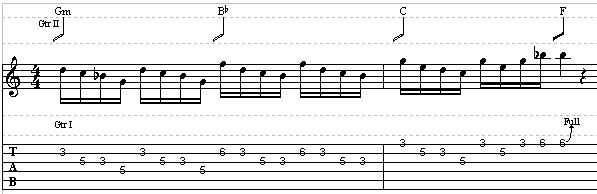
Another method to treat this progression is to incorporate scale tones with chord tones to acheive the best sonority. Scale tones or any tone that don't belong to the chord become embellishing tones (these are also call outside notes, improvisors such as jazz muscians deliberately exploit these in order to create tension). Such as passing, neighboring, changing just to name a few. But for now we'll just use passing tones. Okay, so we'll use Gminor pentonic scale for this one. It should fit nicely into G Dorian based progression because G Dorian contains all the notes that G pentatonic has. First you would want to place the chord tones on strong portion of the beat, such as placing D, the fifth of Gminor, in the very begining and the passing tones somewhere in the middle (see the circled notes). We'll need a guitar accompaniment for this one: |
|
|
|
 |
|
|
|
Listen to it here |
|
|
|
Or you can do the reverse and place the non-chord tone on strong portion of the beat (suspension) but make sure a nearest chord tone follows right after. |
|
|
|
phish |
|
|
|
Another great series of books for heavy metal guitar is ones written by Troy Stetina. I highly recommend them. you can find it |
|
|
|
Here |
|
|
|
Click here for book recommendations |
|
|
|
Rock Jazz Metal Uncategorized |
|
|
|

|
|
|
|
|
  |
|
|
|
|