















|
|||||||||||
|
|
|
|||||||||
|
|
|
|||||||||
|
|
|
|
|
|||||||
|
|
|
|
|
|
|
|||||
|
|
|
|
|
|
|
|
|
|
|
|
The Kyrgyz Republic is located in the heart of the Eurasian continent. The country occupies a strategic location on the Silk Road - between the markets of the former Soviet Union and Europe, the Middle East, South Asia, and China. Stretching 900 km from east to west and 425 km from north to south, Kyrgyzstan's total landmass is 199.9 thousand square kilometres, which is about the size of Switzerland, Belgium, the Netherlands, and Portugal combined. The northernmost part of the country is on the same latitude as Rome, and the southernmost end is on a level with the island of Sicily. The borders of the Republic generally follow natural boundaries - mountain ranges and rivers. Kyrgyzstan borders on Kazakhstan to the north, Uzbekistan to the west, Tajikistan to the south, and China to the south and east.
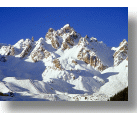
Kyrgyzstan is remarkable for its natural beauty. It is a country of sunshine, high snow-covered mountains, deep gorges cut by swift rivers and 1,923 mountain lakes. The country's generally mountainous terrain has an average elevation of 2,750 metres above sea level. Because of differences in elevation and degree of shelter, the climate of the Republic differs widely. In the summer months, travellers can spend part of a single day in a sunny valley, in a flowering meadow high in the mountains, and in glaciers above the clouds. Extensive mountain ranges featuring ridges, deep gorges, wide steppe valleys and virgin forests are complemented by more than 40,000 rivers and streams that provide irrigation and a vast potential for hydroelectricity production.
