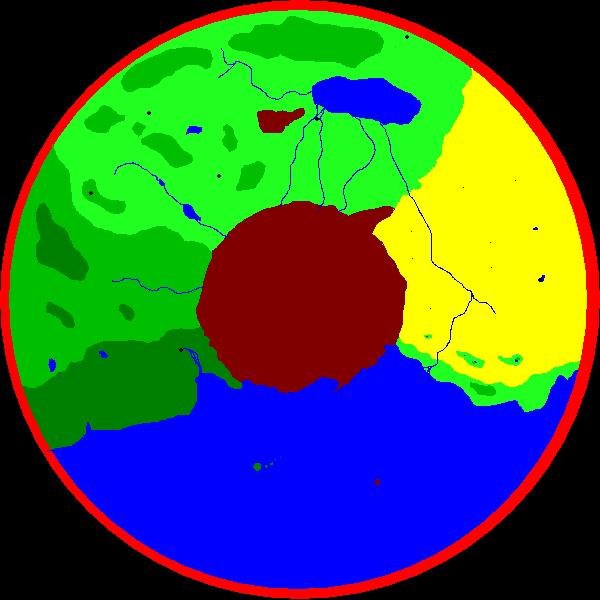
| Lands of Artheria As long as anyone can remember, the lands of Artheria have been as clear and obvious in shape as the four directions of the compass. In a slow circle from the shore of the great ocean that borders the eastern desert, passing around the great mountain until the circle has reached the opposite shore, the vegetation constantly grows more thick, and the life more populus. In the west, its a thick, dense jungle, while to the north the jungle fades to forest, and then grasslands, and to the east, the wide expanse of the desert. In recent times, the desert seems to be expanding slightly to the northwest; at the same time, the Flows, a major hazard in Artheria, are expanding just behind it, perhaps even causing it. But at the far south-eastern edge, by the shore of the ocean, life is once again coming forth, and the southern reaches of the desert may soon be as lively as the northlands. Ancient legends speak of a time long ago, even before the 6,000-year-old banishment of the Dark Elves, when the west was a desert, and the east a sprawling jungle. Few believe this to be true. After all; the east has always been a desert, and will always remain that way, in the eyes of its people. Natural Hazards: Aside from the wildlife and the occaisional undead or magical beast, the greatest hazards in artheria are the weather conditions, the terain itself, and the Flows. Weather: While conditions in the north are fairly moderate, the weather has been known to grow dangerous quite commonly in the east, with fierce sand-storms, freezing night winds, and deadly heat of the day. Sand-Storms: Sandstorms range in power from just barely higher than a dust-devil to a massive tornado-like whirlwind of sand, tearing at anything therein. Its commonly believed that if one stands still at any point in the desert, at least two sandstorms will come by every day. While they aren't truly that common, the magical barriers that the Technologists and some nomad tribes use to protect their homes from them can cause them to be especially common and intense in the areas outside such camps or towns. Sand-storms will typicall start at dust-devil level, and slowly rise up to their strongest point, and then settle back down. To find the duration of a sandstorm, roll the final strength the storm will reach for duration, then go through each of the steps until it reaches it based on the duration of stage(step) list. When its over, it moves back down the duration of stage(step) list at the same rate. Note that in order to survive sand-storms, the Desert Folk typically use a hard leather bag-like tent (equivalent to wood for hardness) and part-way bury themselves in the sand. Damage/Round Hardest Object Damaged Duration of this stage(final) Duration of stage(step) Dust-Devil 1 Ice 1d6+1 rounds 1 round Large Dust-Devil 1d2 Glass 1d6+1 rounds 2 rounds Powerful Wind 1d4 Glass 1d6+1 rounds 3 rounds Sand-Storm 1d6 Wood 1d10+1 rounds 4 rounds Tornado 2d4+1 Stone 1d12+1 rounds 5 rounds Winds of Death 2d6+2 Iron 3d6+1 rounds *cannot be step* Note: Apologies for table errors. I'll see about making them an actual HTML table later. Freezing Winds: To put it quite simply, anyone who doesn't have appropriate cold-weather gear, a fire, or shelter, will take cold damage based on the following table. This damage is applied once per hour, and only at night. Its quite common for an entire army to have come into the desert expecting only hot weather, and for all of them without appropriate gear to simply freeze to death at night, leaving only those lucky enough to have brought the right clothes alive to go home and tell the tale. Winter clothing, as noted, completely negates the damage. Cold Damage Fort save DC(halve's damage. Round down for 1s) 8 hours till dawn 1 10 7 hours till dawn 1d2 12 6 hours till dawn 1d3 14 5 hours till dawn 1d4 16 4 hours till dawn 1d4 16 3 hours till dawn 1d3 14 2 hours till dawn 1d2 12 1 hour till dawn 1 10 *Read about table note Searing Heat: When its not cold, its hot, in the east. While conditions are livable, late at night, and early in the morning, in the hours around noon, you take heat damage much as you took cold damage at night. Anyone who is not under a tent or other shelter will take this damage; wearing appropriate desert clothing provides a +2 bonus to the saving throw. Heat Damage Fort Save(Halve's damage, round down for 1s) Noon 1d6 18 1 hour from noon(before/after) 1d4 16 2 hours from noon(before/after) 1d2 13 3 hours from noon(before/after) 1 10 *Read above table note The Flows: The flows are a hazard not just in the desert, but to a slowly growing degree, in the northlands as well. No-one knows exactly what they are, but it is known they seek to slowly sap the life out of any who come near, and that they are tougher than the hardest dwarf-forged steel. For each hour a character is in a Flow, he must make a Fort Save, DC equal to the number of hours hes spent in the flow. If he fails, he dies. If he passes by less than 5, he takes 1d10 damage, of a life-force nature, and loses 1d4 points of Con temporarily. If he passes by less than 10, he takes 1d4 damage, and loses 1 point of Con temporarily. This saving throw is made once per hour if the character isn't moving around much, and once every half hour if hes exerting himself. Any killed by the Flow will come back as an Undead in a number of hours equal to their former HD squared. They will animate as a skeleton (1HD) if they were a commoner of only 1st level, a Zombie(2HD) if they were not a commoner, or were of more than 1st level, and if they are of high level (4+) then they will come back as a Ghoul(3HD version). If more than 15 HD worth of creatures die in one place, they come back as a single Abomination (Large, HD equal to number of HD of dead, number of attacks equal to half the number of undead, all attacks, stats, and armor as a Zombie). Major Cities Odun-Khai Odun-Khai is the largest city in the North-lands, and is to the west, not that far south of the shell from a worldly perspective. It houses some two hundred thousand people, and is a massive, sprawling thing, with a highly organized central area surrounded by constantly expanding rings of small shops and cheap homes. Government: While Odun is commonly named after whomever currently holds the spot as its governor, the encroachment of the followers of the Spirit Khai has changed this markedly. Khai has slowly developed the old government into a theocracy, with his cultists as the guiding forces. Governor: Lassith, high priest of Khai, Cultist(12) Important Officials: Sub-priests of Khai, Cultist(6) City Guardsmen(normal): Hired mercenary, Soldier(1) City Guardsmen(elite): Temple Guard, Soldier(2), Cultist(1) Physical: The center Odun is divided into eight districts, six major districts surrounding the central government district, with the massive residential district surrounding these. While the two northern districts are the noble residences, and restricted to public access most of the time, the other four main districts form the market of Odun, the largest marketplace in Artheria. They surround it in a rough circle, though the two 'noble' districts are somewhat seperate from the central government district, while the market districts seem to 'blend into' the edge of the government district. Major Organizations: Thieves guilds: As all other major cities, 'thieves guilds' exist. And also just like other major cities, they are both underground and open at once, through some bizzare twist. While the city guards never seem to find the guilds, every noble who wants to hire an assasin or poison an enemy's favorite pet seems to find one with ease. There are seven Thieve's guilds, the two largest of which operate in the market districts. The other four are, due to competition, situated pretty widely spread out in the residential district. They are highly territorial, but willing to cooperate with each other in order to elude city guards. In addition to performing assasinations, these guilds also act as a 'black market', both purchasing and selling illegal goods. These guilds have no special names, but are simply named after their leader at the time; early on in their history, there was a war among the guilds because three of them clamed the name 'Dark Blades', which resulted in this. Thrazar's guild: Thrazar is a bit atypical for a thief. Instead of being fast, quick, or agile, hes large, tough, and brutal; as one might expect from a wild troll. It was jokingly passed about that when he tried to pick someone's pockets, they froze in fear and simply begged him not to kill them as he failed to notice their attitude and yanked their purse before walking off. In reality, this isn't far from the truth, as Thrazar would quite simply bash the target unconscious, grab his money, and leave. How he came to be a success in a thieve's guild, where quick wits were the order of the day, and a knife in the back was as common as a helping hand, was almost impossible; but it happened. Hes surprisingly smart for a wild troll, and guides the guild relatively well, managing to maintain controll of his territory in the market district with ease. Mercenary Guilds: There are three mercenary guilds in the city of Odun. They quite commonly hire out to the city guard, or to help rid the sewers of the city of undead or other beasts, or even on occaision will send some of the elite on a quest somewhere. With as many mercenaries as make up these guilds, one could almost form an army amongst them, if one had enough money, though they might refuse to hire out mercenaries if you work with one of the other companies. They have no particular territory, and their sole concerns are in advancing themselves and the mercenaries who work for them. Quilt of Nails: The quilt of nails is quite an odd name for a mercenary organization, but it is one, nonetheless. This name is derived from the fact that each mercenary, after successfully completing an assignment, is allowed to drive a nail with his name marked on it into the 'quilt', which is, in reality, the main table which the leaders of the organization sit at when planning major missions. If a mercenary fails a mission, he has to pull one of them out; they consider it a point of honor to have many nails in this table, and some even notch their weapons with this number, as if it were a kill count of some sort. Adventurer's Guild: They call themselves an adventurer's guild to attract fools and posers who want to go out and seek glory and fame; but in reality, they are simply a source of mercenary jobs for the unskilled and the foolish. Some go in seeking to slay dragons, and come out getting a three-week job with the city guard, or in the sewers slaying mutated rats. On rare occaisions, more difficult, or even heroic, assignments come in, but they are generally only given to those who have proven themselves by going through numerous less glamorous missions. Bleeding Blades: This small, rough, but well-known mercenary unit is well known for its skill, lack of fear, and complete lack of honor. All contracts with them are generally made 'half now, half on completion', because its perfectly likely that without an incentive, they might never perform the mission. But even despite this, the truly spectacular.. and horrendous.. results they achieve keeps the nobles coming back to hire them again. The Bleeding Blades, if assigned to protect a village, might very well protect it; but then, loot and pillage the village afterwards. They are often the best for the job, but when one hires a member of them, one had best be careful. Maenala City of the Light Maenala is the capital of light elven society; the Light Elves believe it is the center of all civilization. With over a hundred and fifty thousand elves living inside it, it represents a truly masive number, especially considering how very few elves there are compared to humans. The city is roughly well organized, and some four stories in height of 'streets', allowing for a good bit of expansion without creating the sprawling cities seen made by humans. Government: While the old elven royal family was executed long ago by the Dark Elves, the 9 remaining clans chose a new royal family, that most closely related to the old one. This royal family rules, on occaision, with an iron fist, but most commonly simply lets things go along normally. It is a monarchy, with a king at its head, and this king is supposedly the ruler of all Light Elves in Artheria. Using metal tools to craft objects in the city is illegal. Hypocritically, or at least the wood elves see it this way, the elven king not only allows, but encourages other elven cities to make and use metal tools, to give him the swords his armies need. Governor: Zaelak, elven aristocrat (expert 3) Important Officials: Beurocrats, elven (expert 2) City Guardsman(normal): elven archer (soldier 3) City Guardsman(Elite): elven archer(soldier 6) Physical: Maenala consists of four layers deep of 'grown' streets. In reality, giant oaks, twisted and shaped by elven magic into forming almost flat streets upon which the elves can walk, from some twelve feet beneath the forest floor to sixty feet into the sky. On the most eastern side of the city, surrounded by a wall of solid ironwood trees grown together so thick that an arrow couldn't get through, the royal palace rests, formed of the delicate crystal-leafed trees of the forest to sparkle like a gem when the sun is shining. The elves never practiced any form of controll or planning in their city, so shops and homes are spread almost randomly, aside from a few small areas where the heads of the clans reside. Major Organizations: The Shaper's Guild: When the elven king outlawed the use of any metal tools for crafting within Maenala, the Shaper's guild grew in power incredibly. Suddenly, the only legal way to get needed tools for certain jobs was to hire the shaper's guild to grow them magically. With this great power, the Shaper's guild grew in prestige, until it was almost as powerful as an entire elven clan. The sorcerers that make it up practice 'shaping', a type of transformation magic that 'allows' trees and other plants to grow into particular shapes they desire. Building a house using shaping magic can take weeks, and cost a good bit; many poorer elves are forced to simply live in older homes, or to build themselves shacks out of sticks that could not be cut from trees; must have fallen on their own, or be pulled off. Some even buy housing materials from outside the city, and build homes using whatever wooden tools they can; as expensive as it might be, its cheaper than something shaped. The Silver Bow: Even the elves have need of hired soldiers on occaision. The Silver Bow isn't so much an organization, as a building, a meeting place where groups of mercenaries will place notice that they are available for hire, and those seeking mercenaries will post requests for contracts. The elves like to try and claim that these mercenaries are only hired for 'good' purposes, and so associate the 'holy' seeming silver element with the building. In reality, these mercenaries are hired for anything from suppressing riots to going out to raid a Dark Elf village and bring something back, such as a prisoner perhaps. Nafaen City of the Dark The Mountain Sphere Kanark Important Lesser Cities Important Towns, Villages, or Monuments |
 |