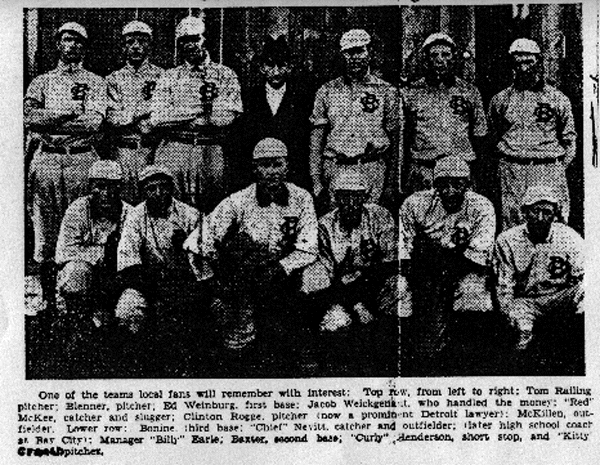
| Nobody is likely to dispute the claim that Jacob Weickgenant is the oldest merchant in Battle Creek --from any standpoint. Jake is 80 years old and has been in business in downtown Battle Creek 52 years. His store today at 42 Northeast Capitol avenue doesn't compare with the big establishments he has had on "Main Street", but he still handles floor coverings and from time to time disposes of draperies and such things that he retains from his last full-sized business. The store is also headquarters for the clothing disposal department of the Saint Vincent de Paul Society -- and a comfortable place for Jake to hang around and chat with old friends who drop in from time to time. It insn't exciting but it suits Jake. Jacob Weickgenant is almost a lifelong resident of Battle Creek. But he can't get around the fact that he was born at Marshall, for his arrival cam at a time when his father was running a hotel at what is now know as Perrinville, just east of the county seat. The natal date was Jan. 11, 1863. Behind that event lies the interesting story of John Adam Weickgenant and his wife Appolonia. John Weickgenant was a native of Minglesheim, Germany -- a small town near Baden. When he and a friend wanted to come to America, their best girls agreed to come along too. In New York, soon after their arrival, John and Appolonia Thome were married. At the time Wendell Ederle, whose granddaughters are well known local residents today, was running a hotel in a wooden building where the Central Electric Co. is now located. He had come from Baden and it was through his acquaintance with the Weickgenants "back home" that John and his bride came to Battle Creek. So did the other couple. The men found work in the Halladay brick yard, south of the city, and all four lived in a one-room house near their work. They had two chairs, one for each wife, and two blocks of wood for the men to sit on. Their mutual table was a big, flat trunk they had brought from Germany. It was not long however, before John Weickgenant found a way to move to town. He became a member of the firm of Weickgenant & Leser, running a bakery, delicatessen, and saloon at the corner of what is today known as East State street and Northeast Capital avenue --the Zang block, as it is best known to many. Of course it wasn't the Zang block then, but a two-story frame building, with the Weickgenants living on the second floor. Mr. Leser was the grandfather of F. Condon(?) (name not clear). Four of John Weickgenant's children were born in Battle Creek: Minnie, now Mrs. George Randall; Mary, now living at Schoolcraft, the widow of George Doremus, a Battle Creek cigar-maker: John A., named for his father and long one of the best known men in the community, and Amelia who became Mrs. John Heyser. The Civil War was on when Jake Weickgenant was born. Mr. Leser had already gone into the Union army, as a cook (he died in the service), and Mr. Weickgenant had established himself in the hotel business along the Rice Creek at Perrinville with a bowling alley and a saloon in conjunction. As he already had four children and was expecting a fifth, he hired a man to go to war for him --an Augusta chap named Heinie. But Jake's mother died and his father went back to Baden, Germany, to think out plans for the future. Before going he arranged with John Boos (father of the late Frank H. Boos) to run the hotel. Boos had five children of his own, which with the Weickgenants made quite a family. Mrs. Leser, who was herself a Weickgenant, took charge of the motherless Weickgenant children. When Father Weickgenant returned from Germany he brought Miss Theresa Damert, whom he was to marry: Leopold Werstein, then a soldier in the German army, anxious to give up his military life for a trip to America; his brother Chris (Mrs. Lena O'Malley's father)and the latter's sweetheart, later to become his wife (and Lena O'Malley's mother). Young Leopold Werstein married Wilhelmina, John Weickgenant's younger sister (who later died and was not the Mrs. Leopold Werstein that Battle Creek knew so well. Father Weickgenant also brought back new furnishings for his hotel and he was sitting on top of the world until early one morning fire destroyed his hostelry and practically every thing he owned. There was some insurance to be collected but the fire came on the morning of the very day Weickgenant had set to take out additional insurance. He always believed it was incendiary. Little Jake, then 4 years old, was carried out in a quilt, by his sister Minnie. It was a close call, because the quilt caught fire, and the little tot's head was scorched. Father Weickgenant then opened a saloon on State street, Marshall, and it ran it for a year, but moved back to Battle Creek to run a saloon on South Jefferson (now Southwest Capitol avenue back of the City Bank). A year later he established himself in a similar enterprise on West Main street (now Michigan) between the old City hall and Hamblin's opera house. The site is now covered by the Security National bank. At the age of 6, Jake started school at old No. 4 but later transferred to No. 1 at Champion and McCamly streets -- in the days when signs read. "Keep off the grass." The streets were the only playground -- dirt streets and without much traffic. Jake intended to finish high school, but quit at the 11th grade to work in Wakelee & Griswold's dry goods store, on the site of the present Strand Theater. The Nightly Moon was then being run by Brown & Allwardt in an upstairs room across the street and Jake carried papers each morning for several years. He also served as "torch boy" for Union No. 1, which had been formed by a fusion of Union Hose Co., No. 1, and Tempest Engine Co., No. 2--fifteen men from each. These were the handengine days, of course, horses did not enter the picture for several years. There is only one other survivor of this outfit today--Chester Doty, whom the writer has previously "biographed" for this column. Jake's job as "torch boy"" was to run to the engine-house on the occasion of a night fire, grab a lighted lantern and hurry to the scene to make this lantern available to the men as needed. He did his thing for five years. Mr. Wakelee, one of Jake's employers, disapproved this practice and Jake had to quit the "torch" job. He joined the "junior hose company" but again Mr. Wakelee interfered, not even permitting Jake to practice during his own supper hour. (The stores were open evenings, as well as days in those times). Jake drew $3.00 a week which wasn't bad for a 17 year old, but there was an understanding that he would be advanced to $4, $5 and then $6 in due time. The "due time" never came, so Jake moved to Peter Hoffmaster's store in the opera house block (where the Grand Leader is today), and was paid $6. Jake stayed with the Hoffmaster store between seven and eight years, and then joined the Edwin Trump organization a little farther west on Main street. Gardner & Gleason were running a rival store on East Main and Jake grabbed a chance to buy Charles Gardner's interest, the firm becoming Gleason & Weickgenant. The partnership was not entirely satisfactory. W.N. Gleason kept the books and handled the money, but Jake ran the store. it was inevitable that he should eventually buy the Gleason interests. As several relatives gave him backing he called the store Jacob Weickgenant and Co., but the "& Co." did not last long. Jake's store on the site of the present-day Rex theater, operated for 20 successful years. Then he moved a little to the east and developed a larger store, which he ran for 17 years. The Kapp block fire that came at the end of this long era of success damaged the adjacent Weickgenant store even more than it did the Kapp property. The third floor was entirely burned out and the second floor nearly so . Like his father at Marshall, Jake was caught with not enough insurance to cover his losses. A "firesale" helped considerably and soon Jake's store was back in full operation. Then Jake bought out the Eccles store on West Main, which was built in front of the abandoned independent Congregational church, and which handled furniture, carpets, etc. For some time Jake was running both stores. Then fire again played a part in his life. The block that had housed C.F. Bock & Sons hardware store (by this time occupied by Brockett Bros. hardware) burned, and Jake bought the property from the Bock estate, remodeling the building and launching a third store, with Severn Korn as his partner. The partnership, though it lasted about eight years, was none too happy and when Mr. Korn took a job in Kalamazoo, Jjake sold the block and decided he had been running too many stores. In fact, most of the sale price, which was paid in cash, went to a local bank that was carrying a mortgage on the property. Back in his original store on East Main. Jake decided to move to the corner of Main and Madison streets--the present Weimer corner. Then he went in with E.H. Clark in establishing the E.H.Clark rug store. His next move was to West State street and then back to East Michigan where the Stark Crockery establishment is now located. But Jake discovered that he was too old for running so-called "big" establishments, so he settled down in the small store at 32 Capital, where he is today. All through the years Jake Weickgenant has been completely saturated with baseball enthusiasm. He played with the independent team run by his brother John, in the days of Phelan and Whalen, the famous battery: Johnny Lyons, Jake Hycoop, Levant Rogers, John Gaines, et al. It was an accident at Greenville that ended his career. A curved ball hit his hand and caromed upward to his nose, breaking it badly. Not until the team was back in Battle Creek did Jake have a doctor fix it up -- Dr. Arthur Kimball, father of the Dr. Arthur Kimball who did so much for tuberculosis victims in Battle Creek. Peter Hoffmaster, then employing Jake, showed no sympathy whatever and ordered him to continue his work at the store, which he did, broken nose and all. But he quit playing baseball. Incidentally, Jake also played football, when in high school--in the days of the large round ball now associated only with soccer. Professor Hill, prinipal of the school, coached the team, which practiced in Champion street and played wherever it could find a lot. The game Jake best remembers is one which the high school played against a picked team of professional men on Bartlett's Commons, between East main street and the Grand Trunk tracks. The idea was to kick the ball, not carry it, and Jake recalls how when big Eugene Converse of the opposing team was about to make a kick, he ran in and kicked the ball away from Converse. The latter who thought Jake was a small boy butting into the game, instead of actually being a member of the high school team, grabbed him by the seat of his pants and threw him off the field. Converse was much surprised and chagrined when he found out his mistake. Incidentally, the light high school team won the game. But baseball was Jake's real love and when his brother John was running the Independents -- with the Indian Gus Mackey, big Mulhern, Nick Ivory, Benny Ireland, et al. -- Jake helped him, eventually taking over the management himself. The Malta Vita team followed this aggregation and it played big teams. On one Fourth of July it played the Detroit Athletic club -- and Jake will never forget that day. John Whalen, who was catching and acting as captain, found he didn't have a pitcher for either game. He couldn't even locate his star Gus Mackey, the Athens Pottowatomie. Finally the shortstop, "Chuck" Gallagher, the smallest man on the team, said he had pitched a little in Detroit, and he was reluctantly sent in to hurl the morning game. Much to everyone's surprise, Gallagher won it. In the afternoon he came back, pitched again, and won again. Then there was a game with a New York team, when Haben, who worked for Stewart's laundry, was outpitching Westervelt, a nationally known hurler, until Levant Rogers dropped a fly that came right down into his glove. Enough runs scored to give New York the victory. These games were played at the park near Verona, which preceded Athletic Park at Lake Goguac, where league ball began--and ended--in Battle Creek, and where boys and girls now go to Lakeview school. The first league in which Battle Creek had a team was known as Michigan State. It did not finish the season. Later came the Southern Michigan League, with Jackson, Flint, Lansing, Saginaw, Bay City, Adrian, and Battle Creek. The local team was known as the CeroFrutos and it made a good showing. Jake was financial manager. He paid the players and settled bills. Associated with him was George Black, who invested no money, but eventually was bought out for $2,000. Thomas C. Morgan enrolled a number of business and professional men as stockholders and Jake got back $1,000 of the $2,000 he had paid to Black. Later Rawston T. Lovell bought Jake's interests and hired Billy Earle to manage. But Jake continued to travel with the team. Billy Earle had been a catcher for the Pittsburgh Pirates, but had no idea of playing ball when he signed up to manage Battle Creek. Jake remembers one day however, when he had to catch. The game was at Saginaw, which was the home town of "Red" McKee, star catcher. Some of McKee's local friends tried to make it "homecoming" week for "Red" and when it started he was too inebriated to play ball. So Earle donned the mask and catcher's glove. He couldn't throw, he couldn't run, but he could hit, and of course, could catch behind the bat. "Billy" liked his liquor, so Jake hit on the idea of giving Earle a "wee nip" before each inning. From start to finish he had all the pep of an old fire-horse. But that night he had a strangly personal angle to his conversation with the sobered "Red" McKee. The next and last league in which Battle Creek figured to any extent was the Michigan-Ontario, and Jake still hung on, making trips with the team to London, Kitchener, Hamilton, Brantford, and the several Michigan cities in the league. Local games were played at Athletic Park and when the township bought for school site purposes, Battle Creek was out of the league. The Business men's association had backed his team but the $5,000 attained from the sale of the park enabled the promoters to pay all their debts. If Jake Weickgenant has had any other hobby than baseball, it has been his church. He has been attending St. Philip for 74 years. Born a Catholic, he can't recall a day when he was formally taken on as a member, but he was an altar boy at age 12. This was in 1875 and the church was a frame building on an elevation, on the site of today's beautiful church. It was moved back to become a schoolhouse when the first brick on St. Philip was erected. Frank Zang served with Jake as altar boy and their labors covered a period of five or six years. In those days the town depended on St. Philip's bell for it's fire alarms. The bell was housed in a crude belfry constructed on four large beams atop the roof. The bell rope hung outside the church and it was Jake's job to ring this bell for services at the same time when he was acting as "torch boy" for the volunteer fire department. The idea was to toll the bell for church services and peal it rapidly for fires. Jake recalls how Father Siebold, who was a highly temperamental priest, decided that the bell should not be tolled for divine services but should be rung much faster. Thus one Christmas morning when Jake and Zang went down at 4:30 to ring the bell, ahead of the 5am Mass the bell pealed out at full speed. It was the long accepted signal of a fire and folks began appearing from everywhere. Jake ran to the engine house as usual, not sensing that it was his bell that had started the alarm. Then he quietly withdrew before anyone else found it out. From altar boy Jake advanced to usher -- and he even assists today when there seems to be a need for extra help. For years he was on the church committee with John Dunn, Tom Browning, et al. but this isn't a part of the set-up nowadays. When the Knights of Columbus were organized here, Jake became a charter member. He never took a "line" office, but he served as trustee. He was also one of the first to join the Elks in Battle Creek. Jake also helped organize the German Workingman's Benevolent association, which built its large auditorium on North Division street. His brother John was long it's president and Jake looked after the rentals. Everybody used the audtorium -- the Elks, the Scots, the Masons, even the public schools. Eventually water from the adjacent Battle creek undermined the building and it collapsed. It was rebuilt, but was sold to Heffley Co. plumbers. A bad fire destroyed most of the old building and the Heffley Co. modernized the front, so that only the older generation remembers today that there was once an auditorium on the site. Of course Jake hasn't gone through life alone. He was married March 5, 1899 to Margaret Grant of Kalamazoo. He met her at a dance in Hamblin's opera house and took her to Webb's restaurant for ice cream. It was not until years later that he renewed his acquaintance and they became engaged. Jake brought his bride to Charles Wells' house on East VanBuren street, occupying the downstairs while Charlie lived on the second floor. Then he bought a house on what is now Harvard street and here the first child, Winifred, was born. She grew up and married Frank Condon, but passes away later. The Weickgenants have lost three other children: Grant W. who was only 8 weeks old: Ruth who was 14, and Norine who taught school in Detroit and in Battle Creek. Surviving are Laverne, who lives with his parents at 202 North avenue: Charles, who is with the Jury-Rowe Co. at Jackson, is married and has three children: Margaret, who is Mrs. Francis Griffin, 298 Garfield avenue, with two children: and Catherine, who is Mrs. George Garn in Perrysburg,, O., with three children. So Jake is very decidedly a "grandpa". At 80 Jake Weickgenant doesn't seem at all old. Always a little fellow, he is still wiry and keenly interested in life. He admits that he gets tired easier than he used to but he has a nice easy chair at the store -- and plenty of visitors. And he's a good man to visit with, for he has a background and he has memories. With 52 years on "main Street" so to speak, he could tell enough stories to keep this column busy for weeks -- but this is all we can crowd into the allotted space. G.B.D. |
| Mainly About Folks from the Battle Creek Enquirer June 7, 1943 |
| The man the article is about is not in our direct line, but his uncle, Christopher Weickgenant who was the Great Grandfather of Joseph Francis Bauman,, is briefly mentioned (in the larger violet font below) and it also gives some history of Battle Creek and St. Philip Catholic Church. |
 |
 |
|
 |
|