Primavera (M.1) - for
keyboard
This work is an early effort. It is believed to be one of Gibbs' student compositions. It may possibly be the only one extant. Note the very interesting use of tempo in this piece. It is assumed that Gibbs was in a hurry to complete the assignment. Composers and teachers that followed Jonathan Newman at the Royal Academy of Music reputedly destroyed everything by Gibbs they could get their hands on after he left the institution.
The Very Little Prelude in G Major
(M.2) - for soprano, alto and tenor
recorder and continuo
This work is apparently one of the early student works. It is extremely short. There is virtually no thematic developent and the piece served no apparent purpose other than something to wipe your pen nib on. The autograph manuscript is covered in blobs of ink as Gibbs actaully did use it to remove excess ink, making it almost undecipherable.
B - Yootiful! (M.7) - for recorder and keyboard
Gibbs' short piece for recorder and dysfunctional keyboard is rhythmically interesting but thematically inane. There is only one pitch (b natural) used in the entire recorder part. It was rumored that Gibbs (being a poor recorder player at best) was only able to play one note successfully!
The Battle of ABBABABA (M.6) - for 2 sets of recorders and
hand drums
This is an attempt by Gibbs to write an epic battle piece, something which he fails at on a grand scale. Firstly, there was no battle in European history fought at anywhere called ABBABABA (perhaps he is confusing this with Ali Baba and the Forty Thieves?) and secondly, scoring it for recorders and hand drums makes it sound like a slight disagreement instead of some gigantic confrontation. Interestingly, only the notes 'a' and 'b' are used in the recorder parts.
Baa Goes The Sheep (from "The Farm of
MacDonald.") (M.7.1) - for recorders and
continuo
This piece was originally written on a scrap of newspaper Gibbs found in a refuse bin behind the Royal Opera House. It was later included in his suite of pastorale music and is scored for 23 recorders in unison and continuo to devastating effect.
By The Old Farm Pond (from "The Farm of
MacDonald.") (M.7.2) - for recorders and
continuo
Another piece from Gibbs' farm suite. This one places the consort of twenty three unison soprano recorders in the key of E minor. Note the use of the Picardy Third at the end of the piece. This effectively throws the piece into the key of E major at its conclusion. This was standard baroque practice, accepted by all composers of the time. How a second-class hack like Gibbs found out about it is anybody's guess.
The Tree
(M.9) -for keyboard
This piece is delightful only in its brevity. A vocal version was later produced for inclusion in the Second Book of Songs and Airs. The lyrics are as follows:
Springtime winds may blow through the leaves
as they bloom in majesty.
They grow up raisedly towards the sky
Never showing grief or care.
Plant seeds in balmy spring;
Watch the seedlings rooting.
Each and every day
Growing tall.
See the tree as it's growing in daily life with me and you and me.
Then some awful day a man with an ax hacks it all down
Alleluia Amen!
(M.12) - for choir and
organ
One of Gibbs' many short pieces composed for church services in one of his many positions. It has been pointed out that the harmonic structure of the piece bears a striking resemblance to The Beatles "Strawberry Fields" introduction. An uncanny coincidence.
Minuet #1 (from The Notebook for Anna
Madonna Gibbs) (M.26) -for recorders and
keyboard
One of several baroque dance pieces collected in the notebook for Anna Madonna Gibbs, a cousin of Jonathan Newman on his father's side. Anna Madonna achieved a fleeting fame as an exotic dancer. This piece was probably written as an exotic dance accompaniment.
Etude in A Minor (from The Notebook for
Anna Madonna Gibbs) (M.27) - for recorder
and keyboard
Another short piece from the notebook for Anna Madonna Gibbs. Remarkably, this piece is fairly inoffensive which leads musicologists to believe that Gibbs may have actually had some talent at one point.
Gavotte
(from The Notebook for Anna Madonna Gibbs)
(M.28) - soprano and alto recorders and
continuo
Another piece from the notebook, this gavotte was subtitled "In the Land of Tjnalvii." No geographical reference can be found to Tjnalvii on any map. Gibbs scholars believe that it is a reference to the mexican town of Tijuana and has just been characteristically misspelled. After all, he spelled Songs and Airs wrong, didn't he?
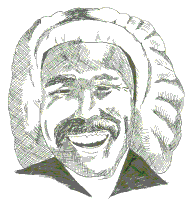
The only known pencil sketch of Gibbs drawn from life by noted artist Vermeer Wildercollie (from the collection of Mr. Keith Kitchin)