
The following brief excerpt was adapted (notably changing "he" to "she")
from the chapter on the Bodhisattva Regarder of the Cries of the World,
in the W. E. Soothill translation of The Lotus Sutra (The Lotus of the
Wonderful Law, published by Curzon Press):
Praise To Kwan-Shih-Yin Bodhisattva
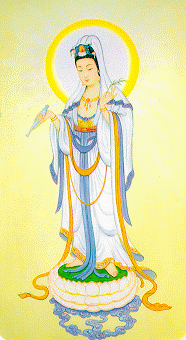
Kwan Yin Bodhisattva's compassion for all beings is so vast and inconceivable,
our gratitude cannot comprehend nor fully express the magnitude of her
blessings. Her body and garments of brilliant, translucent White Light.
Her adornments, a white vase of Compassionate Water in her left hand, The
Sacred Willow Branch in her right hand.
Enlightened through infinite acts of compassion countless lifetimes
ago. Her feet rest upon a fragrant red lotus flower above a vast ocean.
Her brows curved and radiant like the crescent of an autumn moon. With
the sweet dew drops she sprinkles from her vase, She relieves the suffering
of beings everywhere and always, for countless autumns.
Prayers for help arise from thousands of hearts, and thousands of prayers
are answered by her vow of eternal compassion: Beings in Samsara, who sail
the ocean of suffering, She will guide and deliver safely to the ultimate
shore of enlightenment.
Six Character Great Bright Mantra 

Significance of OM, MA, NI, PAD, ME, HUM
OM
Go for refuge to the Buddha
Produce the aspiring enlightened mind.
Perfection of Generosity
Guard the vows of an auditor
Purify physical obscurations
Overcome the god demon
Cure the sickness of bad accumulation
Pacify all defilemnts
The Dharmadhatu wisdom arises
Freedom from the god's suffering of death and rebirth
Union of all the Buddha families, Mahakarunika, and Consort Sadaksari
Obtain the state of Sarva-dakini
Obtain the Dharma Body
MA
Go for refuge to the Dharma
Produce the engaging enlightened mind
Perfection of Moral Conduct
Guard the vows of a bodhisattva
Purify vocal obscurations
Overcome the female demoness
Cure fever
Defeat nescience
The mirror wisdom arises
Freedom from the jealous gods' suffering of fighting
Buddha Vairocana and Consort Buddhalocana
Obtain the state of Buddha-dakini
Obtain the Enjoyment Body
NI
Go for refuge to the Sangha
Produce the non-dual enlightened mind
Perfection of Patience
Guard the vows of fasting
Purify mental obscurations
Overcome the rgyal-gong demon
Cure wind diseases
Defeat anger
The equanimity wisdom arises
Freedom from the human suffering of change
Vajrasattva and Consort Samantabhadri
Obtain the state of Vajra-dakini
Obtain the Emanation Body
PAD
Go for refuge to the Guru
Produce the natural enlightened mind
Perfection of enthusiasm
Guard the vows of the layperson
Purify the obscurations of defilement
Overcome the local deity/naga demon
Cure mucous disease
Defeat pride
Discriminating wisdom arises
Freedom from the animals' suffering of service
Ratnasambhava and Consort Manaki
Obtain the state of Ratna-dakini
Obtain the Essence Body
ME
Go for refuge to the Yidam
Produce the wisdom enlightened mind
Perfection of Meditation
Guard the vows of celibacy
Purify the obscurations of the traces
Overcome Mara and the Lord of Death
Cure arthritis
Eliminate desire
All-accomplishing wisdom arises
Freedom from the hungry ghosts' suffering of hunger and thirst
Buddha Amitabha and Consort Pandara-vasini
Obtain the state of Padma-dakini
Obtain the Enlightened Body
HUM
Go for refuge to the Dakinis
Produce the ultimate enlightened mind
Perfection of Discriminating Insight
Guard the tantric vows of a Knowledge Holder
Purify the obscurations to knowledge
Overcome the Raksa and Rahula demons
Cure bilious disease
Eliminate jealousy
Inherent wisdom arises
Freedom from the hell sufferings of hot and cold
Buddha Amoghasiddhi and Consort Samaya-tara
Obtain the state of the Karma-dakini
Obtain the unchanging Vajra-like Body
Benefits of Reciting OM MANI PADME HUM
by Lama Zopa Rinpoche
The benefits of reciting OM MANI PADME HUM are like the infinite sky. Depending on how perfectly qualified one’s mind is and on one’s motivation, even reciting OM MANI PADME HUM one time can purify negative karma. For example, a fully ordained monk who has received all four defeats can completely purify that very heavy negative karma by reciting OM MANI PADME HUM one time. So it is very powerful.
Reciting One Thousand Mantras Each Day
In the teachings it is said the benefits of reciting OM MANI PADME HUM are so many that the explanation will never finish. It is explained that if one recites OM MANI PADME HUM one thousand times every day, then one’s children up to seven generations will not be reborn in the lower realms. So if, for example, parents recite one thousand mantras every day then their children, their children’s children and so forth up to seven generations will never be reborn in the lower realms. So parents have quite a responsibility! This is one way that parents can benefit their children and grandchildren.
If one recites the OM MANI PADME HUM mantra one thousand times every day, then one’s body becomes blessed. So when a person who recites one thousand OM MANI PADME HUM every day goes into water, into a river or ocean for example, that water becomes blessed. Whoever that water touches fish, tiny or big animals, or tiny insects, the negative karma of all those sentient beings is purified and they do not get reborn in the lower realms.
If one recites one thousand OM MANI PADME HUM every day, then at the
time of death, when the body is burnt, even the smoke that comes from it
purifies the negative karma of whoever it touches or whoever smells it.
The negative karma of those sentient beings to be reborn in the lower realms
is purified.
Fifteen Major Benefits
There are fifteen major benefits, which are the same for both the long and the short mantra. Actually, there are so many benefits but if one can remember these fifteen, these are the most important, the integrated outlines.
1.In all lifetimes, one will meet with virtuous kings - religious kings like His Holiness the Dalai Lama and other virtuous leaders - and by being in such a place where there is a virtuous king one will have much opportunity to practise Dharma.
2.One will always be reborn in virtuous places where there is a lot
of Dharma practice, where there are lots of temples, where one can make
lots of offerings, where there a lot of holy objects, statues, stupas and
so forth. Being in a place where there are all these holy objects gives
one the opportunity to practise Dharma, to create the cause of happiness,
to accumulate merit. And being in a place where there are many in the city
doing practice inspires oneself to practise Dharma, the cause of happiness.
3.One will always meet with fortunate times and good conditions, which
will help your Dharma practice. Having many good things happen it inspires
you to practise Dharma, to receive teachings and to meditate.
4.One will always be able to meet with virtuous friends.
5.One will always receive a perfect human body.
6.One’s mind will become familiar with the path, with virtue.
7.One will not allow one’s vows, one’s morality to degenerate.
8.People around you - family, Dharma students, people in the office, and so one - will be kind and harmonious with you.
9.You will always have wealth, the means of living.
10.You will always be protected and served by others.
11.Your wealth will not be stolen or taken away by others.
12.Whatever you wish will succeed.
13.You will always be protected by virtuous nagas and devas.
14.In all lifetimes, you will see Buddha and be able to hear the Dharma.
15.By listening to the pure Dharma, you will be able to actualise the profound meaning, emptiness.
It is said in the teachings that anybody who recites this mantra with compassion - devas or humans - will receive these virtues. In addition, the mantra has the power to heal many diseases and to protect from any harms.
The Compassionate Buddha manifesting in the form of the mantra leads us to enlightenment. In relation to the Holy Body of the Compassionate Buddha we make offerings, accumulate merit, purify and meditate. Then the Compassionate Buddha manifests in the form of the mantra OM MANI PADME HUM. Reciting this mantra unifies our negative karma and causes us to actualise the whole path from guru devotion through renunciation, bodhicitta, and emptiness up to the two stages of tantra. Then we are able to bring all sentient beings to enlightenment. That is how the mantra benefits us. It is the Compassionate Buddha’s holy speech manifesting in an external way in order to benefit us.

The
Sanctuary