Geo 4041 Geography Project of Hong
Kong
The major reason of Internet
Banking Usage is the high Accessibility it offers.
Instructor
: Prof. Yee Leung
Student
Name : Leung
Chuk Kwan
Student
I.D. : 98518901
Date
of submission: 19
May, 2001

Table of Content
[ Abstract
] [ Introduction ] [ Literature
Review ]
[ Research
Design ] [ Result & Implication ] [ Significance ] [ Conclusion
]
[ Reference
] [ Appendices ]
This paper is
going to discuss about whether the major factor affecting internet banking
usage is the high accessibility with timeless and spaciousless feature, in
terms of B2C, that is, the mode of “business to customers”.
B2C mode of
trading is the “Business
to Customer”
mode of trading, which aimed at provide highly customized services to
individual customers, it becomes more important in Internet Banking. Importance
of branches might reduce relatively, as people can use Internet Banking
conveniently. Convenience should be a complex of product time utility, consumer
tracking technology, information richness… … etc. Among all, the most
highlighted feature is the timeless and spaciousless interface, of which
Internet Banking can explore a larger market and provides various services.
The research is
limited at the B2C mode of trading, and it is going to carry out along with
questionnaires, with which the design is based on the Technology Acceptance
Model (TAM). The population is all the individual account holders, and the
frame is the Internet Banking users and the branch goers who are aged between
16 and 50. The questionnaire has posted on the writer’s personal homepage, sent
to the staff of online@hsbc, networkers through email and icq, and conduct a
field survey with the branch goers.
It locates the
major reason for Internet Banking Usage, and the reason why people are not
willing to use Internet Banking despite the global trend, and suggests the
futurism of such business. Only when people are confident enough with the
security of Internet Banking would be more widely accepted.
Internet banking
is introduced with the belief that it would progressively attract more
customers than traditional banks, because of its convenience and highly
personalized interface. According to Mary J, “the primary rationale for
banking on the web is the convenience of anytime anywhere access” (Mary J. ed, 1997).
Furthermore, it is the much more cost-effective the running a traditional
branch. In this paper, it is going to examine whether the major reason of
Internet Banking usage is the high accessibility with timeless and spaciousless
interface. The research is limited to B2C mode, that is the mode of “Business to Customers”. It is aimed to serve
individual customer specifically with a highly customized service. B2B is
another term stands for “Business to Business” mode of trading, in the case of bankers, it refers to the
business account holders, business loans or other services for business.
Another term I
would like to define is the “Internet Banking”. It is not the same as virtual banking or PC banking. The former
one is a collective noun including ATM, phone-banking, PC banking and Internet
Banking. PC banking requires customers to install a specific banking software
application to perform the banking function, (Liao. S, et al, 1999), thus the
function is supposed to operate with only one specific computer. However,
Internet Banking requires customers to connect through the World Wide Web, with
the ubiquitous browser, based access, offered a completely different delivery
model for banking, one in which customers could tap into their accounts from
home, office, dorm room, hotel, library, or cafe to conduct transactions at any
hour. (Kim Humphreys, 2000).
Internet has
influenced most of the industries in this informative era, the most
advantageous feature of Internet is the timeless and spaciousles platform, in
case that all customers register for an online account, they can manage their
finance according to their own time schedule. Attraction to customers includes
accessibility, privacy, personalization, alliance services, product time
utility, convenience, consumer tracking technology, information richness.
(Leung Bun, 2000)
Varieties of
products are equivalent to those offered in branches. Apart from the viewing
account information, customers can make transfer, remittance, buy or sell
shares, pay bills and place time deposit orders online, other products like
credit cards, loans, insurance, MPF, investment, foreign currencies, their
information can easily be access through the internet and they are able to submit
online. (張子強, 2001)
If any problem
exists during the navigation of the homepage, effective customer services is
offered on the Internet by the help content, also a 24-hour hotline is
available for inquires. All written inquiries by email would be handled within
24-hour, phone-in inquiries would be answered immediately. Most of the
inquiries and problems can be settled no more than two days. (online@HSBC)
Because of the
automatic operation of the computer systems, no manual interruption is involve,
processing of data and pending time of transaction is ore efficient than
before. The quick response is the essence in the trading market.
With the support
of most advanced technologies, much faster response is allowed in investment by
the AMS/3, identity verification becomes possible by identification technology,
which make online banking services more promising. Other related technologies
like firewall, security system are also advancing day by day, and would help in
development of Internet banking.
The above features
are all around-the-clock. Distance constrains is no longer exists as long as
customers could have Internet connection, they can manage their account
information as well as their own finance online.
This paper would
first make a brief description of the recent researches of internet banking and
its related topics in Hong Kong, and to review the development of online@hsbc.
Secondly, it is going to introduce the research design which is based on a
Technology Acceptance Model (TAM), the hypotheses, methodology of data
collection, data types and analysis method. A conclusion can be draw with the
help from the questionnaire result, other primary resource and secondary
resources. Lastly, there is a reference list, and appendices that include the
questionnaires, the model structure of TAM and the timetable of this research.
Up to April 1999,
there are already 167 licensed banks in HK completing for the market share
(Financial service Bureau, 1999). In order to success, banks must find ways to
reach customers and deliver the financial service to them in a convenient way.
With year end Y2K computer fears now out of the way, banks are free to innovate
with new internet product and services and can catch up with latest
development. (Anonymous, 13 Apr 2000)
Europe is the
earliest one to develop Internet Banking business and now is flourishing,
quoted by the American Banker Magazine. The first adopters are beginning to see
glimmers of profit ability from their online offerings. The world’s first purely online
banking is the Security First Network Bank (SFNB), which is established on18
October 1995. (E世代新樂園 )SFNB, NetB@nk, Eggbank in
America has also established their online financial. It is predicted that the
growth of online banking in Europe will be enhanced by the use of third
generation mobile networks and WAP enabled mobile handsets of which there
should be about 300 million in use by 2022, (Power et al, 23 Apr 2000).
Internet Banking
is gaining popularity in the Asia-Pacific region, Australia and New Zealand
became the leading ones. But in Asia, Singapore was the first to invest in its
online financial market, according to VISA International, that many
transnational companies have originated their local online business in
Singapore as a pilot strategy. There are existing 6 Internet Banks including
Standard Chartered Bank and Citibank (Webb, Sara, 12 Apr 2000)
However, in Hong
Kong, Internet Banking was just in the infantile age. HSBC group has developed
the HSBC.com in 2000 and partnered with IBM in order to produce an Interactive
Financial System (IFS), which is the interface for e-commence, and it is able
to handle 100 billion transactions every year. The Standard Chartered Bank was
the first local provides foreign currencies investment. Citibank as well as
other local banks have also provides online channels for the customers. Most of
them provides similar functions just like account queries, foreign currencies,
securities, and online-submit applications for other products, furthermore,
some of them may integrate with shopping site or other functional site, in
order to provide a one-stop service. (劉金寶著)
Although there is
little research discussing user’s acceptance towards Internet Banking, basing on past
researches, a model TAM can be used to study the factors affecting internet
banking usage. TAM refers to the Technical Acceptance Model, which is a model
consisting of a number of factors, which are hypothesed to have significant
relationship with Internet Banking usage. TAM has raised the concept of
perceived ease of use (PEOU) and perceived usefulness (PU), both of them
consists of a number of attributes that influence people’s acceptance towards
certain kind of technology. (Leung Bun et al, 2000) Moreover, some literatures
have also provided the ground for hypothesizing the existence of significant
relationship between certain variable and PU of Internet banking usage.
Take Online@hsbc
as an example, it has taken subscriptions for offerings on both the main and
Growth Enterprise Market (GEM) boards, and has extended its service to the
public in Hong Kong, Online@hsbc has gained more than 100 000 customers since
the initial launch in August 2000. In just over four months, over a third of
all the bank’s
stock trading volume in Hong Kong now goes through the online channel. It is
claimed that the population is potentially rising. (online@hsbc, 12b Sep 2000)
The company has
drawn a statistical report posted on its website. The most frequent transaction
inquiries are statement inquires investment inquiries and balance inquiries.
Customers whose ages between 30to 50 account for 66% of the total number of
online users. Working class accounts for 74% in the customer profile. Usage
peaks are at lunchtime and just before the HKSE closes, but there still a
certain number of customers after 20:00 and during the trough at 03:00 to
07:00. (online@hsbc, 12a Sep 2000)
The research is
constructed with the help of questionnaire.
The population is individual account holders in local banks. The frame would
then be the Internet Banking users and the branch goers who aged between 16 and
50. Therefore it is going to invite networkers to finish it via email and icq,
also interview with the branch goers will be carry out.
The questionnaire
design is based on the variables of PEOU and PU that raised by TAM. Those
variables include task ambiguity, information richness, accessibility, privacy,
personalization alliance services, would contribute to PU and PEOU, in turn,
affects the attitude towards use of technology.
It is going to
find out whether accessibility is the major factor affecting Internet Banking
usage. The questions and the corresponding attributes are listed below:
- The recent satisfaction level. Question 1 and 2 asked about the
satisfaction level for the banking services that they normally
encountered.
- Information Richness. Question 3 to 5 asked about the
information it offers.
- Accessibility. Question 6 and 8 asked whether
Internet banking really creates a timeless and spaciousless platform, and
the ease they can access to the web site.
- Personalization. Question 9 to 11 asked whether they
can customize the interface in terms of content and presentation.
- Privacy. Question 12 to 14 asked how secure
they feel and the level of protectiveness they were using Internet
Banking.
- Alliance services. Question 15 to 17 asked whether
the web site can direct other services to them and provides one-stop
service.
- Task ambiguity. Question 18 and 20 asked about the
task ambiguity about banking services they normally encountered and using
Internet Banking.
- Ease of use and usefulness. Question 21 and 24 asked directly
whether they feel easy and useful respectively in using Internet Banking.
- Task-tech fit. Question 22 and 23 asked about the
task ambiguity and information richness in order to determine the task-tech
fit.
- Perceived satisfactory level. Question 25 asked about the
perceived satisfactory level about Internet Banking.
From question 3 to
Question 20, 3 questions as a group to test one attribute, with the third one
an overall review of the attribute. At the last of the questionnaire,
comparison of Internet Banking and other remote banking services is being
asked.
This project is
going to find out whether the highly accessibility of Internet is the most
attractive point for people to use Internet Banking. Thus hypothesis testing is
used as below:
H1:
Task ambiguity is the same for using Internet Banking and Branch.
H2:
Information Richness is the same for using Internet Banking and Branch.
H3:
Accessibility is the same for using Internet Banking and Branch.
H4:
Privacy is the same for using Internet Banking and Branch.
H5:
Personalization is the same for using Internet Banking and Branch.
H6:
Alliance Service is the same for using Internet Banking and Branch.
Chi-sq test and
K-S test is used in testing the hypothese. However, only the differences from
the theoretical frequencies can be shown from the testing result, the
tendencies can be drawn from the distribution. Apart from the testing result,
personal experiences from the part time job in online@HSBC and being a user of
online@HSBC would also be used as primary resource.
Apart from the
primary resources, there are a number of secondary resources include newspaper
cutting, consultant report and statistical data downloaded from the web sites
of some famous banks. Citibank, for it is the first local bank to introduce the
idea of Internet Banking. Hong Kong and Shanghai Bank Corporation, for it is
the first local bank to introduce the idea of PC banking. Hang Seng Bank, for
its Internet Banking service was said to be the best Internet Banking services
in Hong Kong by the Next Magazine.
Questionnaire
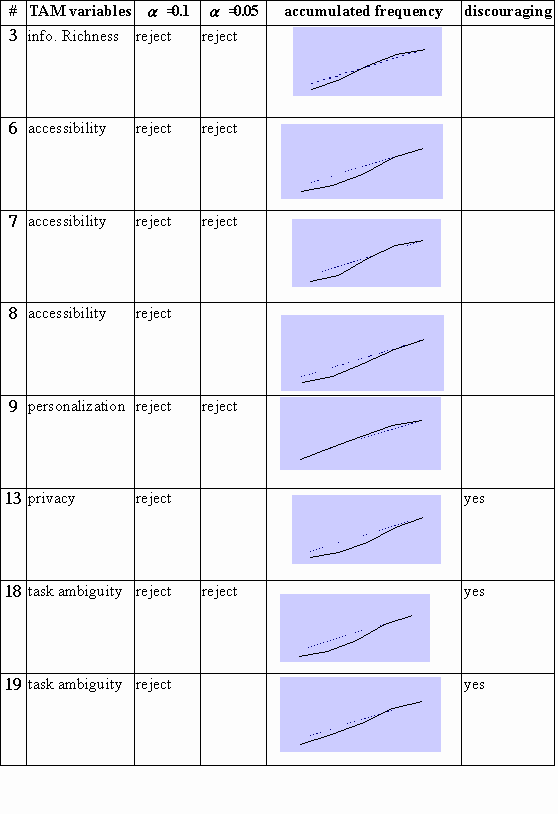
result has gone through the K-S test, at the significance level 0.1 and 0.05. Only
a few questions have differences between the observed frequencies and the
expected frequencies. Question 3, 6, 7, 9, 18 rejected H0 at both
0.1 and 0.05 confidence level, question 8, 13 and 19 rejected H0
only at 0.1 confidence level.
Question
3 refers
to Information Richness, Question 6, 7, 8 refer to Accessibility, Question 9
refers to Personalization, Question 13 refers to Privacy, Question 18, 19
refers to Task Ambiguity. However, the tests can only show whether there is
difference but the preferences can be seen from the distribution. The testing
result can be refered to the Appendix
2.
For Question 3, 7
strongly disagree, 25 disagree, 34 no comment, 25 disagree and 27 disagree,
showing an inverted U-curve, reflecting that most people have no idea about the
information richness it can offer.
For Question 6, 7
strongly disagree, 16 disagree, 26 no comment, 38 agree and 28 strongly agree,
revealing that most people agreed that there is no limitation about the
interface.
For Question 7, 6
strongly disagree, 15 disagree, 41 no comment, 33 agree and 12 strongly agree,
showing a sharp increase from disagree to no comment, and a sharp decrease to
strongly agree. Though most people have no idea about the using time, the
number of people with positive attitude is greater than the number of people
who have negative attitude. They generally agree that there is no time
limitation using Internet Banking.
For Question 8, 8
strongly disagree, 14 disagree, 30 no comment, 33 agree and 22 strongly agree,
showing a gently ascending curve, with more people agree that Internet Banking
can be used anywhere.
For Question 9, 17
strongly disagree, 27 disagree, 27 no comment, 24 agree and 12 strongly agree,
showing a slight inverted U-curve. It is quite evenly distributed for people do
not have a clear preference on the flexibility of the presentation of
information.
For Question 13, 8
strongly disagree, 11 disagree, 26 no comment, 37 agree and 25 strongly agree,
showing a sharp increase from strongly disagree to agree, and numerous people
choose strongly agree. Reflects that people do believe that the bank would
monitor their usage of the Internet Banking services.
For Question 18, 6
strongly disagree, 14 disagree, 27 no comment, 38 agree and 22 strongly agree,
showing a sharp increase, most people feel it is easy to use Internet Banking
service.
For Question 19, 8
strongly disagree, 23 disagree, 26 no comment, 34 agree and 16 strongly agree,
most people think that they have good enough knowledge about the Internet
Banking service.
There are questions in nominal
scales. By applying a Chi Sq.
test, it is found that only the satisfaction about interesting is the
same as the expected frequency and fail to reject the H0.
Satisfactions about security, convenience, interactiveness obtained significant
differences with the expected frequency. From the distribution, 74 out of 87
people felt that security problem do exists with the Internet Banking services.
55 felt that using Internet Banking is convenience than using other remote
Banking services. 54 felt that Internet Banking is more interactive than using
other remote Banking services. It reflects that most people agree with the
convenience the Internet Banking can offer.
The number of
people using Internet Banking accounts for 17% of the total population that
have using Internet services. (顧壽康撰, 9 Feb 2001) According to
a consultancy agent AC Nelson, the major discouraging reasons for Internet
Banking usage, are the insufficiency of computer knowledge and equipment (51%),
difficulties in learning how to use (26%), and privacy and security (23%). The
result counter-proved that the task ambiguity and privacy is not the reason for
Internet Banking usage. Therefore, these two variables are not discussed.
Overlaying the questionnaire result and the statistic report from AC Nelson,
the variables of information richness, accessibility and personalization
remain.
An official
statistical report released on the web site of HSBC at Feb 2001 (online@HSBC),
showed that investment count the largest of daily transaction volume and that
the usage peaks are at lunchtime and just before the HKSE closes. It is obvious
that people would like to have quick response in making investment decision, as
the market changes very quickly.
Therefore, an
assumption that the main reason for Internet Banking usage for most people is
the accessibility, i.e. the quick response and limitation free interface, it
can offers.
In order to prove
the assumption, an interview with Miss Hon, one of the respondents of the
questionnaire, has been made.
It is found that not
many people would like to use Internet Banking because of the computer
knowledge and privacy. And the major reason for Internet Banking usage is the
accessibility and convenience. The finding has left different opportunities for
further research.
In order to
familiarize the public with the industry, and to enlarge the market of Internet
Banking, a number of measures can be done. The immaturity is caused by the lack
of computer knowledge and sense of security. However, computer knowledge would
gradually decrease as the latest generation would get in touch with computer
very frequently and their knowledge would be definitely much better than the
recent generation. On the other hand, technology is advancing very quickly that
security problem would properly overcome within these few years. However, when
Internetization gradually becomes mature globally, this no longer a problem. It
needs time for improvement.
There are also a
number of humanistic factors causing the immaturity. Habitual behavior of going
to branches and make transaction, the service attitude of customer service
officers is the obvious ones. Ongoing and continuous improving of Internet
Banking would attract more customers. In the case, marketing strategies help
much but this is not the theme of this research, therefore, this is not going
to be discussed and should be left to the Business student for further
research.
One the other
hand, there are a number of ways to encourage people using Internet Banking, in
terms of Geography, construction of optical fibers network and broadband
network in planning residential zones would increase the opportunities for
people to use computers. Construction of digital port, which is a clustering of
severs and is able to process a large volume of data, has been a hit topic in
the real estate and property last year when there is a digital rush. It is
claimed that digital port would help the economies of Hong Kong. In fact, the
determination of the location of the digital port is also a geographical
problem.
When the WAP phone
is more common, there would be an increasing number of people using it for
networking. Therefore establishing terminators of the WAP should also be a
geographical problem, whereas the decision of location should meet certain
geographical criteria, that the GIS system would help in determining the best
location.
There is another
issue in economic geography. With the existing bank policies, reducing
operation cost by reduce number of branches and staff, encourage people to use
other remote banking services such as ATM machines, phone banking as well as
Internet Banking. Obviously, they are undergo a transitory stage, take
online@HSBC as an example, it would gradually shift their operation interface
to the backyard area--Guangzhou. The policy has been discussed on the radio
program.
When the number of
branch being reduced, the remaining branches and the main building become more
important. It should be able to process a large volume of transaction everyday,
the environment, facilities and associated infrastructure, which are the
criteria for the type A office in the planning guideline.
Despite the global
trend, there is still limited number of internet banking user. This might be a
combine effect of traditional close-minded thinking, economic recession just
after 1997, and the immature computer knowledge level.
However,
internetization of banking is the global trend, which would definitely be the
way of banking industry in the future. The timeless and spaciousless channel is
always been emphasized, thus this paper is going to examine whether internet
provides a timeless and spaciousless platform for people in terms of B2C, and
whether it is the major reason for people to use internet banking.
- William D. Pattison (1990). The 4 traditions of
geography. The Journal of Geography. No 5, 202-206
- 張子強撰 (2001),網路銀行不打烊 跑三點半快成歷史,[online]. Available:
http://www.ibank.uot.com.tw
- 顧壽康撰,港網銀用戶劇增九倍,二零零一年二月九日,太陽報
- 王永 ,第三條創業道路,二零零零年三月二十一日,信報
- 林萬興,網上銀行將推融資現曙光,二零零零年三月二十八日,香港經濟日報
- 澳四大銀行聯手拓網,二零零一年一月十三日,太陽報
- 穆烈著 (1997), 電訊政策及數碼匯流; 香港經濟研究中心, 香港經濟政策研究會議, 香港 : 商務印書館(香港)有限公司.
- 劉金寶主編 (2000),互聯網與銀行電子化,香港:香港文匯出版社有限公司
- E世代新樂園, [online]. Available: http://www.wintel.com.tw/octactivity/wintel/bank_1.html
- Stanley D. Brunn ed. (1991) Collapsing space and time:
geographic aspects of communications and information. London :
HarperCollinsAcademic.
- Hong Kong's Potential for Internet
Development,
[online]. Available: http://www.hkbea-cyberbanking.com/
- http://www.national.com.au
- “Asia’s Markets: Emerging or Submerging?” [online]. Available:
http://www.asiapacific.hsbc.com/ap/about/speech/23feb99.htm
- HSBC Launches Online IPO Service [online]. Available: http://www.hsbc.com.hk/hk/about
/press/archive/00sep12b.htm
- HSBC Opens Online@HSBC to the Public [online]. Available:
http://www.hsbc.com.hk/hk/aobut /press/00Dec12a.htm
- Chan Chi Chuen et al. Adoption of internet banking in
Hong Kong. Chinese University of Hong Kong. Graduate School Division of
Administration.
- Mary J. Cronin, ed (1997). Banking and finance on the
Internet. New York: Van Nostrand Reinhold.
- Leung Bun et al (2000). An integrated model for
internet banking acceptance. Chinese University of Hong Kong. Graduate
School Division of Administration.
- Chan Wing Fung (1997). Internet banking in Hong Kong. Hong
Kong: Chinese University of Hong Kong.
- Marilyn L. Seymann, ed (1998). Managing the new bank
technology: an executive blueprint for the future. Chicago: Glenglake:
Fitzroy Dearborn.
- Anonymous, “with
Year-end Y2K computer fears No Out of theWay, Banks are free… …”, 13 Apr 2000, SCMP
- Power et al, “European
Banks say they’ll show Web profit”, 23 Mar 2000, American Banker, New
York, p.1
- Webb, Sara, “Asia:
online venture raises OUB profile among Asian Banks- Analysis say effort
Volsters case for owning its stock”, 12 Apr 2000, The Wall Street
Journal Europe, p.9
- Liao, S. et al, “The Adoption of Virtual Banking: An
Empirical Study”, Feb 1999, Internation Journal of
Information Management, p.63-74
- Financial Service Bureau, 2000 [online]. Available:
http://www.info.gov/fsb/content.htm
Appendix 1-Time table
October _ December
2000
Literature Review
January 2001 Pilot
Study
Feburary 2001 Data
Collection
March - April 2001 Data
Analysis and Interpretation
May 2001 Presentation
and Written Report
Appendix
2-Figure 2 Chi sq Test [back]
Appendix
3-Questionnaire [back]
the
attitude toward Internet Banking in Hong Kong
In the light of
the range of banking tasks (e.g. bank account enquiry, bank account transfer,
securities trading, purchase of insurance, mortgage
arrangement …) you normally perform:
1.There is a clearly
known way to do banking tasks I normally encounter.
strongly disagree disagree no comment agree strongly agree
2.I can rely on
established practices to do banking tasks I normally encounter.
strongly disagree disagree no comment agree strongly agree
3.Internet Banking
allows me to give and receive timely feedback.
strongly disagree disagree no comment agree strongly agree
3.Internet Banking
provides information in an interactive manner.
strongly disagree disagree no comment agree strongly agree
4.Internet Banking
provides in the information a variety of different cues such as emotional
tones, attitude, or formality.
strongly disagree disagree no comment agree strongly agree
To what extent do
you agree with the following statement:
5.I can find
physical Internet connection easily.
strongly disagree disagree no comment agree strongly agree
6.Basically, I
find the interface is of no limit in terms of time and distance.
strongly disagree disagree no comment agree strongly agree
7.I find the
amount of time spent in waiting reasonable during using Internet Banking.
strongly disagree disagree no comment agree strongly agree
8.I can use
Internet Banking at anytime of a day.
strongly disagree disagree no comment agree strongly agree
9.I can use
Internet Banking at anywhere in the world.
strongly disagree disagree no comment agree strongly agree
10.Internet
Banking enables me to customize the presentation of information on a bank's Web
site according to my personal needs.
strongly disagree disagree no comment agree strongly agree
11.Internet
Banking enables a bank to deliver personalized messages to me (e.g. via email).
strongly disagree disagree no comment agree strongly agree
12.Internet
Banking enables a bank to record my access duration to the bank's Web site.
strongly disagree disagree no comment agree strongly agree
13.Internet
Banking enables a bank to learn my banking behaviors after recording my access
duration and pattern.
strongly disagree disagree no comment agree strongly agree
14.I find my
personal information under sufficient protection in using Internet Banking.
strongly disagree disagree no comment agree strongly agree
15.By visiting a
bank's Web's site, I can find information from third parties other than the bank.
strongly disagree disagree no comment agree strongly agree
16.By system
integration with other parties via Internet, banks can provide to me integrated
services, which are traditionally offered by separate organizations.
strongly disagree disagree no comment agree strongly agree
17.By system
integration with other parties via Internet, bank can provide expanded services
to me.
strongly disagree disagree no comment agree strongly agree
18.Learning to use
Internet Banking is easy for me.
strongly disagree disagree no comment agree strongly agree
19.I know all the
banking service that can be access through Internet.
strongly disagree disagree no comment agree strongly agree
20.I find it easy
to use Internet Banking to accomplish my banking tasks.
strongly disagree disagree no comment agree strongly agree
21.Overall, I
believe Internet Banking is easy to use.
strongly disagree disagree no comment agree strongly agree
22.I can
accomplish my banking tasks more quickly using Internet Banking.
strongly disagree disagree no comment agree strongly agree
23.Internet
Banking enables me to make better decisions in utilizing banking services.
strongly disagree disagree no comment agree strongly agree
24.Overall, I find
Internet Banking useful.
strongly disagree disagree no comment agree strongly agree
25.In my opinion,
it is desirable to use Internet Banking.
strongly disagree disagree no comment agree strongly agree
Personal
information:
1.Gender: Male /
Female
2.Age:
3.Work Experience:
4.Income:
5.Occupation:
6.Are you
currently using Internet Banking services? Y/ N
7.Are you
currently using any other remote banking service such as phone banking? Y/N
8.Compare to all other
remote banking service (e.g. phone banking, home banking … ):
|
I find that
Internet banking is |
Yes |
No |
|
More secure |
|
|
|
More convenient |
|
|
|
More personalize |
|
|
|
More informative |
|
|
|
High task
ambiguity |
|
|
|
More alliance
services |
|
|
~the end~