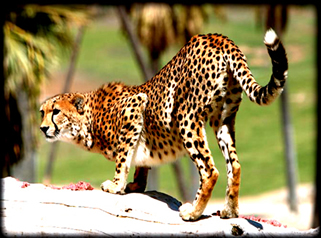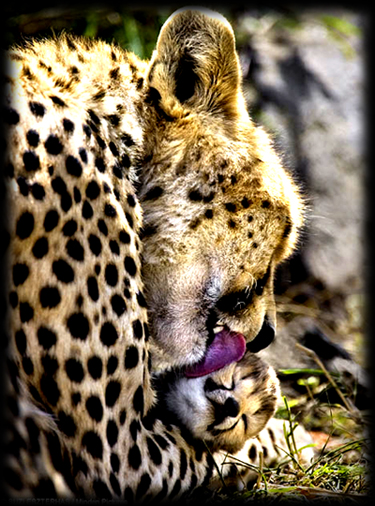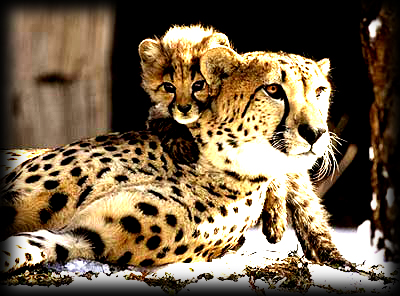
The Cheetah's name comes from the Sanskrit word "chita" meaning "spotted one". A cheetah has a long streamlined body, flexible spine, long legs, a long tail that acts as a rudder, an enlarged heart, large lungs and semi retractable blunt claws which aid the cats traction and turning ability at high speed. Its eyes are physically adapted for speed, enabling it to spot distant prey and follow it with pinpoint precision before racing in to kill. The cheetah has a small rounded head with a delicate skull and jaw compared with the lion and leopard. Distinctive black stripes extend from the inner corners of the eyes to the mouth. Its coat is pale tan to a tawny gold with beautifully spotted round black markings of fairly uniform size. Demand for their skins is one of the reasons they have disappeared from much of their historical range. The coat is somewhat coarse, with hair slightly longer at the nape, forming a short mane. A cheetah weighs between 88-143 pounds (39-65 kg). Its head and body together measure 44 to 53 inches (112-135 cm). The tail is 26 to 33 inches (66-84 cm). Males tend to be slightly larger than females.
|
|
|---|---|
|
Cheetahs thrive in areas with vast expanses of land where prey is abundant. In Namibia cheetahs have been found in a variety of habitats, including grasslands, savannahs, dense vegetation, and mountainous terrain. Ninety-five percent of the Namibian population lives on commercial farms. The Cheetah prefers to live in open grasslands, savannas, dense vegetation, and sometimes even mountainous terrain. The open land of grasslands and semi-desert better accommodates the Cheetahs way of hunting, which is running as opposed to the stalk and pounce method. Namibia is home to the largest population of Cheetah at about 2,500 cats. Due to the continuous growth of farmland and expanding development 95% of the Namibian Cheetah live on cultivated farmland. The Cheetah was once widely distributed throughout Africa, the Arabian Peninsula, Asia Minor, and even East of India. Fossils were recorded to be found from China, Northern India, Southern Europe, and as far as the Western United States. Sadly now the species is burning out and can be found sparsely scattered amongst Namibia, Kenya, Asia, as well as a handful of other small countries.
|
|
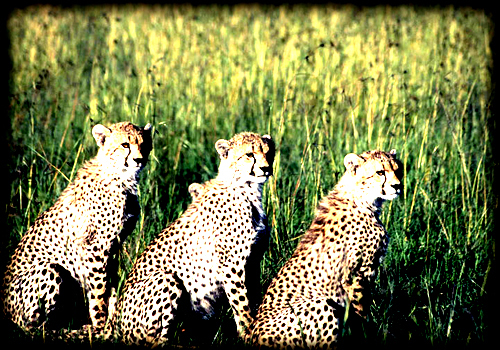
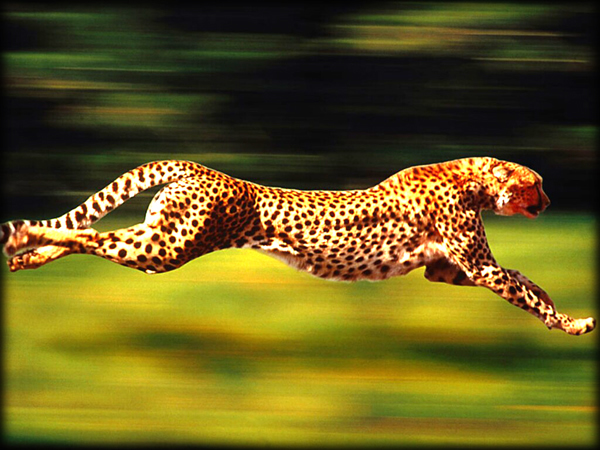
The Cheetah is the fastest land animal, reaching a top speed of 70 mph! The Cheetah however can only run for short sprints of up to 300 yards. These sprints will usually last for 20 seconds, but rarely ever reach a full minute. Non-retractable claws and tough pads on their feet closely resemble that of a dog. These features offer better traction to get to those high speeds. A long heavy tail acts as a rudder for making those sharp turns while in pursuit. The Cheetah's long fluid body is set over extremely light bones, this accompanied with large nasal passages, and oversized lungs, liver, heart and adrenals enable rapid physical response. This response is imperative to accommodate the Cheetah's way of hunting. A strong spring-like spine gives added reach to the Cheetah's long legs. A stride is the measured distance between successive imprints of the same paw. With the added reach given by the spine 1 stride can stretch as far as 7-8 meters. The Cheetah averages 4 strides per second or 1 stride per .28 seconds as the horse averages 1 stride per.44 seconds and can reach top speeds of 43 mph. The Cheetah can out run the horse going from 0-45 mph in 2 seconds flat, though this will not very last very long. The horse would inevitably win in the long run. Cheetahs are equipped with several special features that are crucial in successful and efficient hunting. Binocular vision is a very important asset since Cheetahs rely on sight to hunt as opposed to scent. The retinal fovea of the eye is of an elongated shape, giving a sharp wide-angle view. This aspect of the eye is also adapted for speed. The dark "tear marks" on the Cheetahs face reduce glare from the bright sun also and aid in excellent vision. The Cheetahs will perch upon a fallen tree or rocky ledge to scope out the surroundings and potential prey. The Cheetah is also a very vocal animal. With the ability to mimic the calls of some birds, by displaying a high pitched chirping sound. When a bird falls for this deceiving call it will also fall prey to the sly Cheetah. The Cheetah is a carnivorous animal and a diurnal hunter, which means it hunts during the day usually early morning and late afternoon. Cheetahs are solitary hunters except when living in a coalition. When this is the case they will hunt in groups so that they can take down larger prey. Unlike the common misconception, the Cheetah will pick out animals that have strayed from the herd as a target, not necessarily the weak or old. After chasing down and catching the prey, the Cheetah suffocates larger animals with a bite to the jugular and holding for as long as 15-25 minutes. Smaller animals are killed with a quick bite to the head usually killing them instantly. By this time the Cheetah is so tired from the chase that it must wait for as long as a half hour before consuming its meal, and could not fend off other predators, who might want to steal the Cheetah's dinner. The Cheetah's resting heart rate is approximately 120-170 beats per minute, while it's heart rate after a chase is 200-250 beats per minute. The Cheetah's resting breaths vary from 20-30 per minute depending on whether the Cheetah is in direct sunlight or in the shade, after a chase the Cheetah's breaths per minute are 150-200! When done resting the Cheetah will quickly eat, as they can not defend their food from other predators for this reason they will not bury the food and come back for another meal. Half of the Cheetah's hunts are successful, the other half are hard life lessons.
|
|
|
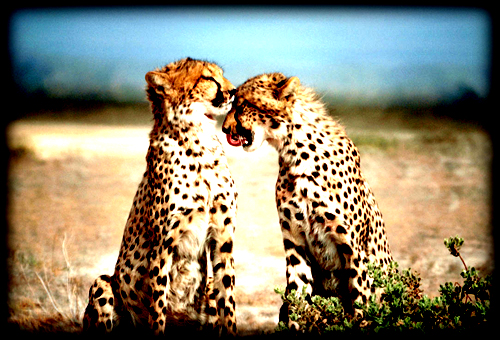
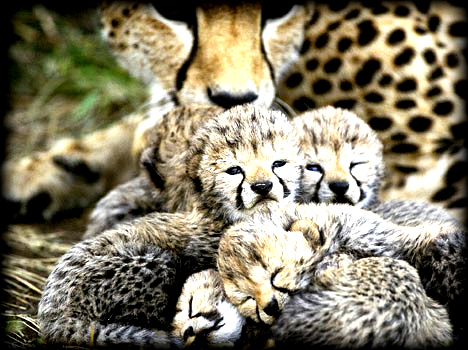
The cubs are usually weaned at 6-8 weeks and will then leave the den and follow the mother from then on. If a young cub loses its original family, due to some great misfortune, it will find another family and join them despite the ill will from the new mother and being out cast by the new brothers and sisters. At 5 months old, the cubs are playing with one another, sharpening their stalking, chasing, and wrestling skills in a playful manner. At 6 months the mother Cheetah will fetch live prey injuring it and then giving it to the cubs so they may practice the art of the kill. At 8 months the cubs are chasing inappropriately large prey such as Giraffes. A Cheetah will not be a very skilled and efficient hunter until about 3 years of age. Cheetah cubs kill less than 10% of the prey, which the family feeds on. At 15-24 months the cubs will leave the mother, but may stay together for several more months. Young females will leave her brothers when they reach sexual maturity. Young males will travel far from parents and will lay claim to a territory as large as 300-800 square miles. Young females will stay closer to home and may even overlap territory with the mother. The cheetah may be a predator, but it is also preyed upon, and recent studies in Kenya and the Serengeti park in Tanzania show that 90 per cent of cubs die before reaching the age of three months. So a mother cheetah's maternal role is critical to the survival of the species, which has been considered endangered since the Sixties.
|
Decline in prey , loss of habitat , poaching , and indiscriminate trapping and shooting as a livestock predator threaten the survival of the cheetah throughout its range. As a protected species in Namibia, people are allowed to remove cheetahs only if they pose a threat to livestock or human life. Unfortunately, some farmers will capture cheetahs indiscriminately (the "problem" animals may not be singled out), often removing or killing those that have not taken any livestock. Limited international trade in live animals and skins is permitted from Namibia, Zimbabwe, and Botswana. Illegal trade in other parts of Africa and indiscriminate capture and removal in southern Africa continue to threaten the survival of this species. To help this sleek hunter of the African wild win it's race against extinction, we must:
Educate everyone about the need to conserve biological diversity, and the predators unique role in a healthy ecosystem.
|
|
|
|