| Newton's 2nd law |
| F = m x a |
| Back to Home page |
 |
 |
| A given force when in a frictionless environment will always equal the mass of an object multiplied by the change in velocity. |
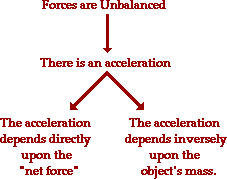
| This chart further explains Newton's second law. |
| The formula for momentum strikingly resembles the formula for Newton's second law of gravity. |
| Momentum |
| F = m x the change in v |
| A force equals the mass of an object multiplied by the change in the velocity the it had. |
 |
 |
| Chart on Newton's second law |
|
| Both of the concepts that were talked about are essentially the same thing. They are just used in different situations. Both talk about the contious movement of an object and that there is a force being aplied to an object. This object will have mass and can be accelerated. |
| To describe the second law I will tell about a situation and follow it with a problem. There is a car going down the road. It is being pushed with a given force. The car has a certain mass. What is the acceleration on the car? F = m x a Force on the car = 1000 newtons The mass of the car = 500 kg. The acceleration = ? 1000 = 500 x a 1000 / 500 = a 2 meters per second = a |
| Momentum is a concept that can be applied to certain situations. For example; A semi- truck has a large amount of mass and can be accelerated to a high velocity. A Geo- Metro has a low amount of mass but can also be accelerated to high velocities. If the two vehicles were to collide The momentum of the semi- truck would be enough to carry both vehicles over a long distance. The two collectively have the same amount of momentum after a collision as they would before the collision ever took place. The momentum before a collision will always equal the momentum after a collision. The momentum from both vehicles can not be lost. The law of conservation of momentum states that momentum can only be transfered not created or destroyed. |