A
big-screen,
well-appointed
"Spider-Man"
is a hard
concept to
screw up,
and director
Sam Raimi ultimately doesn't.
The movie does what it has to
do: puts this most populist of
comic-book superheroes at the
center of a colorful,
computer-enhanced popcorn
entertainment.
It's got appealing performers as
the leads -- Tobey Maguire as
Peter Parker/Spider-Man and
Kirsten Dunst as Mary Jane
Watson -- as well as a
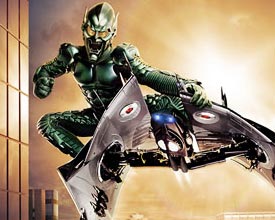
formidable villain in the Green
Goblin/Norman Osborn, played
with a heaping scoop of relish
by Willem Dafoe.
And it's got the people's
superhero. Superman is an
alien, the X-Men are mutants,
and Batman is some dark,
haunted guy living in a stylized
gothic version of America, but
Spidey is just an everyday teen
who gets bitten by a radioactive
spider and gains special -- and
especially fun -- powers.
What's surprising, then, is how
thin the material comes to feel.
Although the first sequel
already has been ordered
(Columbia knows it has
marketed a blockbuster), by the
end of this introductory
installment, the tank seems
near empty.
The screenplay by David
Koepp ("Panic Room" and the
first two "Jurassic Park"
movies), a writer who's better
at moving characters from
place to place than providing
strong connective tissue or
memorable dialogue,
streamlines Spider-Man's
back story efficiently. High
school senior Peter Parker is an
unpopular, science-minded
dweeb being raised by his
kindly Aunt May (Rosemary
Harris) and Uncle Ben (Cliff
Robertson). Gwen Stacy,
Peter's blond girlfriend who's
shockingly killed in the comic
book "The Amazing
Spider-Man No. 121," has
been deleted, and Peter's
fetching, red-haired classmate
Mary Jane has taken on some
of her traits. Although she's
lived next door for years, Peter
can barely work up the nerve to
talk to her before that spider
bite on a field trip.
Although the movie omits
Peter's comic-book revelation
of jumping away from a
speeding car and winding up
affixed to a building, the scenes
of Peter discovering his powers
and swinging around
Manhattan contain an
exuberance too rarely seen in
superhero movies, which tend
to emphasize the burdens of
superpowers. When Peter
draws multiple versions of his
Spider-Man getup, he's living
out the dream of every kid who
has imagined himself as a
superhero.
In the comic book, Peter
manufactures his
web-shooting mechanism, but
here that phenomenon happens
organically; when he flicks his
wrist, those sticky webs spurt
out. Although the change may
offend purists, it makes
dramatic sense and reinforces
the theme that Peter's new
physical gifts are a metaphor
for puberty. Norman Osborn,
the ultra-rich father of Peter's
friend Harry (James Franco),
also gains superpowers when
an experiment goes awry and
half of his personality is taken
over by the maniacal,
sky-gliding, fireball-hurling
Green Goblin. Initially driven
to take revenge on
double-crossing business
associates, Norman/Goblin
becomes an all-purpose New
York terrorist.
Although the movie was filmed
before Sept. 11, that tragic day
seems to inform the film, such
as in the closing shot of Spidey
and the American flag, and the
scene in which an angry New
Yorker, among a crowd
throwing debris at the Green
Goblin, proclaims, "You mess
with one of us, you mess with
all of us!"
Since his "Evil Dead" days,
Raimi has been a fan of fancy
camera movements, and his
"Spider-Man" certainly looks
lively, with lots of swooping
and swinging to capture the
hero's acrobatics. The
computer effects don't usually
draw too much attention to
themselves, though sometimes
Spider-Man looks like a
cartoon. Maintaining a
consistent tone is not,
however, this director's strong
suit. J.K. Simmons is a hoot as
grousing Daily Bugle editor J.
Jonah Jameson, but the "His
Girl
Friday"-goes-to-the-cartoons
flavor of his exchanges with
Peter isn't matched elsewhere,
certainly not in Peter's
occasional glum voiceovers.
Raimi inserts numerous
"Superman" nods, including a
gratuitous shot of Peter
running and ripping open his
shirt to reveal the Spider-Man
logo. But while the first
"Superman" movie took itself
less seriously as it progressed,
"Spider-Man" is the opposite,
turning more violent, downbeat
and tedious as it goes along.
Despite the kid-friendly
beginning, by the time the
Goblin and Spider-Man
pummel each other endlessly
during the climax (the bridge
setting borrowed from the
Gwen Stacy death comic), the
movie has earned its PG-13.
With his big, round, soulful
eyes, Maguire always has been
able to convey a sense of
wonder, and his instinct for
understatement also serves him
well here. His few off-notes
come when the screenplay calls
for Peter to be inexplicably
rude to his aunt and uncle.
Dunst again shows why she's
one of today's most alluring
young actresses, conveying
deep yearnings beneath Mary
Jane's sleepy-eyed beauty
while not repressing the
character's teenage-girl
impulse to hurry out to the
lunk with the fancy new car.
Mary Jane's thank-you kiss to
an upside-down Spider-Man
is one of the most winning
romantic moments of a
superhero movie.
Dafoe is fine, although
Norman's "Sybil"-like battles
with his Goblin alter ego get
silly. Franco may have been a
fine TV-movie James Dean,
but his pretty-boy pouting just
makes Harry a bland drag. One
of the primary functions of
such an introductory movie
installment is to set up the rest
of the series, but the prospect
of Harry as a future
Spider-Man rival -- as
forecast here and played out in
the comic books -- seems
grim. The Spider-Man saga is
a classic for a reason, and the
filmmakers don't squander the
material's strengths. But they
do perhaps exhaust them. After
the enjoyable setup, the
dynamic becomes routine, the
content repetitive; we don't
need to hear the refrain "With
great power comes great
responsibility" three times.
There's no denying that Spidey
spins a nifty web here. But in
the end it's the movie that
doesn't stick.