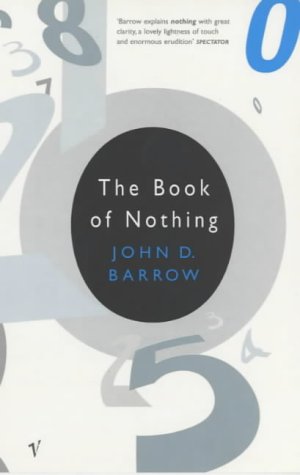
 If, like me, you'd find this book in the fiction section of your local bookstore, you might think this was a postmodern novel, the sort of fact-mocking work Thomas Pynchon or John Barth would write.
First, let's work our way through the text on the cover: "From the zeros of the mathematician to the void of the philosphers, from Shakespeare to the empty set, from the ether to the quantum vacuum, from being and nothingness to creatio ex nihilo, there is much ado about nothing at the heart of things. Discoveries in astronomy are shown to shed new light on the nature of the vacuum and its dramatic effect on the explanation of the Universe. This remarkable book ranges over every nook and cranny of nothingness to reveal how the human mind has had to make something of nothing in every field of human enquiry."
Got that? That's a good summary of this book by John D. Barrow, a Research Professor of Mathematical Sciences at the University of Cambridge. So the book is bulky (380 pages is a lot if you write about nothing) and highbrow (he's a professor), but is it any good if you didn't study maths?
Yes, it is. With remarkable ease, Barrow tells you about all sorts of nothing: from the number nothing (zero), explained in a highly interesting chapter on the origins of 0, via Shakespeare (Much Ado About...) over the philosophical notion of nothingness to the most difficult chapters, those on the vacuum and quantum theory (really, the word 'lambda' will make you go berserk after a while).
That something, usually regarded as the most difficult theory to be understood, is still explained in a way most people can understand most of it, is an accomplishment. Some mathematical terms could be explained a bit better for the occasional layman that'll read The Book of Nothing ('lambda' is the "cosmological constant" by the way), but it's a great help the book goes from relatively easy chapters to the least comprehensible ones.
Sadly, it's not just the easiest chapter you'll find at the beginning of the book (the one on the origin of zero), but it's also the best written and most fascinating chapter. (Which doesn't mean that there's one poorly written chapter in this book.)
The use of figures to explain all these notions of nothingness can only be called lavish and makes the book pleasant to read.
At times (given the subject), The Book of Nothing is a tough read, but it's the sort of book you don't always encounter, it's superbly written and manages to explain lots of difficult concepts in a comprehensible way. If that's nothing short of a recommendation, then I don't know what is. If you'd thought only Bret Easton Ellis managed to write books on nothingness, you're dead wrong. Nothing can beat this book.