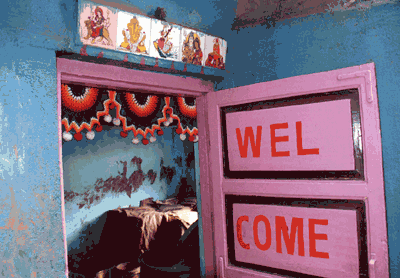
TYPOCITY
Cities are littered with letters: typographic forms on posters, billboards,
signboards, shop signs, street signs, name plates, number plates, bus
timetables, train graffiti etc. cover the city communicating urgently,
announcing pompously, informing mundanely, declaring hopelessly…
The typographic styles employed in these communications convey beyond the
literal meaning of the texts, revealing the traditions and aspirations of
the culture they emerge from. The city of Bombay has a diverse range of
signage styles and typographic forms arising from its varied social and
cultural fabric. The influences of the film industry, the demands of commerce,
the changes in political power etc, are all constantly reflected in the signage and
typographic styles employed in various communication
media around the city.
TYPOCITY is a project that aims to document and analyze interesting and rare
instances of typography throughout the city of Bombay from the point of view
of graphic design, production technique and social significance. The scope
of research will include rare and interesting forms of typographic display
such as painted film posters, hand painted restaurant menu boards, hand
crafted shop signs, calligraphic taxi number plates, iconography used by
Bombay dabawalla's to simplify area locating task, archaic electronic
displays etc. This research shall be sorted, annotated and archived.
The best of these lettering styles will be typographically examined and
converted into digital fonts (true type fonts).
In recent years, the influx of globalization has led to a rapid replacement
of many locally evolved styles of signage in Bombay. Backlit vinyl boards,
digital printouts and stickers are replacing hand painted posters,
signboards and graffiti. However, some old forms still survive and it is
important that they be urgently documented. There are still a handful of
film poster painters, the shops on Muhammad Ali road still retain the hand
crafted signboards, some old textile mills still have the old embossed
lettering above the arched gateway...
The team of Kurnal Rawat and Vishal Rawlley will combine their
specializations in typography and communication media respectively, in the
execution of this project. Scouting the city, area by area, they shall
photograph all interesting and rare typographic instances. These typographic
forms shall be contextually sorted and archived under cross-linked
categories such as language, period, style, technique, medium, area etc.
The entire catalogue that thus emerges shall be archived on a website and
made freely accessible. The best of these lettering styles shall be
typographically examined and using appropriate computer software converted
into true type fonts with the possibility to download these from the project website.
This exercise will help in studying the social fabric of Bombay form a
typographic lens. The documentation of this aspect of the visual culture of
the city will also help in tracing the cultural history of the city. The
reintroduction of vernacular styles in a digital form will help in
preserving the cultural link between contemporary graphic-design with the
traditional design practices.
WORKPLAN
Research Work
We shall scout the entire city, photographing unique, rare and interesting
typefaces. We shall also visit the workshops and meet the craftsmen involved
in the production of these type forms as part of our research.
Cataloguing and Archiving
The research material will be sorted according to various contextual
categories such as language, period, style, technique, medium, area etc and
archived on a website.
Creating True Type Fonts
We shall make a typographic study of the ten most interesting typefaces
emerging from the research. Examining the available alphabets and numbers of
the particular font, the entire range of alphabets and numbers of the
typeface shall be evolved. This will then be converted into a true type font
using appropriate computer software. These fonts will also be made available
for download from the project website.
Project Owner: Kurnal Rawat & Vishal Rawlley
Contact:
[email protected],
[email protected]
Research Funded by:
www.sarai.net
UPDATED ON: 22 JAN03
VISIT THIS PAGE MONTHLY FOR MORE...