The
Kurdistan Observer
www.kurdistanobserver.com
Iraqi Kurds' story of expulsion
BBC
Nov 3, 2001
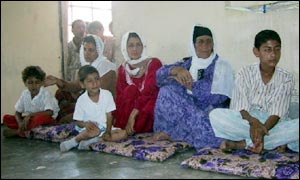
Thousands of women and children are left without husbands
or fathers
Iraq's Kurdish region is dotted with refugee camps and collective
towns created over years
of expulsion and mass deportation. In the last of four features,
BBC journalist Hiwa Osman
reports on the situation in the camps.
Binaslawa is a collective town outside the city of Arbil in the Kurdish
region. It is a hot, dusty pile of
grey cement houses and tents for more than 50,000 displaced people.
The Iraqi Government created many "modern villages" like Binaslawa in
the 1980s to remove the
Kurdish rural population from the countryside into camps near the major
cities.

In this era of globalisation, justice should also be global  |
| Bakhtiar Amin, Coalition for Justice
in Iraq |
Hamid, a Kurd from the city of
Kirkuk, has been living with his family in Binaslawa since 1997,
when they were expelled from
their home by the Iraqi Government.
He had received a visit from a
security official who told him that he had to leave and go to the
Kurdish-controlled area. His
house, appliance shop and farm were confiscated.
He was not given a reason for
his expulsion by the security official, but didn't have to ask.
As a Kurd, he knew it was his
turn to join perhaps 100,000 others who had been forced out of the
oil-rich areas in and around
Kirkuk.
Arabisation
Hamid's scenario is
a typical one for Kurds, Turkomans and Assyrian Christians who have
lived under the control
of the Iraqi Government. But recently, a new deportation method has
been put in place.
Any non-Arab who needs to have
any official dealings with the Iraqi Government - whether
property conveyance, vehicle
registration, or enrolling children in schools - has to fill in
a form that says: "I wish to
correct my ethnic origin into Arabic."
Those who refuse to sign the form
are automatically expelled to the Kurdish-controlled area.
Those who "correct" their ethnic
identity are told that "since they are Arabs," they should
move to the south of Iraq.
Al-Ta'mim (nationalisation in
Arabic) is the new name of the traditionally Kurdish governorate |
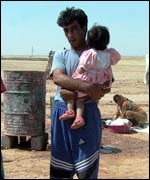
"They did not let us take anything with us" |
of Kirkuk. It is also the name of
a government newspaper published in Kirkuk, which carries regular reports
about
"the leader president's gifts
to the people".
President Saddam Hussain's "gift"
for new Arab settlers is a plot of land in Kirkuk, a lump sum of money,
and arms for "protection". Hamid's
shop, farm and house are amongst these gifts.
Scorched earth
| The Anfals |
| A campaign of mass displacement and disappearance Conducted
by the Iraqi Government in the late 1980s An estimated 182,000 Kurds were
buried alive in the southern deserts |
Shorish is another former "modern
village" not far from Kirkuk inside the Kurdish region. The people who
live there tell a different story
of forced expulsion. The majority of Shorish's inhabitants are what Kurds
call "Anfal widows".
Anfal, (spoils in Arabic), was
a campaign of mass displacement and disappearance conducted by the
Iraqi Government in the waning
days of the Iran-Iraq war in the late 1980s.
Using a scorched-earth policy
that included chemical bombing, thousands of villages were depopulated
and razed to the ground. Anfal's
goal was to prevent Kurdish opposition parties from relying on the Kurdish
villages.
Eyewitness accounts, documents
seized from Iraqi security during the Gulf War uprising and international
organisations estimate that 182,000
people, mostly men, were forced from the Kurdish areas and buried
alive in mass graves in the southern
deserts.
The Iraqi Government
refuses to confirm the fate of those who were taken, despite repeated
requests from Kurdish officials.
The social, economic and psychological
impact of this issue is enormous.
Without a death certificate, women
with missing husbands cannot remarry and their children
cannot inherit family property.
Without a working head of household,
women are sometimes forced into the smuggling trade
or worse.
House after impoverished house
in Shorish is filled with women and children. |
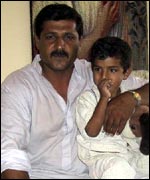
Hamid's son, Azad, was born in the camp |
International Tribunal
The Anfal and Arabisation campaigns
are "acts of genocide and ethnic cleansing", says Bakhtiar Amin,
head of the Washington-based
Coalition for Justice in Iraq (CJI), which includes more than 260
non-governmental organisations
from 120 countries.
The 14 tonnes of security
documents seized in the uprising, make "Iraqi genocide, in
which one million Iraqis were
killed, the most documented case since WW II," Amin
said in an interview with BBC
News Online.
The CJI is calling for an expert
commission under a UN mandate to study the available
evidence and decide whether there
is a case for crimes against humanity in Iraq.
"Unaccountability means a continuation
of violence and encouraging other dictators to
commit similar crimes," Amin
said.
"In this era of globalisation,
justice should also be global."
Photographs copyright of Hiwa
Osman |
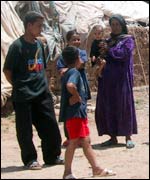
Tent cities are the first stop for expelled families |
-----------------------------