Jun 25, 2005
"Time is more important than
price; when time is up price will reverse." -W.D. Gann
W.D. Gann spent many years
studying the history of markets going back centuries. While
researching commodities and commodity markets he discovered what
he called Master cycles of 30 and 60 years. I have continuously
posted charts of gold and silver bullion that demonstrate the
remarkable similarity of timing between our current bull market
in gold and silver and the bull market of the 1970's. Major
highs and lows have occurred within weeks of each other. However
gold and silver bullion have demonstrated that they are on a
different time schedule from the gold and silver shares.
A major confirming tool for
the Gann cyclical studies is the fact that a Delta long term
turning point always arrives at all major highs and lows.
Students of Delta know it could not be otherwise. I also use my
own form of monthly wave counting. I have found the monthly form
of wave counting to be the most useful. Tracking every single
tiny wave movement intra day and then trying to put it together
in order to see the large picture is similar to putting your
nose next to a Rembrandt painting. If you do that you can not
see the entire picture. You must stand at a distance in order to
see the beauty of the entire work of art. However my approach to
wave counting is considered heresy by die hard wave enthusiasts.
So be it.
It was monthly wave counting
that enabled me to see the top and a completed 5 wave move in
the HUI precious metal shares index in January 2004. I mentioned
this on a particular web site populated by gold bugs and, to say
the least, had my competence and intelligence seriously
questioned. That was O.K. by me. The reason their comments did
not "bug" me was that they were just another small confirmation
of the correctness of my opinion. When I saw the top in the HUI,
I had no idea what kind of a correction we would experience.
Many weeks passed before I caught a glimpse of the type of
correction we were having. It turned out to be a flat type of
correction that may be ending with one more move down and it may
complete in late July or early August.
If this assessment is correct
we should then have a strong move back to the old high in the
HUI. If the HUI bottoms in the 140 to 150 area there will be an
opportunity to make a substantial profit if it returns to the
265 area which was the previous high. At that point in time,
when and if we reach the old high, we will have another
difficult decision to make. I have mentioned this before but it
may be worth mentioning again. The flat type correction we are
in may become what is called an extended correction and may look
like one of these. You can see that the flat part of the
correction is what we may be completing in a number of weeks.
Notice that the "any three" part of the correction happens in
about one third of the time it takes the flat part to complete.
Once the move up begins it may be possible to obtain substantial
profits in six to eight months.
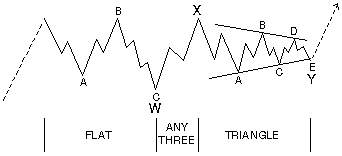
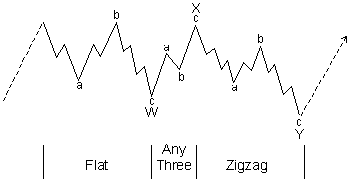
The reason I am mentioning the
possibility of an extended correction is because this is what
happened to the precious metal shares 30 years ago, although
they had a "zig zag" type of correction not a flat type. A "zig
zag" has a lightening bolt appearance and represents a
substantial decline. In the same items, amazing as it may seem,
corrections do tend to alternate in type even 30 years apart.
The gold and silver shares topped in 1974 and had a severe
decline and did not begin a major rise until 4 years later in
late 1978. Many commodities are following the 30 year "Master
Cycle" not just gold and silver and the gold and silver shares.
Of course it may be different this time around for the precious
metal shares and they may not undergo an extended correction.
However it is important for us to keep this probability in mind
if and when the HUI has a substantial rise. It may be prudent
for you to take some protective action when and if we get back
to the old high. The kind of protective action where you sell
and take enough profits to buy puts on the position you retain.
O.K., I know I am way ahead of
myself. We have yet to bottom and start up. However I like to
think ahead, based on the past, and not scare everyone as we
approach a possible top area. It is better to be aware of the
possibility ahead of time. If and when the HUI gets back to the
old highs we can be assured that many folks will be screaming,
"This is it. The shares are taking off in a huge bull move" They
will have all kinds of fundamental and technical reasons why it
is happening. They may be correct but I will be examining the
possibility of an extended correction and keeping everyone
posted. Hopefully it won't happen, but too much of the 30 year
cycle in many areas is repeating for me to totally ignore a
possible extended correction. If it happens you will have
another opportunity to buy "cheap" stock. If it doesn't happen
your P.M. shares will just keep on increasing in value.
So here's to increasing values
for all.
For the more conservative
minded there is the
Tocqueville Gold
Fund. It is a no load fund. The fund is charged a one and
five eights (1 5/8 %) annual advisory fee. The application and
prospectus can be downloaded from the internet. John Hathaway is
the manager and he has done well. The gold fund paid about a 4
1/2 % dividend from capital gains last year. I do not receive
any form of compensation from anything I may mention.
Overview of the HUI
For those who would like to
have a portfolio of precious metal mining shares there is the HUI
and XAU.
Two major gold indices
dominate the market--the Philadelphia Stock Exchange's XAU and
the AMEX's Gold BUGS Index (HUI). The major difference between
the two is that the BUGS index is made up exclusively of mining
stocks that do not hedge their gold positions more than a
year-and-a-half into the future. This makes the BUGS Index much
more profitable than the XAU when gold prices are rising, but
can also compound its losses when gold declines. BUGS is an
acronym for
Basket
of Unhedged
Gold
Stocks.
The index was introduced on March 15, 1996 with a starting value
of 200.
Ron Rosen

to be continued. |