 |
|
|
|
|
|
|
|
|
|
|
|
|
|
|
|
|
|
|
C60 polymerization at High Pressure High Temperature Conditions |
|
|
| 1 The 2+2 cycloaddition mechanism of polymerization and photopolymerization of C60 |
|
|
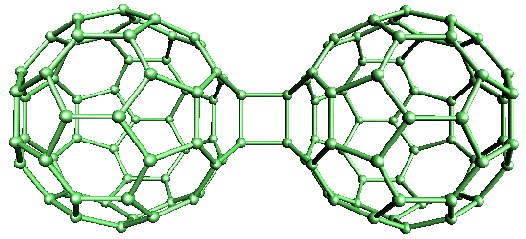
| It is now well established that C60 molecules can polymerize by breaking double bonds of the neighboring molecules and joining two molecules by a four-membered ring (see Fig.1). It is also clear that more then one square ring per C60 molecule can be formed to produce a stronger polymerization. |
|
|
|
 |
|
|
| Figure 1Dimer of C60 molecules connected by a 2+2 cycloaddition mechanism . |
|
|
| �C60 can be polymerized by laser light or by prolonged exposure to UV light . These polymers are insoluble in the organic solvents typically used for C60 (e.g. benzene, toluene) and show a small decrease of the cell parameters of the cubic fcc structure from 14.17� to 14.05 � . Recent results show that the phototransformation can lead to the formation of chains with two square rings per molecule and branched chains (three square rings per molecule).� Polymerization by the 2+2 cycloaddition mechanism has also been observed in C60 doped with alkali metals.��� The alkali metal in these compounds catalyses the polymerization process . Finally, C60 polymerization occurs easily also under High Pressure High Temperature conditions (HPHT) as will be discussed below. The square ring connecting the C60 molecules can be broken by heat treatment and C60 polymers can be reverted back to monomeric C60 at moderate temperatures and ambient pressure ]. |
|
|
| 2 One and two-dimensional polymers obtained at HPHT conditions |
|
|
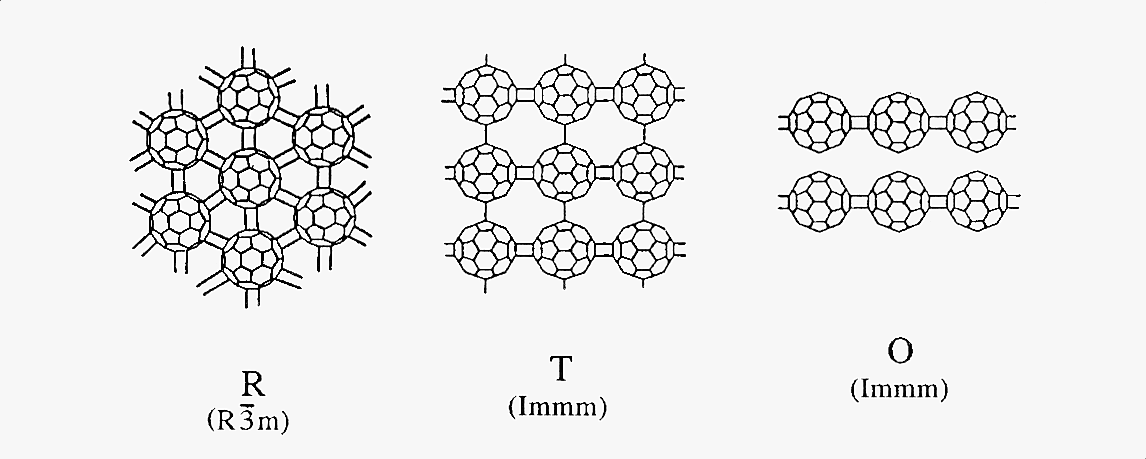
| �It is well known that high-pressure high-temperature treatment (HPHT) of C60 below 9 GPa and 900K leads to the formation of several kinds of one- and two-dimensional polymers .� One-dimensional orthorhombic C60 polymers (chain-like) have been obtained over a wide range of pressures (up to 8 GPa) and relatively low temperatures (starting already from 370 K) . At higher temperatures, two different two-dimensional polymers have been reported which are tetragonal at lower pressures and rhombohedral at higher pressures (see Fig.2).� Studies of two-dimensional polymers have recently also been carried out on single-crystals . Today, Raman spectra have been recorded for all one- and two dimensional polymeric phases and characteristic features of the spectra have been identified for each phase. Some of the most typical signatures for polymerization are: (i) a shift of the Ag(2) mode proportional to the number of square rings connecting neighboring C60 molecules,� (ii) peaks originating from square rings vibrations around 900-1000 cm-1 and (iii) new peaks below 200 cm-1 due to intercage vibrations |
|
|
| � |
|
|
|
 |
|
|
| Figure 2. Schematic structural arrangement of C60 molecules in the two-dimensional rhombohedral (R) and tetragonal (T) networks; and in the one-dimensional orthorhombic (O) chains. |
|
|
| All results summarized in available P-T diagrams originated from ex situ studies where the samples were heated to a certain temperature and usually cooled down to room temperature and analyzed with Raman spectroscopy after a quick release of pressure (quenching). A problem with this type of studies is that the phase composition of the quenched samples can be different from the phase composition at the HPHT conditions.� This means that the P-T diagrams recorded ex situ should be considered rather as a map showing the conditions under which a certain phase can be produced.� It must be also noted that a discussion of the real phase diagram for fullerene polymers is not correct since C60 is a metastable modification of carbon and the term "equilibrium phases" should therefore not be used. |
|
|
| 3 Superhard materials and three-dimensional polymerization at HPHT conditions |
|
|
| Three-dimensionally polymerized fullerites have been claimed to exist at pressures above 12-13 GPa and temperatures above 800K . The structural characterization of these phases so far remains very poor but their extremely high hardness has attracted a lot of attention. Several structural models have been proposed for these "superhard" phases, including different hypothetical kinds of bonding between C60 molecules but so far none of them is well proven .� The problem with characterization of these "superhard" phases is that they are either completely amorphous or exhibit very few lines in XRD which allow a quite ambiguous interpretation. Raman spectra of these phases are also typically almost featureless and have been interpreted by some researchers as "collapsed" fullerite with only fragments of C60 cages remaining. Nevertheless, the most recent review of the P-T diagram showed a number of different phases in the pressure range 12-13 GPa and high temperatures although the existence of some of them have been based on single observations. The review by Blank et al. reported four different structures above 9.5 GPa and 700K, which were suggested from fitting conventional XRD patterns . |
|
|
|
Later results obtained with synchrotron radiation showed strongly elliptical Debye-Scherrer rings in 2D XRD images from a sample treated at 13 GPa and 830K .This suggests that structural analysis with conventional XRD patterns is not correct since they represent sections of 2D pattern with unknown ellipticity. For such conditions the fitting of conventional pattern (without using 2D images) may give different results depending on orientation of the sample etc. Nevertheless, some recently published structural models have been based on Rietveld analysis of XRD patterns obtained by such conventional methods . Superhard phase has been also obtained without heat treatment at much higher pressures, above 20-22 GPa.� This amorphous phase was suggested to be the same as the phase obtained by HPHT treatment at 12-13 GPa (so called Amorphous II; phase) . |
|
|
|
�It should to be noted that data reported by different groups in this pressure region are significantly different. One of the reasons for such a difference is that all studies above 12 GPa have been performed ex situ and with an unknown pressure variation during the heating process.� Furthermore, in many HTHP studies rather short time of heating has been used (1 min) and therefore it is not known whether the transformations were completed or not. The samples obtained at these conditions were inhomogeneous and the authors faced problems in separating between different phases .� |
|