
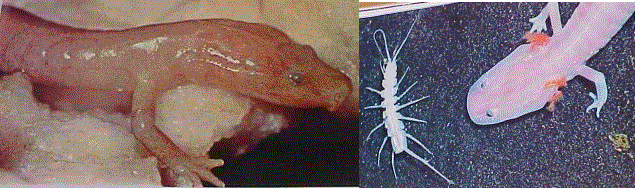
Left: Several highly adapted species of cave
salamanders found in Texas probably looked somewhat like this common surface
dweller before they entered caves. Like its cave-dweling relatives, this
salamander retains feathery gills and other larval characteristics even as an
adult.
Right: Two Texas salamanders, each inhabiting
separate cave systems, probably resemble past stages of the highly adapted Eurycea
rathbuni. Compared with their surface relative, they show progressively
greater loss of pigment, degeneration of eyes, elongation of legs, slimming of
the body, and flattening of the snout. Possibly at some time in the future both
species also will develop the grotesque modifications of Eurycea rathbuni.
With some
similarities to Eurycea rathbuni,
Typhlomolge
rathbuni, the famous Texas blind salamander, which inhabits the San
Marcos Pool of the Edwards Aquifer. This was the first species listed as
endangered in the USA in 1967. © Robert & Linda Mitchell, Artesian Well & Ezell's Cave,
Texas, USA. And similar to the second
one: Eurycea new species, a troglobitic salamander from the Buttercup
Creek Karst, near Austin, Texas. © William R. Elliott, Ilex Cave, Texas, USA.
Left: Slender and ghostly pale, the fully
transformed adult Ozark blind salamander is three to four inches long. Its
gills have disappeared, and its eyelids have grown together over small,
nonfunctional eyes. The adult salamander moves freely in and out of water and
usually lives deeper in caves that the larval form (right), which is from two
to three-inch-long, and lives in cave streams and pools but sometimes ventures
aboveground, unlike the adult, it has eyes, conspicuous coloration, and
plumelike gills.
Right: As the larval Ozark blind salamander
approaches metamorphosis, it gradually loses pigmentation, its gills begin to
regress, and its eyes become smaller in proportion to its head. Already losing
the use of its eyes, the maturing larva begins to depend more on vibrations
sensed through its lateral line system in order to locate isopods (in the
picture), flatworms, and other small prey. (see the Head
of G. palleucus, the Tennessee cave salamander. There are three
subspecies. © William R. Elliott, Russell Cave,
Alabama, USA).
Page 6.
Useful Links:
Research on Intelligent Design
Tasters of the Word (YouTube), videos recientes: "Astronomía y Nacimiento de Jesucristo: Once de Septiembre Año Tres A.C.", "Estudio sobre Sanidades" (en 20 episodios), "Jesus Christ, Son or God?":
Tasters of the Word (the blog, with: "Astronomy and the Birth of Jesus Christ"):


