ASTRONOMICAL ASPECTS OF THE BIRTH OF
JESUS CHRIST (SUPPLEMENT SIX)
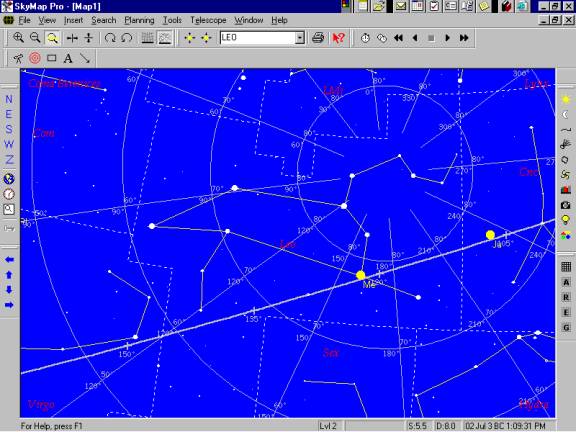
Figure 11. Planetary meeting in Leo. See the detail of the conjunction of Jupiter with Mars (Ma), both seen as one, and both in conjunction with Mercury and
Venus. As noticed in Figure 10, Venus also experienced a retrograde motion, as to meet with them.
Mercury is ready to lead and the Sun can be seen in Virgo. Give glory to GOD with all your
heart, read the Bible constantly, be saved and be thankful and joyful for your living
Lord and Savior Christ Jesus, because he is our sufficiency.
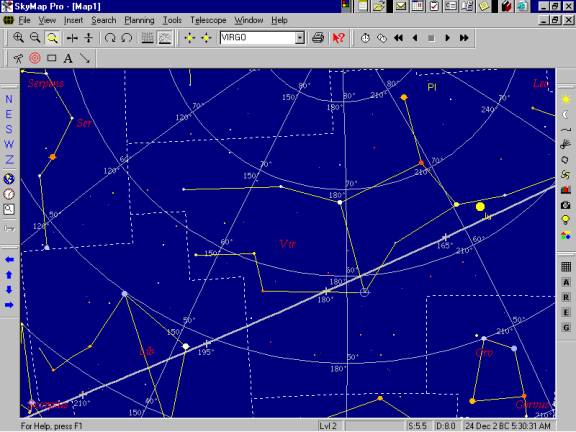
Figure 12. The stationary point of Jupiter (Ju)
in Virgo that had been seen over Bethlehem since the 24 of December 2 BC, when the Magoi from Persia went to visit and to give gifts to
Jesus Christ, who then was one year, three months and about thirteen days old
(that stationary point of Jupiter in Virgo lasted from about the 24th of December 2 BC
to the 1st of January of 1 BC. After his resurrection from the dead, Christ Jesus brought the age of
Grace on the day of Pentecost, when he freely poured out holy spirit over every
one who confessed with his mouth that Jesus Christ is the Lord and whosoever who
believed that God raised Jesus Christ from the dead, as Romans 10:9-10 says).
To
compare Bible versions: Diatheke, check its source. Demo
software used here: SkyMap Pro 9 (Web site: http://www.skymap.com) Software Review: “This demonstration version comprises the program and a manual,
with a small database of 30,000 stars (down to magnitude 7.5) and 10,000 deep
sky objects. Fully functional, with some exceptions: the observing log and
observation planning tools are not present; solar eclipse maps are not
available, although local circumstances of solar eclipses are 8.59 MB. Demoware; Windows 98 and above.
Download and its Service Pack 1. From the Website: http://www.ntu.edu.sg/cits2/sw_frames/sw_utilities.html.” To download
additional versions of Sky Map, go to: smp7demo.exe or to smp11eval.exe.
This Figures are supplementary to a Jesus’ birth study (in Spanish, see there the links for references in English). [Note: To see for
yourself all these events in motion, download the free demo, set the location by clicking the world icon at the left side of
the screen and putting in it "Israel: Jerusalem", the center of Prophecy. Set the time by clicking the
clock icon at the left side of the screen. Here we started on July the 1st
of 3 BC. Then center the constellation Leo by going to "Search" at the top of the
screen and then to "constellation". At the left top side is the zoom out or in for
the screen. To make it stationary at the center and to read from Right to Left
click the icon that is just below the word "tools", at the top of the screen as
shown. To abbreviate the planets' names, click the icon of a moon in the right side of the screen. To set them in motion, go to the second clock at the upper right and determine the frecuency of observations (minutes, days...), the single arrows go back or forward and the double arrows set the automatic movement. Finally, to
see details of the moon phases or to see planetary trajectories, directly
right click over the icon for each of them. Deep thanks to Mike Nelson for correcting my English]To go again to the first part of this Figures. To see both, the other event at the very moment of the birth of Jesus Christ and one that occurred thirty years after that.
Tasters of the Word (YouTube), videos recientes: "Astronomía y Nacimiento de Jesucristo: Once de Septiembre Año Tres A.C.", "Estudio sobre Sanidades" (en 20 episodios), "Jesus Christ, Son or God?":
Tasters of the Word (the blog, with: "Astronomy and the Birth of Jesus Christ"):