
Memories of Braxton Deaton Fincher
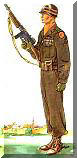
I am a Veteran of both WWII and the Korean War. I was assigned to the constabulary regiment which was part of the occupation forces of Germany and Austria after WWII was over. These constabulary units brought order to a chaotic, war torn Germany and all of Europe. We were hand picked elite force trained to police the U.S. Sections of the two countries. The occupation lasted from the end of hostilities to May 1st, 1952, when the last constabulary unit was deactivated.
In Europe, I was assigned to the occupation forces from May, 1946 to November, 1948. My first unit was temporary. It was the 74th Air Base Guard, later changed to the 78th Constabulary. We moved into the Patch Concern in Augsburg, Germany. The breakdown is as follows: 5th Constabulary Regiment, 74th Constabulary Squadron, Troop 'C', 2nd Platoon. Sharidan Concern, Augsburg, Germany
In Korea, I was in the 40th Division (the California National Guard, called the Sunshine Division.) 160th Infantry Regiment, Service Company. I served in two positions with this unit. First in the Motor Pool, then later as the labor supervisor in my own labor office. I was in charge of a battalion of Korean men above draft age, but still able bodied. Their purpose was to work on the front lines or any where else they were needed to build bunkers, dig trenches or repair roadways.) They owed the United States Army 24 hours a day. Just as we had to give complete attention to our duties 24 hours a day. These men seemed to love me and when I was to rotate home they gave me a quilted uniform complete with cap and booties. I gave this uniform to Luther’s oldest son, Luther, Jr. I think "Little Luke" still has this uniform at his home in Charlotte.
I reenlisted in the Army on July 16, 1951, and was sent to Europe. I did not arrive back into our country until April, 1952. I was there when my mother died at our home located at 512 East 19th Street, Charlotte, NC. I was notified of her death on the day she was buried. I came home as the war was ending.
Neither Jim, nor I attended our mother’s funeral, but at the same time our sister, Mary Evelyn (Fincher) Brown was on her death bed, dying of cancer. The Red Cross was contacted and we flew home from opposite ends of the earth on an emergency leave. Mary Evelyn was not expected to live more than 90 days. Jim had to return to his unit in Korea.
Instead of returning to Europe, I volunteered for duty in Korea, since an announcement was made at Camp Kilmer (named for Joyce Kilmer, the famous poet and author of the poem "Trees", killed in WWI) was asking for much needed volunteer replacements there. I volunteered and was sent to Camp Stoneman, California.
My orders were put on "hold" and I was assigned to a holding company pending Mary Evelyn’s death. When she died, I was given 30 days emergency leave again, but by the time I arrived Chicago, she had died and was buried. Alva Douglas Fincher lived in Chicago at that time, teaching in Chicago Academy of Fine Arts, so I took a cab out to his house where I spent the remainder of my 30 days leave. After which, I returned to Camp Stoneman by delivering a car to California for a Chicago Broker.
For more information on the Constabulary, check out: http://www.geocities.com/usconstabulary/index.html
Jim, my youngest brother, was in Korea when
mother died. I know he was not able to attend her funeral. When the war
broke out in Korea, Jim was in a National Guard unit in Charlotte, NC, the
378th Combat Engineers. He had earned the rank of sergeant. His unit was
activated very early in the war. He was in Pusau when it was bottled up by
the Communist from the north.
One of my older brothers, S.G. "Van" Fincher (also known as "solid gold"),
was a marine, First Air Wing. He saw hand to hand combat on
Guadalcanal air strip which the Japanese were trying to recapture. Van
died in 2002.
Stories my Daddy (S.L.
Fincher) told me:
Daddy’s father, Silas Alva Fincher, wanted him to take over his 1,000 acre farm in Chesterfield County. Daddy did not like the farm or farming. He moved to Charlotte at a young age to get a job. He hired on to the Southern Railroad as a fireman. Two or three years later, he took his examination for engineer and passed. He was the youngest engineer on Southern Railroad at that time.
My mother was Charlcie Durell Deaton. Mother went to work when she was 9 years old. She learned to run a set of looms in a weave shop at Concord, NC. She carried a box with her to stand on to do her work. When she came to a loom that had stopped, mother would put her box down and stand on it to tie the broken ends. Then she would start the loom, pick up her box and go to look for another loom which had stopped.
Mother would walk on a deep cut path in the railroad bed on the way home from the mill each day. A train would pass that spot at the same time each day. Daddy was the engineer and he noticed the slim, dark haired girl walking the foot path each time he passed. One day he threw a note to her asking her for a date. She replied the next passing with a "yes" as her answer. He came to her home to meet her and her parents and their courtship began. They were married as a result of this little note being thrown from a moving train. To this union, eleven children were born and ten grew to adulthood. One daughter died when she was two years old.
This was the story
that Uncle Charlie told me:
It seems that Uncle Charlie had a desire to do honest work for his living so he got a job on the section gang of a railroad. He worked the first day until quitting time. He never went back. He said, "Whatever the company owed me for that day’s work they still owe me. I had made up my mind not to ever go back there to work for any reason. I meant it, too. I haven’t been back there to this good day." (This is as close to the exact words Uncle Charlie used as I can recall after all these years.)


