
332 East 1st Street
Wichita, Kansas 67203
(316) 263 - 4218
Government of the Rite
Under the Grand Constitutions of 1786, a Supreme Council elects its own Active Members and is self-perpetuating. It charters Subordinate Bodies in cities (called Valleys) of states, territories, or countries (called Orients). In the Southern Jurisdiction, the Subordinate Bodies must observe the Statues of our Supreme Council, its orders and regulations and, when The Supreme Council is not in session, those of the Sovereign Grand Commander.Caps and Their Significance
The Supreme Council has set forth a rule for the correct wearing of the cap. When wearing the cap it shall be considered to be a part of the apparel of the wearer and shall not be removed. At the presentation of the flag, the cap shall remain in place, and the members shall stand at attention with the right hand over the heart.During prayer the cap shall remain in place and the hands and arms shall be crossed as in the 18th Degree.
The wearing of caps is considered proper at Reunions, regularly scheduled meetings, Maundy Thursday services, Easter celebrations, and other official Scottish Rite functions.
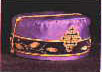
Sovereign Grand CommanderThe Sovereign Grand Commander is the highest-ranking officer of The Supreme Council and the chief executive and judicial officer of the Rite within this Supreme Council's Jurisdiction. He is the representative of The Supreme Council when that Body is not in session and is invested with general powers of supervision and administration everywhere within its Jurisdiction. The cap for the Sovereign Grand Commander is violet in color and features a darker violet band embroidered with laurel vine, leaf, and berry pattern in gold. On the front is the symbol of his office, a Cross of Salem with crosslets. |
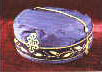
Sovereign Grand Inspector GeneralThis is the title of an Active Member of The Supreme Council. There is only one Active Member for any one Orient (state, territory, or country). He is the highest-ranking officer of the Rite within his jurisdiction, and, in relation to the Rite, his powers are similar to those of a Grand Master of the Symbolic Craft subject, however, to The Supreme Council and the Sovereign Grand Commander. The cap of an Active Member is purple and features the symbol of his office, a slanting Patriarchal Cross with crosslets. |
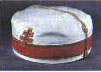
Deputy of the Supreme CouncilIn Orients (states, territories, or countries) that do not have an Active Member, the Sovereign Grand Commander appoints a "Deputy of The Supreme Council." The Deputy has powers similar to those of a Sovereign Grand Inspector General. However, he has no vote in The Supreme Council and holds his office at the pleasure of the Sovereign Grand Commander. The Deputy's cap is white with a scarlet band and features on the front a slanting Patriarchal Cross. |
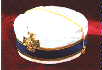
Grand Cross of the Court of HonourThis is the highest individual honor that The Supreme Council bestows. It is voted very rarely to Thirty-third Degree Masons only for the most exceptional and extraordinary services. The Grand Cross cap is white with a blue band. On the front is a replica of the Grand Cross jewel, which is composed of a Teutonic Cross, with an embroidered crimson rose with green leaves at its center. |

Inspector General Honorary of the Thirty-Third Degree (White Hat)During the Biennial Session of The Supreme Council, Sovereign Grand Inspectors General and Deputies nominate a small quota of members who are Knights Commander Court of Honour to receive the Thirty-third Degree. A committee reviews the nominations, but The Supreme Council must vote upon every nomination. Members unanimously so elected become honorary members of The Supreme Council. The Thirty-third Degree may not be requested. The Degree is conferred solely out of recognition for outstanding services. The only difference between the jewel of the Thirty-third Degree and that for an Active Member of The Supreme Council is that the latter is larger. The cap for an Inspector General Honorary is white with a white band edged in gold, featuring the symbol for this honorary Degree, a red slanting Patriarchal Cross. |
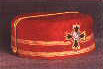
Knight Commander of the Court of Honour (Red Hat)The Rank of Knight Commander of the Court of Honour is not a Degree but an Investiture bestowed upon members deserving recognition for faithful services to the Rite. The respective Sovereign Grand Inspectors General or Deputies likewise nominate members for this honor, and The Supreme Council must also unanimously approve these. This Investiture is a prerequisite of receiving the Thirty-third Degree at some later time, though relatively few receive this distinction.A Knight Commander of the Court of Honour is a Scottish Rite rank peculiar to the Southern Jurisdiction, except that our Supreme Council has permitted the Supreme Council for the Philippines (part of our Jurisdiction until 1949) to continue the practice as one of their special honors bestowed. The cap of the Knight Commander Court of Honour is red with a darker red band trimmed in gold. In the center front is representation of the Knight Commander Jewel, a Passion Cross with fancy arms, featuring in the center a trefoil embroidered in green encircled by the words "Kt.�.Comm.�.Court of Honour" embroidered in gold. The symbol used here, the tripod .�., was regularly used in formal Masonic documents in place of a period in the abbreviation of formal titles. Its use is maintained as a tribute to the Craft's distinguished past in much Masonic writing today, such as in the Scottish Rite Journal, but it may be and often is replaced by a standard period. |
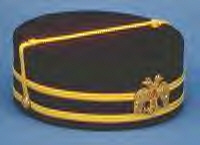
Master of the Royal Secret (Black Hat)This is the title of a 32o member of the Scottish Rite. The cap of a Master of the Royal Secret is black silk with a black band trimmed in gold. In the center front is a double-headed eagle emblem with a rayed equilateral triangle above in gold. The triangle is red, has 32o in its center and is trimmed with gold.The jewel of the Thirty-second Degree is a Teutonic Cross of gold, one and three-fourth inches square, with raised or beaded edges and a background frosted surface, having in the center a wreath of green enamel, with a gold tie at the bottom, and within the wreath the Roman numerals XXXII in gold. |
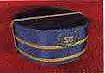
Fifty-Year MemberAny 14° member of the Scottish Rite, Southern Jurisdiction, who is in good standing and who became a member fifty years prior to the current calendar year is entitled to recognition as such. Such recognition entitles the recipient to receive a proper certificate and to wear a 50-year lapel pin or cap. The cap of a 50-year member is blue with a blue band. In the front at the center is a figure "50" surrounded by a green silk embroidered laurel wreath. |
Subordinate Bodies of the Rite
A complete set of Bodies is four in number, and these are called: Lodge of Perfection, conferring the Fourth Degree through the Fourteenth Degree; Chapter of Rose Croix, conferring the Fifteenth Degree through the Eighteenth Degree; Council of Kadosh, conferring the Nineteenth Degree through the Thirtieth Degree; and the Consistory, conferring the Thirty-first and Thirty-second Degrees.Applicants must be Master Masons in good standing. Their petitions must be endorsed by two Thirty-second Degree members of the Rite and are subject to investigation and vote.