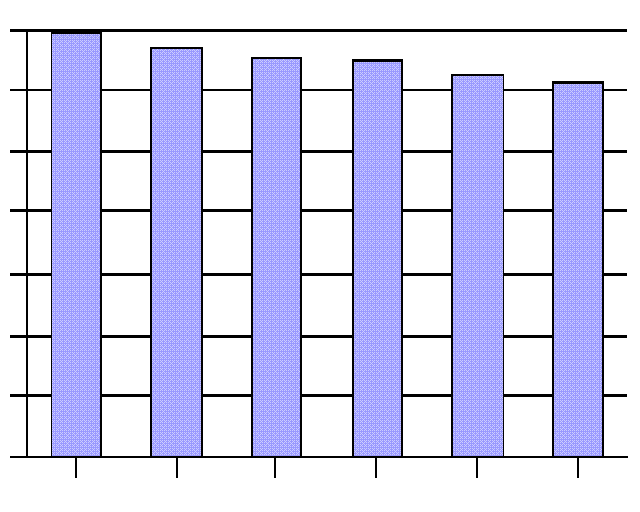
| Purpose: To observe the effects of the loss of calcium in a bone when it is submerged in vinegar. Introduction: Osteoporosis occurs when the skeletal system loses bone volume and mineral content. The bones then develop spaces and canals that become larger and larger. These spaces and canals are then filled with fatty tissues. Such bones can easily be fractured and can suddenly break because they are no loner able to support body weight. Osteoporosis will be simulated by placing a chicken bone in a cup and submerging it with vinegar for several days. Hypothesis: The vinegar will cause the bone to lose its calcium and become brittle due to the loss of bone density. Procedure: 1. Obtain one long bone from a chicken 2. Clean and dry the bone 3. Record the mass, volume, density, and the physical properties of the bone 4. Place the bone in a cup and fill it with vinegar until the bone is completely submerged 5. Place the bone sample in the designated location 6. Repeat step 3 each day for a period of two weeks. Data: Bone A Day Mass (g) Volume (mL) Density (g/mL) Observations Measured 1 27.84 g 20 mL 1.392 g/mL 4 26.75 g 20 mL 1.338 g/mL 5 26.02 g 20 mL 1.301 g/mL 6 26 g 20 mL 1.3 g/mL 7 25.04 g 20 mL 1.252 g/mL 11 24.65 g 20 mL 1.233 g/mL Graph of Density: Analysis: In this lab, a long bone from a chicken was completely submerged in vinegar. However, before it was placed in the vinegar, the bone was weighed on a scale to find its weight. Then it was placed in a graduated cylinder filled with water to find its volume. From these two measurements the density of the bone was able to be found. The bone was then set in the vinegar and was left until the next day for recording. Sometimes the bone was left in the vinegar for more than one day because of weekends so data was unable to be collected for those days. This did not disrupt the experiment though because there was a constant trend that was found. After the weekend the density of the bone had rapidly decreased and everyday throughout the week the density was gradually going down (this can be seen in the table and graph). This proves that although data was not recorded over the weekends, the bone density was becoming less and less. Each time that the bone density was recorded it was done in the same manner (scale to find mass, graduated cylinder filled with water to find volume, divide the mass by the volume to find density). Another way that data was collected was by observations. Every time the bone was measured, observations of how the bone looked and felt were also recorded. The observations helped to prove that the data was true because as the measurements showed the density decreasing, it was observed that the bone was becoming softer and softer (brittle). The first day the density of the bone was 1.392 g/mL, but by the fifth day the density decreased to 1.301 g/mL. Finally, by the eleventh day, the density had dropped all the way to 1.233 g/mL. Everyday the density of the long bone decresed proving that vinegar causes calcium loss. When calcium is lost the bone becomes brittle; this is what happened to the chicken bone. Conclusion: This experiment proved that the hypothesis was true. The longer that the bone sat in the vinegar, the softer and more brittle it became. This loss in density shows that the calcium in the bone was being lost. |
 |
| 1 4 5 6 7 11 |
| 1.4 |
| 1.2 |
| 1.0 |
| 0.4 |
| 0.2 |
| 0.0 |
| 0.8 |
| 0.6 |
| Time (Days) versus Density (g/mL) |
| The vinegar turned a murky brown color. The bone is very hard. The bone feels softer, especially on the ends. It appears to be cleaner and also looks darker. The bone feels softer, especially on the ends. It appears to be cleaner and also looks darker. The bone is softer than before the day before. The bone is a dark color and is still getting softer. The bone is a yellow color and also darker. The bone is so soft that it is becoming flexible. The bone is extremely soft and flexible. When it was squeezed with the tongs, the bone was left with an imprint. |
 |