THE THUNDERS OF
A STORY OF SUCCESS IN THE
60’S
[All copied from contents of the publication/CD album of “A Story of Success in the 60’s”]

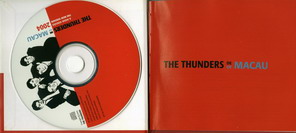
THE THUNDERS
Keyboard Herculano Airosa (Alou)
Bass Armando Sales Ritchie
Lead Guitar Rigoberto do Rosário Jr. (Api)
Rhythm Guitar Domingos Rosa Duque (Lelé)
Drums
& Percussion Manuel Costa
Lyrics
& Music Rigoberto do Rosário Jr.
We were half way into the 1960’s, when a boys’ band was a
talking issue among those who attended dancing tea parties and nightclubs. Not only because of
the “different” way in which they played and their voices, but
mainly because they presented their very own original lyrics and scores, both
in English and Portuguese. Not very common in
Herculano
Alexandre Airosa, Rigoberto do Rosário Jr., Domingos da Rosa Duque,
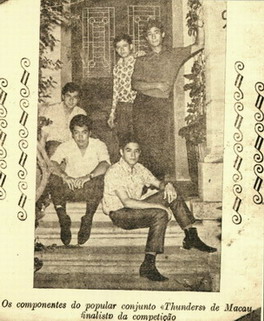
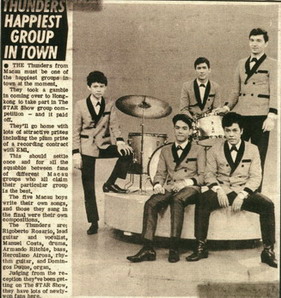
Armando Sales Ritchie and Manuel Costa, five names in a pop band, that in July
1968, scored success in Hong Kong, by winning the mostly popular Star Show
organized by HK-TVB. A several step elimination contest for the many young and fiery
bands that coloured the musical scene of that time. These and other
– shows or quests – were the means record companies used to emerge
from dullness and launch new talents among the so called “Pop
Music” groups, that started imposing their different sound here and
there.
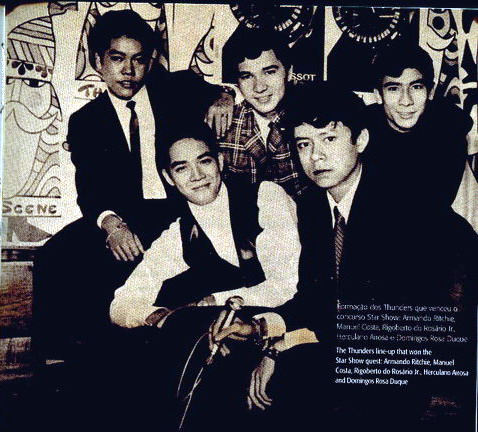
Of the
many contestants, the band featuring Alou, Api,
Lelé, Armando and Manuel (household names by which they are better known
by the Macanese Community) was the only one from this side of the
But
before that they were also placed second best amongst twenty in a previous
contest: the
By
winning the Star Show, hosted by Samuel Hui one of
“She’s
in
The
second half of the 1960’s – from 1964 to 1969 – was one of
the most remarkable periods of
Up
till 1983 when local TDM (Teledifusão de Macau) broadcasts started, four
What
was played over the radio, and on the Hi-Fi systems of those who could afford
to buy and collect vinyl records, confirmed the public’s acceptance of
the new rhythms. With Commercial Radio and Radio Hong
Kong leading the preferences, along with Rádio Vila Verde and Emissora
de Radiodifusãde
The
local radio station would broadcast recordings of contests and festivals on
primetimes, and our Johnny Reis with his unmistakable vocal style, would always
give the boys the attention they deserved.
Talented
youths with an itch for success get together in “Canto-pop” bands
– a Hong Kong made expression -, which critics called “bubble-gum
music”, due to the banality of lyrics and chords. Many of these bands were very short
lived and unstable, since their members would indiscriminately mix and jump
from one band to another. Groups
would last until conflicts of interests and of personalities arose. Just the normal field day for those who
would last until conflicts of interests and of personalities arose. Just the normal field day for those who
would have their 15 minutes of fame and fade to oblivion the day after.
As in
With
rare exceptions, at least in
The
family was supportive and the neighbours would put up with the endless and loud
sessions that took place in attics, cellars and garages. There was always quite
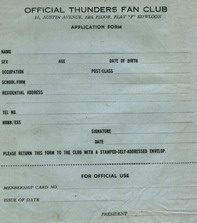
a big group of girlfriends and admirers that formed the “fan
clubs”. They were always
ready to attend the concerts staged on schools, cheer their idols, and provide
props and dancers. Fan clubs would collect and mail popularity survey coupons,
aimed at increasing the sales of newspapers, and magazines that published
them,; and also gave out signed pictures and posters of their favourite bands,
besides making phone requests to radio studios so their idols’ songs
would have most airtime.
Some
of these Bands kept playing for a while in the so called tea-dances, organized
by “café” and restaurant owners as they realized that
“dancing weekends” were becoming increasingly popular with
teenagers (and not only them), which made them “sure money in the
pocket”. The fixed price entry tickets entitled the bearer to two drinks,
sandwiches and salty savouries, and at least three hours of dancing. The
ranking of these amateur musicians was determined by their popularity with the
girls that followed them wherever they were performing. The bands that pulled through the
tea-dances phase, either by their real talent or simply by the fact of not
disbanding but most importantly by their coming of age as musicians, would move
on to play for more mature audiences in bars, restaurants and cabarets. They became semi-professionals and were
often hired to play abroad.
But
playing or singing in a pop band, would never be considered a job that would
put food on the table, as most of the youngsters that lived the golden years of
pop music here in Macau, agrees today.
If was then, by late sixties and early seventies, that the pop age
started losing its sparks, mainly due to the Cultural Revolution in China,
which had strong consequences both in Macau and Hong Kong. But then it was also true that brought
along pop music also faded slowly.
And the professionals went to try their luck elsewhere. In this setting the Thunders were one of
the most characteristic (and well deserved) cases of “reaching stardom
while learning how to play”. Deprived of formal musical education. Something that was only possible as those
were changing times, a breeding ground for improvisation and creativity. Times that also brought a sense of
tolerance and freedom that spread worldwide topped with “Flower
Power”, Bob Dylan and the
To Stardom while
“learning music on our own” …..
One
afternoon in 1964, the doorbell rang and Armando Ritchie went to the balcony to
check out who it was. There stood
Alou (Herculano), Api (Rigoberto) and Manuel
Costa. Alou was carrying a
typically African “bongo”.
He went down to get the door and invited them in the living room where
there was a Telefunken Hi-Fi record player system.
Alou,
Armando’s schoolmate from Escola Comercial, introduced him to Api and Manuel who were students at the Colegio Dom Bosco.
“We
were thinking on getting the band together again and would like to know if you
are willing to join us,” said Alou.
“But I can’t play anything!” – was
Armando’s surprised answer.
Alou insisted, “it’s a piece of
cake! (He handed over the small bongo to Armando. You know that song “Apache”
by the Shadows?” (He took the
bongo from Armando’s hands, and started drumming it to the rhythm of
“Apache”, and handed it back to Armando, who makes his attempt to
the same rhythm).
“See?
You got it already!” – says Alou excitedly. “You just have to practice a bit
more…” adds Api.
Full
of enthusiasm, Armando accepts the invitation. The group exchanged some views and the
party leaves, leaving Armando the bongo for further training. The first rehearsal is scheduled for
Alou’s house, who by that time was living at the
Travessa da Misericordia, near the
It was
a joyful and proud moment for Armando, a 14-year old who suddenly recalled what
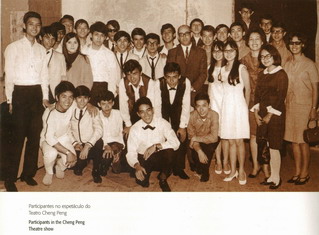
he had watched just a couple of weeks earlier, in Macau’s First Music
Festival, at the Cheng Peng Theatre.
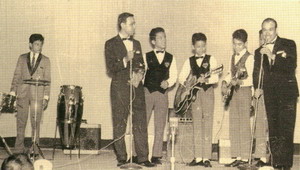
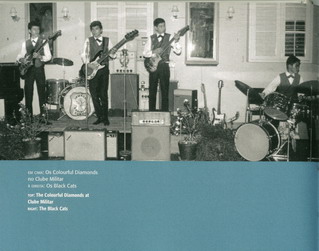
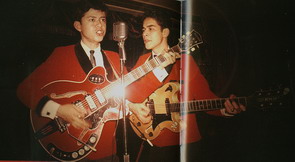
There were Alou and Api, both sporting the flashy waistcoats of the
Colourful Diamonds as they were then known, singing and playing their guitars
along with Sonny Fernandes and Antonio Marinho. At that time, Bélinha (Isabel
Batalha), Alou’s girlfriend was also performing and she did sing well
“I Love You Baby” and “Remember When?” Armando practiced so intensively
drumming Shadow’s “Apache” at home, that his fingers were all
swollen and blue by the time he showed up for rehearsal. He was the barrel of laughs… and
it was then that Api suggested he played bass instead.
“But
I can’t play this!” – Armando cried out again. “No problem. I’ll teach you” – Api assured him.
There you have how Armando learned to play bass.
“It
took a great deal of work to refine one’s tune perception and
understanding music”, recalls Armando who had to memorize the entire
finger positions for each performance.
It took endless and repetitive rehearsal sessions, thanks to Api who although he was perfectionist was always very
considerate in the way he corrected any faults so as not to distress or
discourage others. It was from him
as well, that Alou managed to learn his chords on the guitar.
Leonel
(Neco) Barros, an old hand at teaching music to beginners, was a usual presence
at rehearsals. He would coach the
boys in tuning their voices while singing the difficult but harmonius songs by
the Everly Brothers like “Let It Be Me”, “Pretty Blue Eyes”
and “Bye Bye Love”.
Those were the ones who received more encore requests from the audience.
Herculano
(Alou) came naturally as the band’s leader, because of the way he was cut
out for organizing, directing and marketing. Rigoberto do Rosário (Api) was full of musical talent, persistence and
comradeship. The Thunders’
most remarkable songs are his compositions, especially the one entitled
“Macu, terra minha” which still plucks the heart strings of most
Macanese, young or old, whenever they listen to it. The electrifying wistful poignancy
of its lyrics and melody evokes the soul of one in love with the land that bore
him.
Nevertheless,
Rigoberto recalls and his comrades agree, since there were no schools or
academies for learning music, most of those who dedicated their time to playing
music were self-taught, and would teach others. As to reading music and writing scores,
although “nothing as complicated as Beethoven’s”, Api managed to learn how to compose by whim and will-power.
They
also recall a Portuguese army sergeant named Mário Fernando Tomás
that would be the first in
Returning home carrying
the instruments on their backs
The
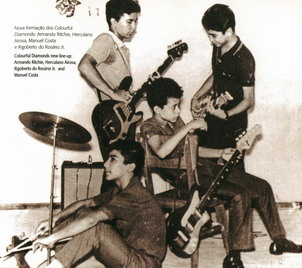
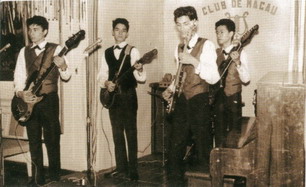
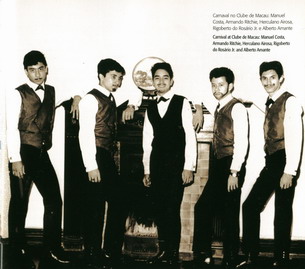
first appearance of the new line up of the Colourful Diamonds (Armando
Richie’s debut), was at the Carnival party at the Club de Macu, where they
playd all right until
As a
matter of fact there really was no money for anything at all… When the
band got together, recalls Herculano, their main trouble was gathering money to
buy proper instruments. At the
beginning they managed by getting some material here and there. Their second-hand loudspeakers, restored
to good use, were acquired from “Chico-Chai” who owned a sound
system repair shop in a small alley of Rua da Palha, the area around
But
amplifying those mishaps during rehearsals added more insult to the
injury. To this day, Alou is still
mortified when he remembers teacher Augusto Canhota, who was their third floor
neighbour, just below where he used to rehearse daily, in a bulding at Rua D.
Belchior Carneiro. Forever praised
the qualities of understanding and tolerance of the Canhota, a very religious
couple that would recite the Rosary every night at
After
Herculano moved to Av. Conselheiro Fereira de Almedia, a landed property with a
back door to Tap Siac road, they found new victims for the high decibels: the
Batalha da Silva and Braga families.
But since they played reasonably well by then,
and there were other youngsters in the neighbourhood to lessen the sound
impact, no reason for ill-feelings were ever created.
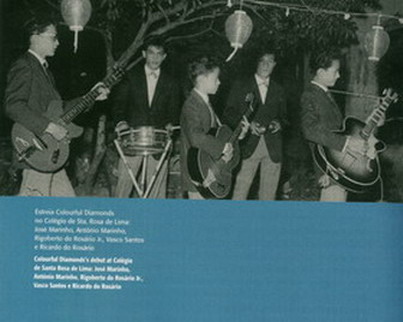
The
original Colouful Diamonds appeared in 1960 and included two Rosário
brothers, (Ricardo and rigoberto): two Marinho brothers (António and
Joséand one Vasco Santos, all aged between 12
and 17. With Leonel (Neco)
Barro’s help, and just a few months of rehearsals they were ready for
their public debut performing in 1961, in a bazaar at Colégio Santa Rosa
de Lima. This traditional bazaard
was held every year and attracted large crowds. The nuns managed little stalls selling
raffles, games and tidbits along both sides of the school’s large and
long stone stairway. Prizes were
voluntarily made and donated by society ladies for the bazaar and the labour
for assembling the stalls was often provided by soldiers sent by the military
headquarters and volunteers among the parishioners.
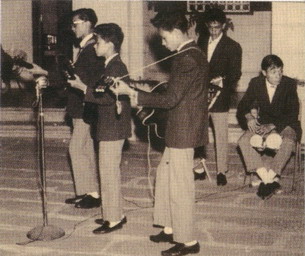
The
Colourful Diamonds evoked peals of applause, due to their young age rather than
their tuned performance. But
Rigoberto (Api) acknowledges the importance of that
debut, since many of the invitations for future performances came after
that. But they soon lost two of
their older band mates. Vasco
Santos took a job in
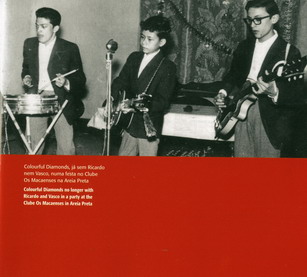
They
performed for the first time at the Clube dos Macaenses (previously called the
Clube-Melco, located in the Areia Preta neighbourhood). It was a real box office hit, with Api receiving loud cheers for his rendering of the song
“Little Darling”. Never
before in this town, had a child dared to sing a pop song, solo.
Music Festivals for
The
arrival of Mário Tomás, sergeant of the new military garrison
that replaced the territorial battalion settled in the Mong Há barracks,
brought some liveliness to town, since he formed a quintet who provided dancing
music to members of the Clube Militar (previously called Grémio
Militar). But Tomás went
even further and came up with the idea of organizing a music festival for the
local youth, following the trend in many European and American capitals.
He
rolled-up his sleeves in 1963 and managed to get nearly every local music group
to accept the invitation to take part.
Next, he succeeded in getting the permission of the owner of Cheng Peng
Theatre, Comendator Ho Yin to borrow the premises and also Dr. António
Nolasco’s promise of a sponsorship by the Centro de
Informção e Turismo, as it was then called.
That
year, audiences for the afternoon sessions of November 9 and 10 saw two
multi-faceted shows although it was intended to be a local pop bands
competition. It included Portuguese
folk music, folk dancing,, fox trot and bolero rhythms
in-between the ultra modern rhythms of twist and mashed potatoes. The Colourful Diamonds performed with
Herculano, Rigoberto, Humberto (Sonny) Fernandes, António Marinho and
Manuel Costa, all aged roughly 14-year.
They didn’t qualify and the three prizes were awarded to the Grey
Coats, to Mário Tomás e o seu Conjunto and to The Lovers.
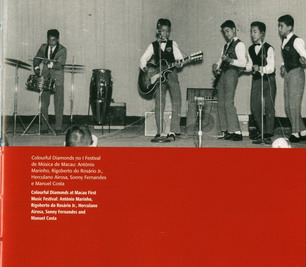
It was
very disappointing for the boys and it led to a few desertions: Sonny Fernandes decided to leave the
band and Alberto Amante stepped in (Amante was a former member of The Lovers,
the band that placed third at the Music Festival and that had come apart
meanwhile).
Nevertheless,
the youthfulness and potential of the Colourful Diamonds caught the eye of
entertainment entrepreneurs and very soon they were hired to play at the
floating casino Macau Palace (at that time moored in the Inner Harbour) and
also at Kam On nightclubs, which had recently opened, next door to the Riviera
Hotel.
It was
another local specificity of
The
quintet became a quartet once more.
Alberto Amante and António Marinho left and Armando Ritchie, the
one who didn’t know how to play anything, joined the band.
With
Armando, there formed performances at formal parties of the Club de Macau,
Clube Militar and other parties at the Escola Comercial and Liceu, and also at
the old Clube Macaense, then located in the Areia Preta neighbourhood, totally
unrecognizable nowadays. They
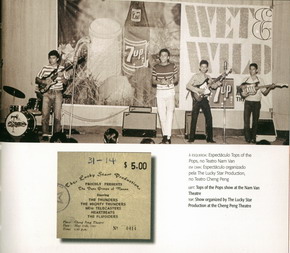
livened up private parties and took part in several music festivals and
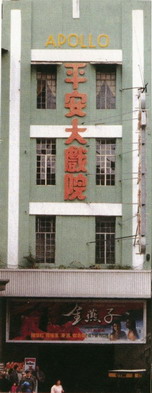
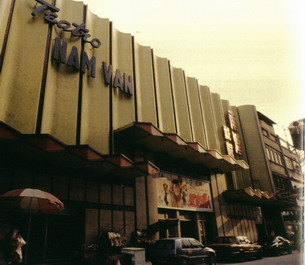
contests – Top of the Pops and Seven-Up Show, among others – staged
in threatres that were more inclined to such events as the Cheng Peng, the Nam
Van and Apollo Cinema.
The
boys would play at tea dances just for practice and basically for their own
enjoyment, since payment came often in the shape of goods and fried
noodles. The band was the first to
play at the tea dances at the Esplanada, a “café” previously
named Waltzing Mathilda established by an Australian gentleman. The Macanese manager, Cândida
Vieira, would allow them to pick any of the dishes of the menu along with a
small pecuniary compensation as payment.
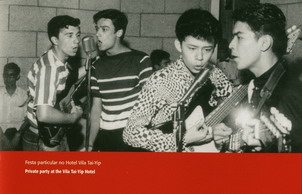
But they also played at the Vila Tai Yip, a guesthouse in Avenida
Rodrigo Rodriques owned by Comendator Kou Ho Neng’s family.
The
Colourful Diamonds were very sought after, with several invitations to perform
sometimes on the same day. Once
they attended three parties on a Saturday: three hours livening up he usual
Esplanada tea-dance, followed by a cocktail party at the British Consulate
(then located at Calçada do Gaio) where they played mood music for the
English guests; after dinner off they went to Club de Macau to provide the
dance music for the birthday party of an Australian young lady.
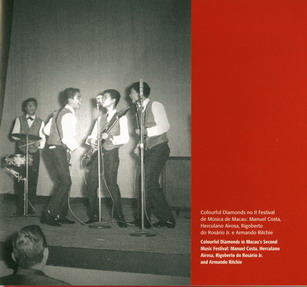
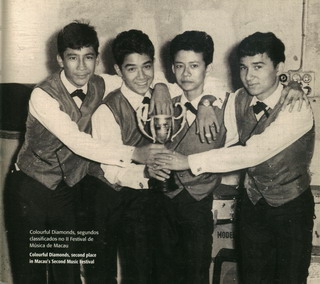
Mário
Tomás went on to organize a second festival on August 15 and 16, 1964. Once more Comendator Ho Yin let him use
the Cheng Peng Theatre to host the event, but this time with a different
sponsor: the Movimento Nacional Feminino presided by Natália da Costa
Freire. It was another festival
with mixed music genres, but this time the Colourful Diamonds earned themselves
the second place, even ahead of Mário Tomás e o seu
Conjunto. The winners were again
the “Grey Coats”, with the same line up as in he
previous festival. But they added
some originality to the contest by performing a burlesque limitation of the hit
song “A little bit of soap” which they called “Maria traz a
sopa” (Serve the soup, Mary).
The audience roared with laughter.
The Colourful Diamonds, with Alou, Api, Armando
and Manuel Costa also decided to present new original songs and give it their
best shot by including an acrobatic performance by playing guitar over their
shoulders. Api
sung his first composition “A minha tristeza” with Portuguese
lyrics. The following day, the press highlighted the whole festival and the
winners.
But
the person who was best impressed by the quintet was an entrepreneur from
Their
generous patron not only gave them a daily allowance for shopping, but also
presented them with new instruments so they could perfect their tunes. Besides making available one of the
houses he owned in Macau, in Avenida Sidób\nio Pais, just next to the
Victoria garden and monument marking the 1622 victory against the Dutch, so
that the boys would have plenty of space to rehearse. Up till the time the Colourful Diamonds
broke up, the house was also used for hosting Saturday evening dance parties.
From the Carnival
’65 till the founding of the Thunders
Alberto
Amante rejoined the Colourful Diamonds in 1965, playing the solo guitar and
piano so that Rigoberto could concentrate on singing. In that year, the band performed at the
Liceu and Club de Macau balls, during the three days of Carnival frolic. They played in turns with long-running
bands like the Banda Estoril (formerly the Rockers), thus named because they
were the hotel’s house band, and also with Tony Abeladro’s
well-known orchestra.
After
that, they had two new opportunities to perform in the Clube Militar balls, and
Api tells that one of their fondest memories is when the Governor and his wife,
approaching the stage while they were dancing and cordially complimented the
band, saying that by keeping their good work they would surely reach “the
top”. The youngsters were sol
filled with joy, that without noticing they speeded up their music.
Performing
at Macau’s nightclubs, they played at the Macau Palace, the floating
casino overflowing with colourful neon lights, docked at the Inner Harbour,
besides at Hotel Estoril, first opened in 1963 and no longer in business. Also the Hotel Caravela, on the
waterfront near “meia-laranja”, had a very pleasant
“café”, unfortunately torn down to give way to nothing as
the grounds on which it stood remains unoccupied to this day.
The
Colourful Diamonds signed a contract with Radiodifusão de Macau, then
based on the penthouse of CTT head office in Avenida Almedia Riberiro, and
recorded four half music shows to be broadcasted weekly. But the band would break up shortly
after when two of its members (Manuel Costa and Alberto Amante) left to join
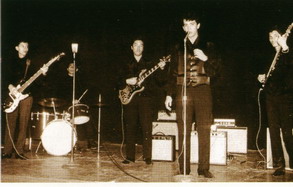
the Black Cats, founded by Domingo’s Rosa Duque (and João
Magalhães). Rigoberto (Api) himself followed them afterwards. The first line up of the Thunders were
put together by two former Colourful Diamonds members: Herculano (Alou) and
Airosa and Armando Ritchie. They
invited
Rehearsals
would take place at Alou’s new home, which had moved to Rua deo Tap
Siac. But this line up also
didn’t last long, and the three new recruits left the band. Armando and Herculano made the best of
the breaking up of the Black Cats (the band lasted between 1965 and 1966), and
got back Manuel Costa and Rigoberto Rosário to put the old band back
together, now called Thunders. The
local press, steadfast to Portuguese language, would soon rename them:
“Os Trovões”.
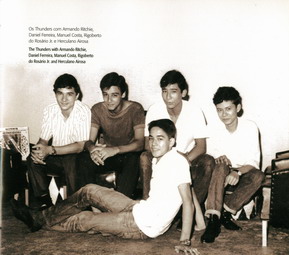
They invited Daniel Ferreira, who had already sung with several bands,
to relieve Rigoberto as lead singer.
On their first performances, at a party of the recently opened Escola
Comercial, on
Stepping to
success
On
They
were very down to earth and didn’t aspire to win the contest, which was
quite out of reach being foreigners and all that. They were actually the only non-local
band among many contestants from
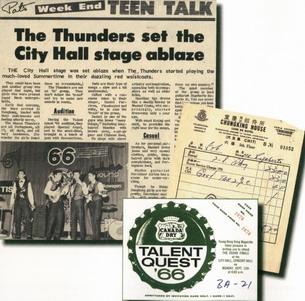
On
their return to Macau, Herculano who was in charge of marketing the band, took
a meeting with José Silveira Machado, teacher at the Escola Comercial,
and got his support and thumbs up from the school board to organize musical
shows in the school’s gym, in which some of the Hong Kong bands the
Thunders had met during the Talent Quest ’66 would take part. The contacts were established with the
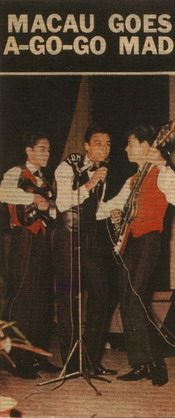
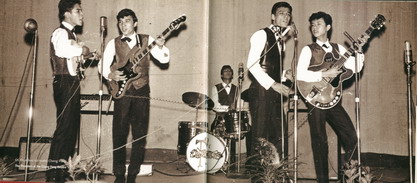
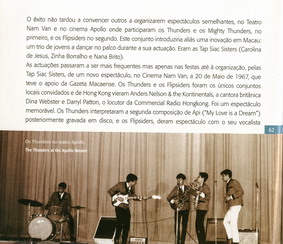
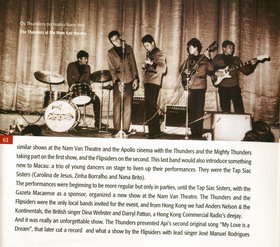
The
perfomances were beginning to be more regular but only in parties, until the
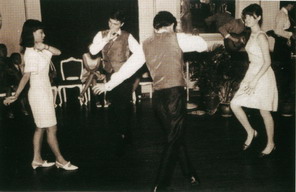
Tap Siac Sisters, with the Gazeta Macaense as a sponsor, organized a new show
at the Nam Van Theatrre. The
Thudners and the Flipsiders were the only local bands invited for the event,
and from
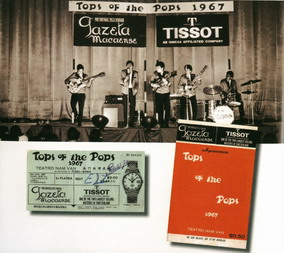
And it
was really an unforgettable show.
The Thunders presented Api’s second original song “My Love
is a Dream”, that later cut a record and what a show by the Flipsiders
with lead singer José Manuel Rodrigues (Chai Chai) fetching hysterical
cries from the girls sitting in the first row. He would later be turned into a craze in
One
week later, Anu Khan, the entrepreneur who organized the first shows at the Nam
Van and the Apollo, would bring another event to the Cheng Peng Theatre
gathering the Thunders, the Irmãos Espirito Santo, the New Telecasters
and the Flipsiders.
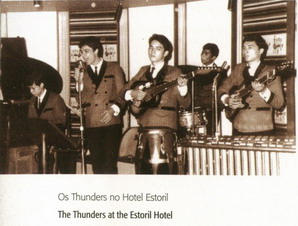
Since
in 1967 and faced with the need to hire a band to share the nightly performance
with the nightclub’s Banda Estoril, Hotel Estoril’s management got
in touch with the Thunders and gave them the opportunity to perform for several
weeks in one of the city’s most luxurious clubs. This invitation tasted as a sweet
victory, since it was an unusual honour for teenage bands to be given the
change to occupy such a post. By
then, they were faced with yet another desertion, this time that of lead singer
Daniel Ferreira who left the band for personal reasons.
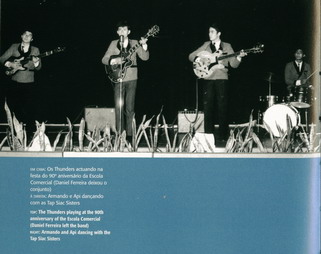
Along
with performances in parties at the Escola Comercial and in a show sponsored by
the charitable institution “Obra das Mães” at the Cheng Peng
Theatres, as from Spring of 1968 the Thunders played
at the Macau Palace Casino for three months. They did attract big audiences, but lost
in turn part of their devoted female fans, since it was ill regarded for young
ladies to hang out in cabarets. As
their season contract reached the end they returned to the Club de Macau and other
parties to once again entertain their cherished audiences.
Success in
In
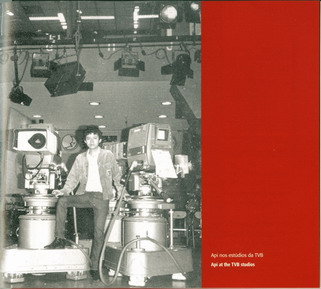
July 1968, newly created broadcasting HKTVB organized a pop music contest, to
be aired during the television program Star-Show, hosted by Sam Hui, TV
audience would decide voting. The
Thunders had some doubts as to whether they should take part. Their last experience in Talent Quest
’66 was still fresh in their minds.
But as HKTVB sent a team to
It was
then that Domingos Rosa Duque was invited to join the band. Besides the guitar, he was a good
keyboard player, and that was one of the instruments in fashion at that time.
Lelé recalls that he first started strumming the guitar, borrowed from a
friend, when he was about 13 years old.
Against his father’s wishes who would order him to study instead,
but his mother’s gave precious advice telling him to learn with
“someone who knew more than he did”.
On the
first trial round of the competition they decided to perform some of their
original songs as a way to stand out from the crowd. Songs like “Do it” and
“I Won’t Say Goodbye” granted them the lead through several
trial rounds.
In the
meantime they kept on rehearsing continuously and diligently back in
The
boys traveled back to
Appraised
and heartened by their fellows back home, the Thunders decided on making a
strategic move. “She’s
in
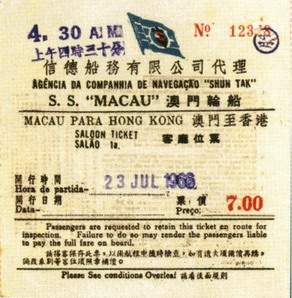
On
When
they boarded the homeland hydrofoil, they entertained some hopes of victory,
but still unable to cast away the feeling that it was a long shot.
Two
days later, Herculano got a call from the producer of the Star Show, announcing
the Thunders’ victory and telling them they were on the line up of the
following show with the awards ceremony.
The
whole Tap Siac neighbourhood was overflowing with joy when the results were
announced over the HKTVB.
Rather
than winning the contest, they were rejoicing most for the fact that they would
be able to cut a record deal with EMI.
They would be the first Macanese badn to launch a record with original
tracks under a famous record company.
Tony
Pereira and Alberto Alecrim, from the Emissora de Radiodifusão de
On the
day of the award-giving ceremony, the boys realized how popular they had
become, when dozens of new fans awaited them at the studio entrance in
They
were much applauded by the studio audience. And also received watches as prizes,
medals, invitations to dinner in luxury restaurants, and from the hands of
Columbia-EMI sales manager, Robert Ascott, the contract, or more precisely the
“makeshift” contract (since the real one would be signed some days
later pending legal advice and support).
It was
a contract for the recording of a single issuing only two thousand copies, since the company wasn’t sure how well they
would sell. On the other hand the
Thunders had nothing to lose because they didn’t have to invest any money
in it.
“She’s
in
Unprecedented sales
success
They
travelled to
This
only shows how difficult it was for the boys to believe they weren’t
dreaming: after all that they would truly be the first Macanese teenage band to
cut a commercial record.
A
fortnight later, Alou’s phone ringed once more. The records made in
A
couple of days later, the record was already available at the shops, and the
first shipment, with the support of Macau and Hong Kong’s press and
radio, quickly sold out. A second
edition of 50,000 copies was issued and later on a third one of 100,000
copies. Robert Ascott was so happy
with the records sale that he admitted in an interview he had never seen
anything like it in this part of the world. The only reverse of this phenomenon
– as Api mentions – was the circulation of
counterfeit copies at half the price.
They showed up in light green vinyl (because on those day counterfeiters
made sure their product had some “uniqueness’ too).
You
could hear “She’s in
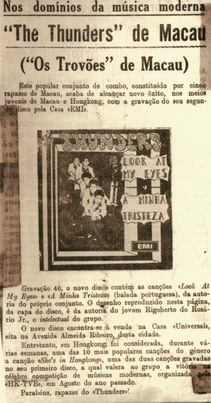
A
group of friends led by José dos Santos Ferreira (Adé) then
secretary of STDM, was organizing a homepage party for
the Thunders, in which all the profit would be handed over to them.
The
party took place on
The
following week, the Thunders were invited to perform at the Casa Lisboa
restaurant in
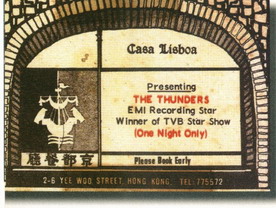
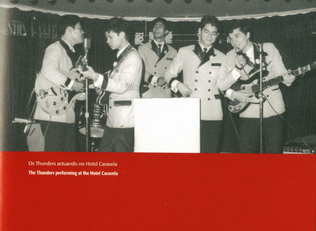
There
were also performances at some events like Irene Ryder’s birthday party,
the Menace show, a farewell party for Marilyn Palmer and the Blue Star Sisters
and also appearances on TVB and RTV.
In
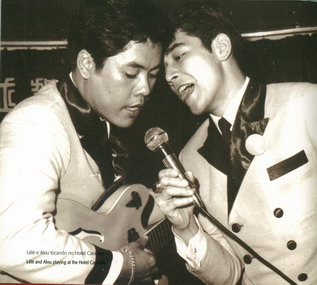
New
Music shows became happenings in Macau, like the one organized by Leonel
Sequeira, on November 3rd, 1968, at The Cheng Peng Theatre a gain sponsored by
the “Obra das Maes”.
Besides the Quests from Singapore, Marilyn Palmer, a five-year old
child-star Rowena Cortez and also Anders Nelson, the only local band that took
part was the Thunders, Ray Cordeiro and Johnny Reis co-hosted the even in
English and in Portuguese. The
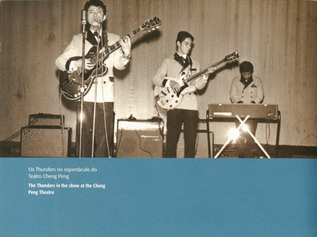
Thunders became professionals in 1968, when they signed a three-month contract
to perform daily at the Copacabana Night Club in Tsim Sha Tsui,
But
Manuel Costa and Armando Ritchie made their choice to stay in
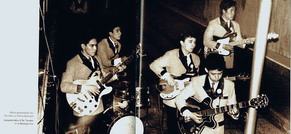
Sent back for
lacking visas…
But things turned sour right on their debut. They were held up by
While
“forced” to enjoy three weeks of compulsory holidays, they watched
four
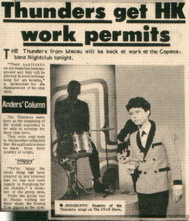
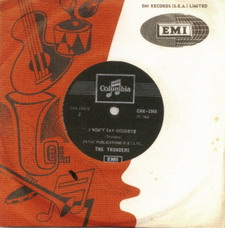
Robert
Ascott led them to record their third single featuring “Summer Fun”
and “I won’t say Goodbye” (1969), but only the second has
Rigoberto’s authorship. The
song “Summer Fun” was written by a young Chinese couple, winner of
a contest launched by the Hong Kong Municipal Hall for a beach promotion campaign,
and it was given to the Thunders to record. That song played all summer long at the
beaches, radios and TV.
They
also got a role on the
The
Thunders shared the stage of the Copacabana with
appearances. During that period,
they recorded eight of the ten Thunders themes we know today, nine of them
composed by Rigoberto.

When
the contract with the Copacabana ended, they signed another to perform at the
Spider’s Web, but Armando Lopes chose to quit the hectic nightlife and
return to
Macanese to join the band.
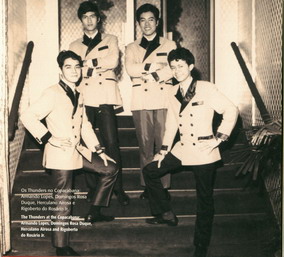
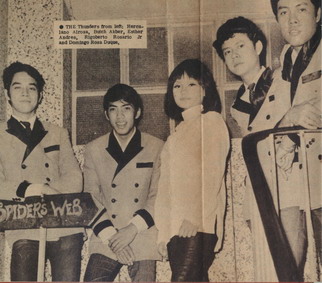
The Thunders with Rigoberto, Herculano and Domingos played every night
at the Spider’s Web, one of the many nightclubs bubbling with many
American marines and GI’s on leave in
A new
contract ensued, and a new nightclub: the Nightbird. By then another “old timer”
left the Thunders. Called to serve
military duty in the end of 1969, Lelé is also forced to quit the band
and return home. To replace him but
not for long, came Sonny Gomes, one of the founding members of the band then
playing at the
Deals
to perform in
they refused. The Filipino
quintet that benefited from their refusal was decimated on their debut when a
terrorist planted a time bomb on the drums. The explosion also killed some of the
many American soldiers, usual customers at the club.
”
One
day Robert Ascott called Herculano and Rigoberto and told them that he wanted a
“record with a fuller sound, combing EMI studio’s symphonic
orchestra.
Rigoberto
still had some originals he had never played, but nevertheless he decided not
to use them and do something he had been intending to do for quite sometime,
ever since he wrote “She’s in
They
spent their night-off from the Nightbird at EMI recording studios, starting at
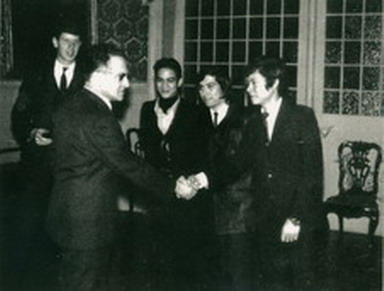
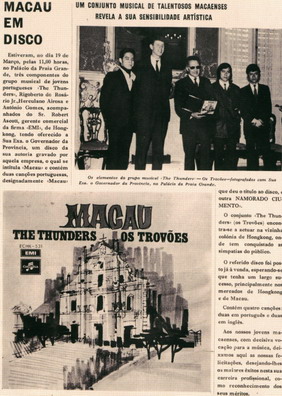
EMI’s
chairman had the good thought of asking for an audience with
Just
before their debut, scheduled for
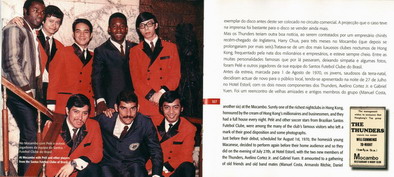
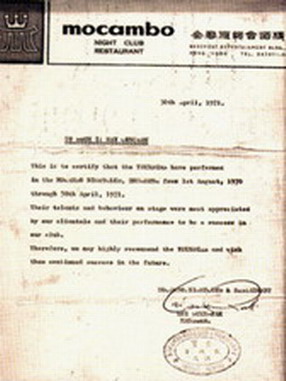
The
end of the contract with Mocambo also marked the end of the Thunders, leaving
Herculano, Rigoberto and Sonny Gomes as the stubborn last remainders of the
original line up. The other
musicians that joined the band, Filipinos and Chinese, came as they went. Their break up became public. The newspapers announced the
band’s end, and the public took a while to believe but the facts where
true. Fate has it that
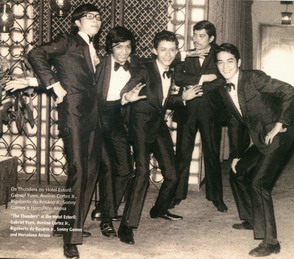
As a
matter of fact, lately some had been drafted for military service, others were
tired of a life of a long nights and nightclubs, conscious of the need to find
a more reliable job, get married and start a family. Waking up to real life or coming of age
fed the members of the Thunders to pack up one by one and return home or start
a life elsewhere. Armando went back
to studying and Manuel Costa to his old job at the Post Services (CTT). Herculano quit being a professional
musician and took a job at the Brazilian Consulate in
Api was the one who lasted longer in the music business, as he worked
with Brazilian bands and orchestras all the way until the end of the
80’s. Manuel Costa migrated
to
“There
is no longer drive, or room. The
type of music playing today at hotel bars and nightclubs is not music for
dancing, as it was in those days, and you no longer invite local bands. Macanese don’t throw birthday or
other parties at home anymore, inviting local bands to play. Times have changed” –
remarks Lelé, which in six years went through the Flipsiders, the Black
Cats and the Midnight Riders before joining the Thunders.
“Everybody
knew everybody. We all got along
very well, although we were constantly drifting to the next band because of
minor disagreements during rehearsals.
But there were no hard feelings.
There was no rivalry, and in truth, at that time when all was happening,
we didn’t realize the lengths of our success”, he says with a hint
of nostalgia still finding it a bit hard to believe.
As for
the other members who at one time were part of the Thunders during the golden
days (some staying longer other less), only António (Sonny) Gomes has
departed from this world.
César Placé moved to
Returning to the sounds at the
new millennium
Recently,
thirty years down the road, one of them decided to call the others;
“Lets’ play for old times sake?” It was Alou. Armando enquires his hands where they still
remember their place on the bass arm, learned by heart half a life ago. And Api finds it a good idea.
One
With
the invitation from the organizing committee of the Encontro dos Macaenses to
perform in
The
Story behind the music
SHE’S
IN
Written
especially for the finale of HK-TVB “Star Show”, which
gave the Thunders their victory.
Music and lyrics by Rigoberto do Rosário Jr. in collaboration
with Herculano Airosa. During the
show’s several eliminating trials they performed other Rigoberto do
Rosário Jr.’s compositions some with lyrics selected from Isabel
Batalha (Airosa) and Bambi Leitâo’s notebook, which never recorded
in a record. It’s a song
about a sailor who travels around the world and finds true love in
MY LOVE
IS A DREAM (1968)
Written
by Rigoberto do Rosário Jr. in 1966 and performed for the first time
before an audience during the “Top of the Pops” at the Nam Van
theatre. Later, it featured on the
Thunders first single “She’s in
LOOK AT
MY EYES (1969)
Music
and lyrics by Rigoberto do Rosário Jr. written during the time the
Thunders were performing in the Hotel Caravela in
A MINHA TRISTEZA (1969)
Written in 1964. This was the
first song Rigoberto wrote, at the beginning of his career. The spoken verses are by Armando
Ritchie.
SUMMER FUN
(1969)
Written by young couple from
I
WON’T SAY GOODBYE (1969)
The “other” side of the single “Summer
Fun” (EMI-Columbia). The fact that it
included the Chinese instrument pipa in its melody (as in “She’s in
Recorded due to EMI’s Robert Ascott’s insistence. It is the debut of the Thunders with a
symphonic orchestra backup, and also the first time the lyrics don’t
include any of the usual themes of that time: dating, love and jealousy. “
NAMORADO
CIUMENTO (1970)
Another
track of the record
GOODBYE
MY FRIEND (1970)
Lyrics and music by Rigoberto.
Again a theme apart from the usual boy meets girls
songs from that time. It is about
the parting of two song, somewhat premonitory,
foreseeing the future for the members of the band.