


WHAT ARE CLASSES LIKE?
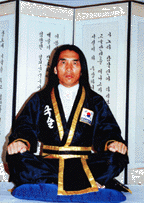
Classes are approximately one hour long. Each class begins with a short meditation session. Next, a series of stretching and conditioning exercises are performed; they are designed to stretch and strengthen the muscles and joints. After the preliminary warm-up, basic hand strikes and kicking drills are executed, followed by falling techniques, joint-locking techniques, and forms practice. Weapons training, along with other specialized training, complete the daily workout.
Most classes are scheduled by skill level -- the beginning students train together and the advanced together. Although children and adults train together in some classes, they are grouped according to skill and age as necessary. Also, class activities are modified when appropriate, such as in cold weather, when more warm-up is necessary.
Class activities
Meditation is encouraged at the beginning of each class for mental well-being and as preparation for class.
Stretching and conditioning exercises (mohm puhl gi), beginning immediately after meditation, are part of the curriculum to warm-up and condition the muscles, tendons, ligaments, and joints so that they adapt to doing the movements required in class.
Basic hand strikes (soo gi) and Kicking drills (johk sool) are performed to give the student practice concentrating solely on hand strikes or specific kicks.
Falling techniques (nahk bub) are specific ways of falling and landing to reduce or eliminate injury. In class, students practice falling techniques along with some acrobatics such as cartwheels, diving rolls and handsprings. Each student is allowed to participate and progress at his or her own pace according to their own abilities.
Forms practice (hyung) is a student´s most important training. It consists of "connected moves." These patterns of movements "condition" the body to the flow of martial art activities. Students are taught a specific form according to their belt rank. Forms are taught slowly and thoroughly.
In addition, instructors continually review forms with students to ensure accuracy. Practicing forms increases concentration, timing, balance, speed, coordination and control.
Joint-locking techniques consists of 270 sets for a total of 3,608 individual techniques for locking/breaking joints, redirecting/throwing/controlling your opponent and more. Through much repetition, spontaneity and automaticity can be developed to adapt these techniques in real life situations.
Weapons training begins at the red belt level. Staff (bong) spinning and form are introduced first to the student. As the student becomes proficient, other weapons are introduced. Kuk Sool has 24 different traditional Korean Royal Court weapons in the curriculum, plus Buddhist and family weaponry.
Specialized training introduces higher-level techniques, pressure-point training, advanced hand strikes and kicks, women´s self-defense, sparring and defenses against street fighting.