Background:
The Urban
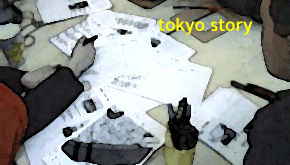
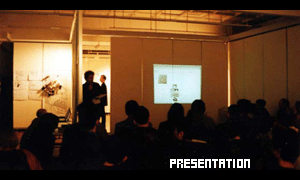
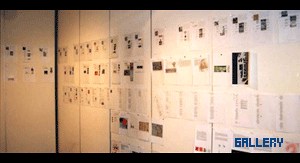
Gallery - Tokyo Story is a project organised by CHORA
architecture and urbanism in collaboration with the
Architectural Association London, the Berlage Institute
Amsterdam and Tokyo University. During a one week event
the Urban Gallery provides an interactive space that
enhances by its given interactive structure a necessary
negotiation process for urban planning. As a new planning
tool for complex urban environment, it is testing its
potentials for a new practise: urban curation. The Urban
Gallery is both, physically rooted in a specified location
in Tokyo and non-physically embedded in an interactive
e-space with link support teams in London, Tokyo Shanghai
and Amsterdam. In that Gallery various urban actors
and agents are brought together to design the Tokyo
Story. It contains four main spaces ,
-
database:
a collection of observed urban phenomena
-
prototypes:
imported devices for intervention
-
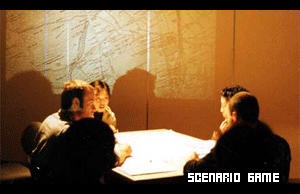
scenario
games: simulation of possible realities and
interactions between those phenomena
-
action
plans: procedure for immediate implementation
of those prototypes
The
Tokyo Story is aiming at the formulation of urban prototypes.
Urban prototypes are engines of change, instruments of
new urban form, linking as an organisational structure
larger contexts to specific environments. The Tokyo Story
is a life project unfolding in between the 30.03.00 and
the 05.04.00. That real-time product becomes an instant
exhibition space after the event which will be hosted
beyond others by the Venice-Biennale Web site and the
Graz media & architecture Web site.
Theory:
450
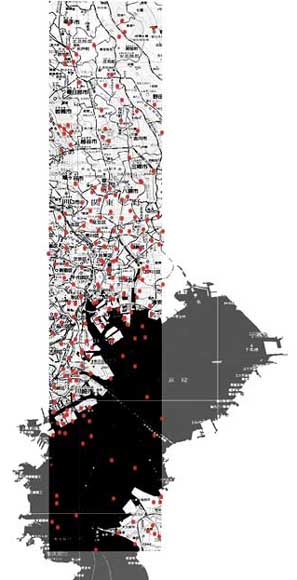
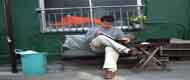
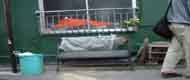
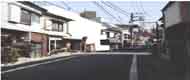
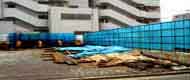
randomly chosen sites constitute the database for the
Tokyo Story
The
database is a collection of observations of emergent urban
phenomena. In a first stage the technique of random sampling
points at a critical number of beansites in the specified
frame in Tokyo. The random choice enables a cutting through
preconceived categories and reveals the way proto-urban
conditions affect specific environments. On the basis
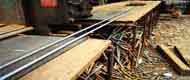
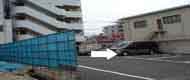
of fieldwork miniscenarios are developped that describe
encountered process in the specific beansites. A miniscenario
describes complex urban dynamics at a particular point
in space and time in form of a little narrative. The set
of four basic processes Erasure, Origination, Transformation
and Migration, is a framing device enabling to filter
and to articulate complex emergent phenomena. Operational
fields describe the underlying mechanisms of the observed
processes and relate actors and agents as driving forces
to those processes.
Erasure:
what is removed or taken away
Origination:
emergence at a single point in space and time
Transformation:
continuous change from A to B
Migration:
things moving through
Our
Team:
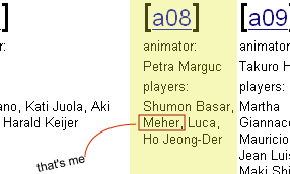
animator:
Petra Marguc
players: Jeong-Der Ho, Luca Kosuge, Shumon
Basar, Khurshid S Almeher,
Milicia Topalivic
The
Exercise:
[
the following links are generated from the original website
]
[ action
plan ] [a08]
[ miniscenario
m279 ]
[ miniscenario
m275 ]
[ miniscenario
m277 ]
[ scenario
game ] [s08] |