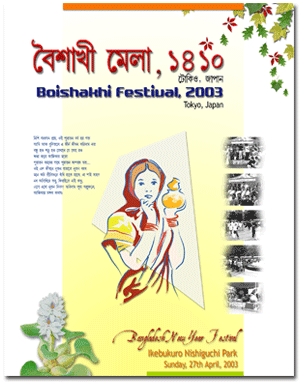
Foreward:
Boishakhi Festival,
Boishakhi Mela in bengali, or Bangla New Year Festival has
become a regular event in Tokyo in the recent few years. It
comes with with all kinds of colors and festivities every
year on the following Sunday of 14th April. !4th April on
the Roman calendar often coincides with the 1st Boishakh of
the original Bangla Calendar year. I have attached a brief
history of Bangla Calendar at the bottom of this page. Please
scroll down if you have interest in it. Incidentally I came
in touch with the chief co-ordinator of the Boishakhi Festival
2003 and we decided to have a designed souvenir. And there
you go. This was infact my first printjob. Not an excellent
work was it. But hey, I enjoyed it. I am only putting the
coverpage here. The others are all textual jargons. Let me
know if you can't wait to see the inside. Cheers!
[
To me, the most Authentic Website for
Bangla and Bangladesh is probably http://www.virtualbangladesh.com
]
|
[ Back to Works
Top ]
|
|
The History
of Bangla Calendar
Source: bangladeshshowbiz.com |
| |
| The Bengali Era
or Bangabda is used in Bangladesh, West Bengal and Tripura. It
is also used in Assam where it is called the Bhaskar (Sun) Era,
The era is an adaptation of the solar calendar that was introduced
by Emperor Akbar in 1584 AD. Netters will recall that the Hijri
era is based on the lunar calendar where the month of harvest
keeps shifting from year to year. This had made it awkward to
assign a fixed date for collecting taxes which became due after
harvest. Akbar's calendar was the Emperor's solution to the problem.
Persians, unlike the Arabs, follow a solar calendar where the
year begins on the day of vernal equinox (21st March). Akbar's
calendar was based on the Persian model. Though introduced in
1584 AD, Akbar had the calendar backdated to start on 21st of
March of 1556 AD which was the year he had ascended the throne.
This was the year 963 in the Hijri era.
Bengal adopted Akbar's calendar with certain modifications.
In 1556 AD, the Bengali calendar was assigned the year 963 to
coincide with the year in Hijri era which today reads 1418.
It is 1406 in the Bengali year.If we recall that a solar year
is about 11 days longer than the lunar year, it is not difficult
to figure out why the Hijri era has marched ahead by: [11 X
(1998 - 1556)] days = 13 years in the 442 years since 1556 AD.
There is one other significant difference with Akbar's calendar
which, like the Persian calendar and the Christian calendar,
had months of fixed number of days. The Bengali month, on the
other hand, is based on the ancient Sanskrit treatise, "Surya
Siddhanta" where the months are assigned by the zodiac
sign. The sun's stay under a zodiac sign varies from year to
year. That is why any Bengali month can vary in length anywhere
from 29 to 32 days. The sun enters the Mesh Rashi (Aries) on
15th of April, give or take a day.This marks the beginning of
the Bengali year and is celebrated as the first of Baishakh.
The Bengali calendar is a prime example of the eclectic spirit
that had prevailed during the rule of Emperor Akbar. It was
a synthesis of features from ancient Indian calendars based
on "Surya Siddhanta" with those of the Hijri calendar
and the Persina calendar. No wonder that the Bengali calendar
is catering successfully to the needs of a quarter billion Muslims
and Hindus of Bangladesh and Eastern India.
I end this posting with a SHUBHO NABABARSHA
(Happy New Year) greetings to all the netters. May it herald
the beginning of an era of harmony in the strife torn subcontinent.
|
| |
The
Evolution of Bengali
Source: virtualbangladesh.com |
| |
| Bengali belongs
to the easternmost branch, called Aryan or Indo-Iranian, of the
Indo-European family of languages. Its direct ancestor is a form
of Prakrit or Middle Indo-Aryan which descended from Sanskrit
or Old Indo-Aryan. Sanskrit was the spoken as well as the literary
language of Aryandom until circa 500 B.C., after which it remained
for nearly two thousand years the dominant literary languages
as well as the lingua franca among the cultured and the erudite
throughout the subcontinent.
Like Sanskrit, Apabhramsa-Avahattha was a literary language,
and in the available records it shows remarkably little local
variation; practically the same form of the language appears
in the poems written in Gujrat and in Bengal. But the spoken
language conditioned by the regional linguistic and ethnic environments
took up the different regional New Indo-Aryan languages. The
emergence of these New Indo-Aryan speeches was not all synchronized.
But some of them, including Bengali, certainly originated by
the middle of the tenth century at the latest.
For old Bengali the only records are mystic carya songs discovered
in a MS from Nepal by Haraprasad Shastri.The language of the
carya songs is basically vernacular, but at the same time it
is also something of a literary language.
Bengali at the present day has two literary styles. One is
called "Sadhubhasa" (elegant language) and the other
"Chaltibhasa" (current language) . The former is the
traditional literary style based on Middle Bengali of the sixteenth
century. The later is practically a creation of the present
century, and is based on the cultivated form of the dialect
spoken in Calcutta by the educated people originally coming
from districts bordering on the lower reaches of the Hoogly.
The difference between the two literary styles is not very sharp.
The vocabulary is practically the same. The difference lies
mainly in the forms of the pronoun and the verb. The Sadhubhasa
has the old and heavier forms while the Chalitbhasa uses the
modern and lighter forms. The former shows a partiality for
lexical words and for compound words of the Sanskrit type, and
the latter prefers colloquial words, phrases and idioms. The
Chalitbhasa was first seriously taken up by Pramatha Chaudhuri
at the instance of Rabindranath Tagore during the early years
of the first World War. Soon after Tagore practically discarded
Sadhubhasa, and Chalitbhasa is now generally favored by writers
who have no particular fascination for the traditional literary
style. The Sadhubhasa is always easy to write but it is somewhat
faded in signification and jaded in rhythm.
The Bengali script, like all other Indian scripts, originated
from Brahmi alphabet of the Asokan inscriptions.The Bengali
alphabet in its present printed form took shape in 1778 when
printing types were first cast by Charles Wilkins. There still
remained a few archaic forms and these were finally replaced
in the middle of the nineteenth century.
|
[ Back to Works
Top ]
|