
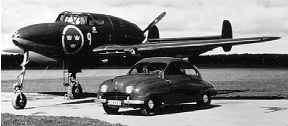
 The Saab 92 was Saab's first attempt at making a car. It was created by a group of aeronautical engineers, some of whom did not even have a driver's licence.
 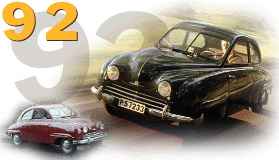 Quirky, odd or just outright weird, it defied conventional classifications and was shaped like an aeroplane wing. As numbers 89, 90 and 91 had been used for aircraft, it was numbered 92. It was available in any colour you liked, so long as it was aircraft green.
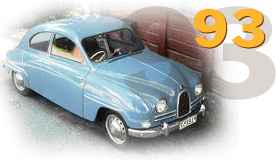 The 93 smoothed the styling cues of the previous car while bringing a new longitudinal 33-hp three-cylinder engine to the successful shape. The 93 would prove even more successful than the 92 - largely, because the 93 was the car that brought Saab to the U.S. market. The 93 had a swift start in the U.S., from its debut at the 1956 New York International Auto Show. A brace of 93s entered that year's Great American Mountain Rally, a 1500-mile trek over wintry New England trails. The 93 took first place.
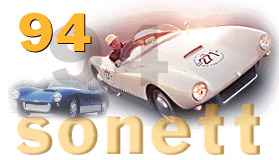 Saab's aborted effort at a sports roadster boasted promising specs, including a fibre-glass body over an aluminium chassis. At just over 1000 pounds and with 57 horsepower from its two-stroke triple, the first Sonett offered a better power-to-weight ratio than a 1956 Porsche Carrera, but only 6 were made. It caused a sensation at the Stockholm Car Show of 1956 and set the flying kilometre speed record as recently as 1996.
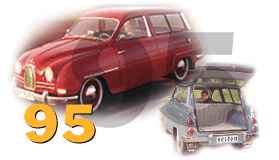 Saab's first wagon model was easily one of the most unique models available in its time. It was the first Saab with four forward speeds; it was also the first Saab with a flexible seating arrangement. Depending on how one used the middle bench and the forward-facing rear seat in back, the 95 could become a two-seat cargo van, a five-passenger wagon, or a seven-passenger people hauler.
The long-lived wagon demonstrated how durable the company's reputation had become. The 95 lasted in the Saab lineup until 1978, with timely updates to its convenient features - additions such as the V-4 engine that would power all Saabs, and the company's own safety innovations, including headlight wipers.
Saab's first wagon model was easily one of the most unique models available in its time. It was the first Saab with four forward speeds; it was also the first Saab with a flexible seating arrangement. Depending on how one used the middle bench and the forward-facing rear seat in back, the 95 could become a two-seat cargo van, a five-passenger wagon, or a seven-passenger people hauler.
The long-lived wagon demonstrated how durable the company's reputation had become. The 95 lasted in the Saab lineup until 1978, with timely updates to its convenient features - additions such as the V-4 engine that would power all Saabs, and the company's own safety innovations, including headlight wipers.
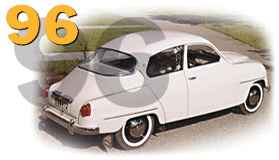 The 96 sported the 93's front end with completely new rear styling and a more powerful 38-hp three-cylinder engine. The famed Saab rally cars of the 1960s were essentially 96s, with increased horsepower. Rally legend Erik Carlsson drove one to victory in the prestigious Monte Carlo Rally in 1962 and 1963. In 1975, the company celebrated its silver anniversary with a special edition of the 96 - painted silver. In turn the 96 rewarded the company with a surprise gift from Finland - a first, second, and third place sweep of that year's Finnish Arctic Rally.
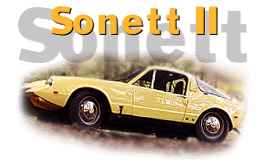 In 1966, Saab's design studio penned the first production Saab sports car -what would become the Sonett II. It was a combined effort from Saab's own studio and an outside design firm.
 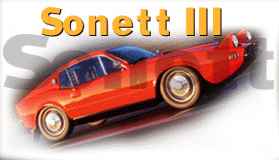 But when it was first shown at the Geneva Motor Show in 1966, the Sonett II showed nothing but Saab heritage inside and out. Its two-seat shape shared the two-stroke, three-cylinder engine of the Monte Carlo: triple carburetors increased its output to 60 hp. In 1970, Saab designers and Italian Sergio Coggiola had recrafted the shape -and Saab renamed the car the Sonett III.
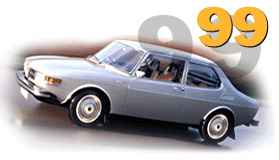 Powered by an 80-horsepower in-line four, the 99 broke new ground in automotive safety with its power-assisted four-wheel disc brakes, safety cage construction, self-restoring 5-mph bumpers and side-impact protection.
 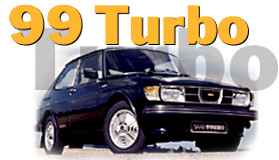 By adapting a test rally-car feature to a normal passenger car, Saab brings out the world's first headlamp washers and wipers. Over its 17-year life span, the 99 received many refinements, but at least one thing remained the same - the ignition switch, mounted on the floor. The high-water mark for the 99 would come in 1976, when the Saab Turbo concept introduced the world to mass-production turbo charging.
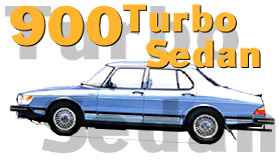 The Saab 900 - the brand's most successful model line ever -- was unveiled in 1979, with the company's innovative turbocharged engines available from the outset. Standard equipment on the new 900 was the auto industry's first pollen filter in climate control system, as well as self-repairing bumpers.
 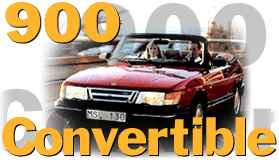 One of the most important developments in the first generation of the 900 was Automatic Performance Control (APC), a system that automatically adjusts turbo boost for differences in fuel grades. The company pioneered asbestos-free brake linings when it added them to the 1983 900 model. Anti-lock brakes made their first appearance on the Saab 900 in 1989. The highlight of its career may have been in 1990, when it was fitted with a new light-pressure turbo - an engine that provided 145 horsepower, excellent fuel economy, and still met stringent fuel economy standards.
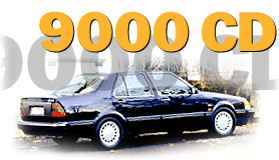 The 9000 was an outgrowth of a loose collaboration between Saab and Fiat to share ideas on developing a large-car floor plan and body structure. In the end, the cars shared very little componentry, but the exercise gave Saab the 9000, while Fiat would introduce the similar Alfa Romeo 164, Fiat Croma, and Lancia Thema. The 9000 was uniquely Saab, in spite of these common beginnings.
 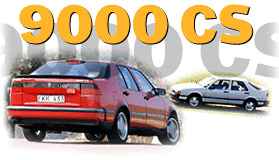 To maximize interior room, it had the first transverse engine in Saab history-- the now-renowned turbo charged Saab four-cylinder engine, a two-liter, sixteen-valve four with APC, producing 175 horsepower. Most surprising was its interior room, which qualified it as a large car by EPA standards - despite the fact that, in overall length, the 9000 was marginally shorter than the contemporary Saab 900.
In 1993, the 9000 received yet another biennial Folksam Award for safety; for the third consecutive time, the 9000 was recognized as the "Safest Car in Sweden." In 1994, a blistering 225 hp Aero addition was added to the lineup, while in 1995, it gained V-6 power with the addition of a 3.0-liter, 210 hp V-6. And in 1996, the 9000 benefited from a new standard engine -the award-winning 170-hp Light-Pressure Turbo.
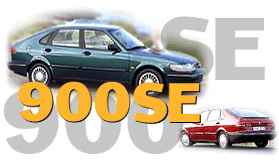 It had been fifteen years since the 900 carved its niche out of the sports-sedan realm. And since then, Saab had partnered with global giant General Motors to build a new generation of Saab automobiles. The first results of that Saab-GM partnership came to market in 1994, in the form of an all-new 900. A genuine Saab down to the floor-mounted ignition switch, the 900 arrived on the market in 1994 with plenty of Swedish tradition and innovation, especially under the hood. Saab's own 2.0-liter, 150-hp four-cylinder was the base engine; an optional 170-hp, 2.5-liter V-6 was Saab's first-ever six-cylinder engine.
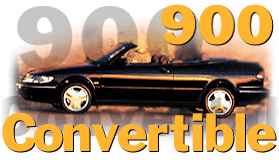 The new 900 came with dual airbags and anti-lock brakes standard, as well as an automatic climate control. And on six-cylinder models, traction control appeared for the first time in a Saab. The characteristic Saab grille and C-pillar graced just one body style at first, a five-door hatchback. That body had received the most intense testing ever on a Saab model - in the end, it proved 55 percent more rigid than the previous 900. The next year, a three-door hatchback rejoined the lineup, as well as two models that needed little introduction - the road-hammering Turbo (with 16 valves, APC, and 185 horsepower) and the handsome Convertible.
The Next Generation
In 1998, Saab introduced an all-new 4-door sedan. Logically, it should have been named the Saab 90000, but Saab decided to name it the Saab 9-5, pronounced "nine five". This was followed by the Saab 9-3 and the Saab 9-5 Wagon. New features include the world's first asymmetrical V6 engine, Saab Active Head Restraint (headrests which considerably reduce the risk of whiplash injuries) and ventilated front seats. The complete line-up is featured in the Main Saab Page.
 [Back to the Main Saab Page]
 Links to Saab sites on the Web
Saab Automobile AB
Saab Cars USA
The Saab Network
Please direct all queries and comments to [email protected]