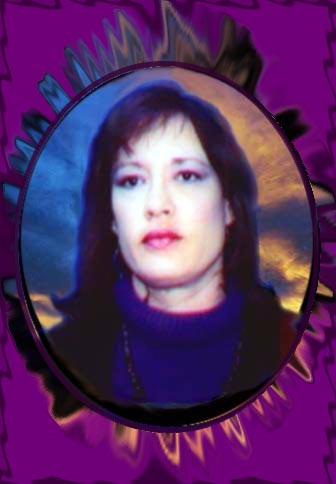
The Egg Lady
I am Judy Cochran, a Master Folk Artist with the Kansas Folk Arts Apprenticeship Program, sponsored in part by the Kansas Arts Commission and the National Endowment of the Arts.
In 1984, I was living on a farm outside a small community in NW Kansas. As a hobby, I was raising my own chickens, turkeys, and geese, selling chicken eggs for 50 cents a dozen to pay for feed. My mother, National Fellowship Heritage Award winner Sonia Domsch, had returned from a Folk-life Festival with two chicken eggs she had purchased from Kepka Belton. They were beautiful, and when she told me that she had paid $7 each for them, of course I had to know how to make those eggs. I tried on my own to duplicate the eggs using paint and tole-painting techniques, but soon became frustrated, realizing that some other technique was used to produce the eggs.
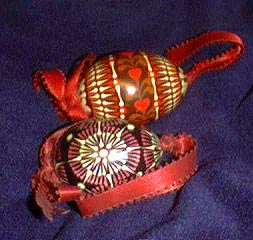
Mother knew very little about the technique, only that the art was known as Kraslice, and that Kepka Belton from Ellsworth had made them. The next time she and Kepka were at the same festival together, she inquired about the art. She returned with a Lap Studio, which Kepka had developed and a short book on the technique. I set right to work. I found the technique fairly easy. My first few eggs, though crude, were taken to Kepka, via my mother, to show her my progress. She was quite impressed and suggested that I apply for the apprenticeship program. This was the first year for the program.
Kepka's eggs Mom brought home
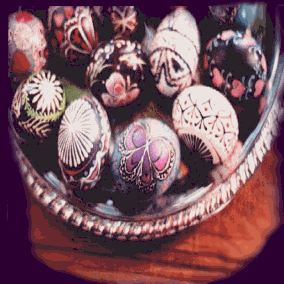
The apprentice and the artist applied together, each listing their background, plans and accomplishments. This is not a program for beginners; one has to have some knowledge of the art form.
The application must be accompanied by slides of ones work. I applied in the fall of 1984 for the 1985 program and was accepted. My apprenticeship consisted of five, eight-hour sessions, which were to take place between January and June of 1985 in Ellsworth, Kansas, at Kepka's home.
First year apprentices, Richard Barnhill and Judy Cochran, with Kepka (middle).
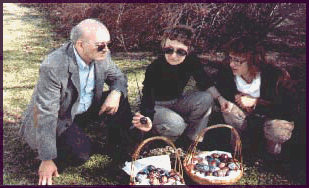
I apprenticed with Kepka for two consecutive years, in 1985 and 1986. I used 1987 to practice, spending as many as 12 to 14 hours a day producing decorated eggs. I was rewarded in 1988 by applying with an apprentice of my own and being accepted as a Master Artist in the program. In order to preserve an old art form, an artist must share their knowledge with others to keep it alive in the hearts and minds of people today. Though I have had only one formal apprentice with the program, I have worked with several other individuals either one-on-one or in workshops.
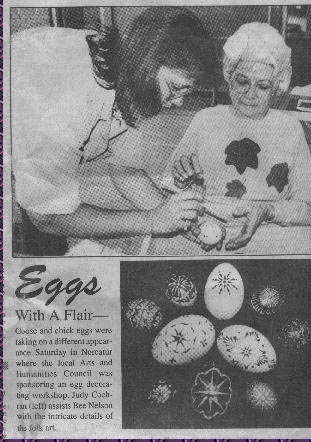
Oberlin Herald Photo