PREPARING FOR YEAR 8 HISTORY EXAMINATION
Length : 1 hour
Format : There will be THREE QUESTIONS. You will have to answer ALL three questions. There will be a mixture of sources and knowledge.
Q1 will focus on Tudor Propaganda. You will need to know:
(a) Why portraits were seen as an effective method of propaganda and why they felt this was necessary?
(b) What problems faced Elizabeth I and how she tried to overcome them with portraits
(c) You need to know about the following examples of portraits – The Coronation Portrait, The Rainbow Portrait, The Pelican Portrait, The Armada Portrait, The Darnley Portrait – when produced, why, what they show, what symbols are used and what they mean
(d) The various symbols used and what they meant.
Q2 will focus on Religion. You will need to know:
(a) Key differences between Catholics and Protestants
(b) Religious beliefs of Tudor monarchs and where Elizabeth stood
(c) What Catholics thought of Elizabeth
(d) Know why Catholics seen more of a threat after 1568
(e) Know AT LEAST two Catholic plots against Elizabeth – who involved, plan, what happened
(f) Missionary priests – who were they, what did they want to do, how successful?
Q3 will focus on Mary, Queen of Scots
(a) Why was she a threat to Elizabeth?
(b) Why were her marriages a disaster – why was she forced to flee Scotland?
(c) Why was she a real danger after 1568
(d) Why was Elizabeth reluctant to execute her?
(e) Why was she executed?
(f) Did Elizabeth have the right to execute her?
NB : Remember you need to know the information but you will also have sources to help you. These will contain useful information. You may also be given a list of information that you should include in your answer.
TUDOR PROPAGANDA
Y8 history – revision notes
Throughout history, kings and
queens have been keen to get their message across to the people that they rule.
They have used coins, statues, written accounts, poems, posters etc. Few people
would actually ever get to see the king and queen and so the use of propaganda
was very important.
Henry VIII and Elizabeth both
recognised this. They knew the importance of projecting a certain message to
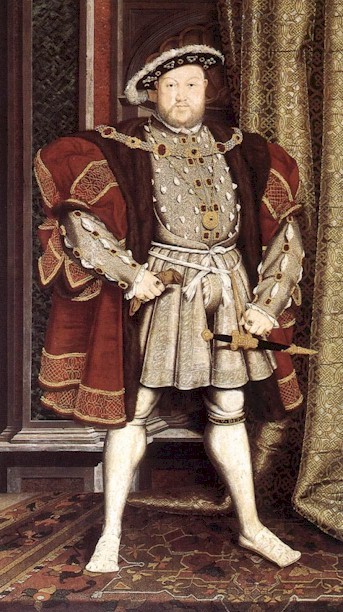
people. Henry VIII used posters like the one below to present an image of a
strong, confident king fully in control of the country:
The use of symbols was extremely
important. There are several symbols in this picture, for example his hand on
the dagger shows a warrior prince, someone who is great in battle and can defend
his kingdom, the posture shows a king who is sure of himself and strong.
The Tudors used other methods to get their messages
across. One was to tour around the kingdom and to be seen by people. However,
this ROYAL PROGRESS was often tiring and expensive and you would have to visit
areas that you knew were safe. Elizabeth, for example, was never totally sure of
the loyalty of the nobles in the north of England, as many were Catholics, and
so she rarely made a visit north of the Midlands. Every
year, Queen Elizabeth went on a royal progress around the country, staying in
the castles and palaces of the great and the good. This gave her the opportunity
to meet her subjects in parts of the country. Elizabeth visited her favourite,
Robert Dudley at Kenilworth in 1566, 1568, 1572 and 1575.
Entertaining Elizabeth was incredibly expensive, and Dudley did his best
to prove to the Queen that he was a loyal and devoted subject. When Elizabeth I went on a royal 'progress' around the country, she
needs 400 carts and carriages to transport her baggage and servants.
As well as visiting the homes of nobles, Elizabeth
also visited important towns. This is an account of her visit in 1575 to
Stafford:
Advance preparations included
pointing houses, gravelling the streets, and repairing the old town cross. When
she arrived she was met at the East Gate by the town bailiffs who presented her
with a tall cup worth £30: "(Alas poor soul other towns give us of their
wealth and you give us of your want)".
She then progressed to the market
place, where she "commended the situation of the town, and asked what was
the cause of the decay of the same". The answer was partly the decay of
capping, and partly the loss of the Stafford Assizes. "Her Majesty most
lovingly answered that she would renew and establish better the said statute for
Capping, and for the Assizes she gave her promise that the same should ever
after be kept at Stafford."
"And so after many most
sweet and gracious words to the great comfort of the poor inhabitants of
Stafford she passed along through the market place, and so in at the Crabbery
Lane to the Broad Eye and over at the new bridge where the bailiffs left her
majesty, her highness going directly to Stafford Castle where she stayed to
dinner and so parted thence."
The progress allowed her to be
seen and for her to make sure that the towns were well run.
Another method used was coinage,
as everyone would handle money at some stage. This was an effective way to
spread a message. Look at the example below:

This coin is useful as it shows
the Queen with her crown, emphasising that she is the rightful queen. It shows
the finery of her clothes, to emphasise her wealth. It shows the royal coat of
arms and has ER, Elizabeth Regina, which means Queen Elizabeth. The whole coin
is designed to reinforce Elizabeth’s position as queen and to make it clear
that she is in control and is the rightful ruler. When she first became queen,
many questioned her right to be queen. With this coin, Elizabeth is making it
absolutely clear that she is the queen.
Another important method was the
use of portraits. Look at the following famous portraits.
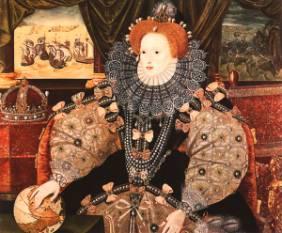 THE ARMADA PORTRAIT
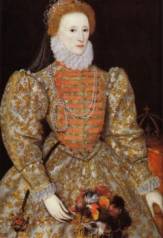
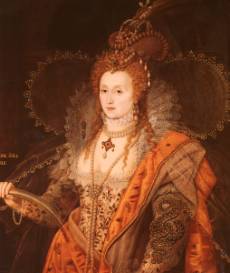
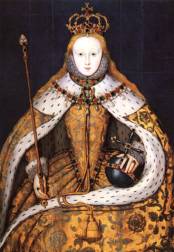
THE DARNLEY PORTRAIT THE RAINBOW PORTRAIT THE CORONATION PORTRAIT
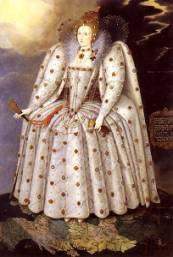
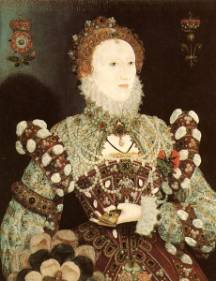
THE DITCHLEY PORTRAIT THE
PELICAN PORTRAIT
Each of these portraits has
images on them that convey a message. Look at the sheet below to see the images
that Elizabeth used. Look at each of the portraits above and make sure that you
know what symbols are used and what they mean.
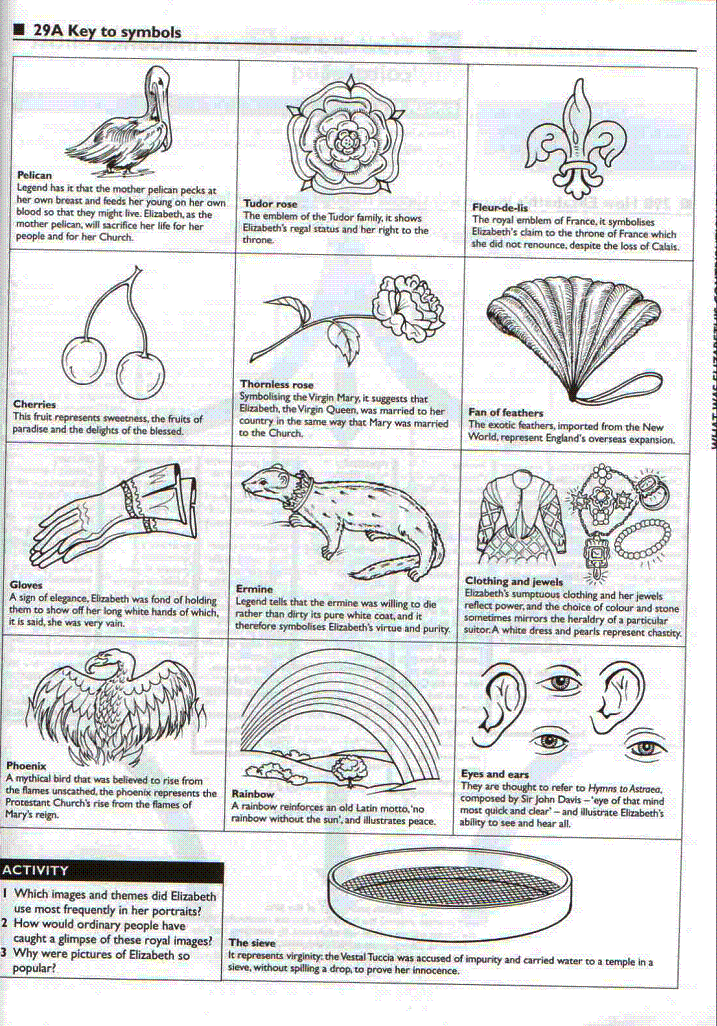
Elizabeth used propaganda to
overcome potential problems, such as being a woman, being seen as illegitimate
and not the rightful queen, being attacked by foreign powers etc. So she uses
the Tudor Rose to emphasise that she is a legitimate member of the family; she
uses the symbols of monarch – crown, orb and sceptre to show she is queen; she
uses a map to show she is in control; she uses the fleet to show the sun shines
on the victorious English and darkness covers the defeated Armada. Look for
other messages.
ELIZABETH AND CATHOLICS
(a)
Why did many Catholics not believe that
Elizabeth was the rightful queen?
n
When Henry VIII divorced Katherine of
Aragon, he was forced to break away from the Catholic Church as the Pope refused
to grant a divorce. Catholics, therefore, did not accept that Henry had divorced
Katherine.
n
If his marriage to Katherine had not
ended, then, according to Catholics, Henry could not legally marry Anne Boleyn
and so that marriage was illegal and so any children would be illegitimate and
so unable to become queen or king.
n
When Elizabeth was born, Catholics,
therefore, regarded her as illegitimate and so unable to succeed to the throne.
n
Instead they believed that the rightful
ruler had to be the closest legitimate member of the family, and that was
Elizabeth’s cousin, Mary, Queen of Scots, who was the grand-daughter of Henry
VIII’s sister, and Elizabeth’s cousin. The fact that Mary was a Catholic
also meant that many Catholics preferred her.
(b)
The differences between Catholic and
Protestant Churches
n
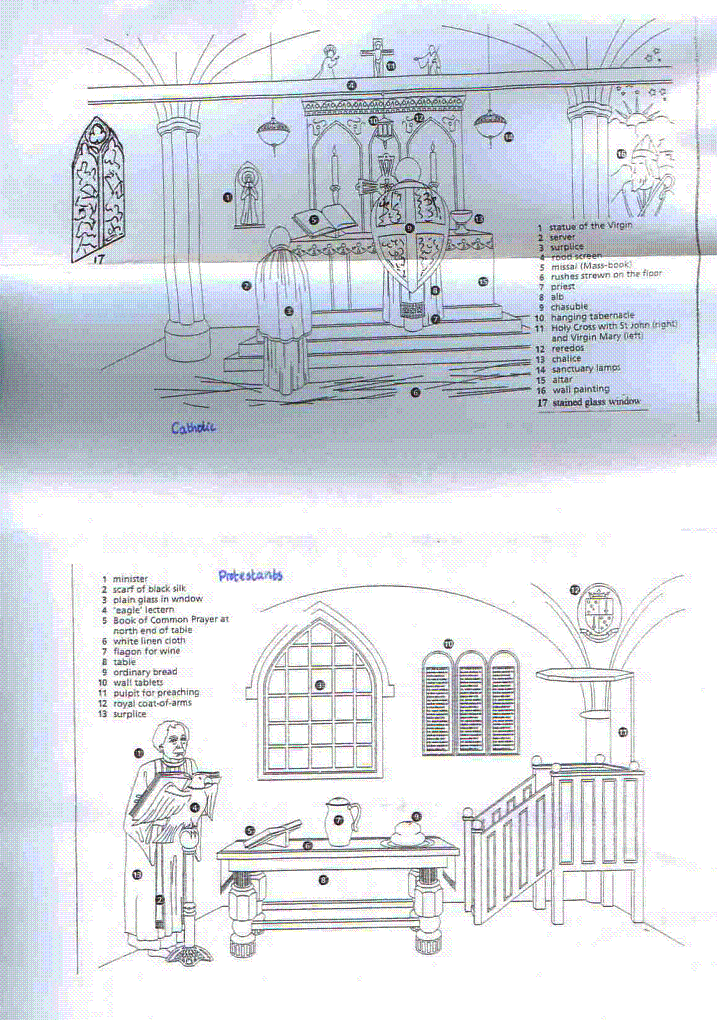
Look at the picture below, showing the
differences between Catholic and Protestant Churches.
n
Make sure that you know some of the key
differences
n
Look at the table below
|
PROTESTANT |
CATHOLIC |
REASON FOR DIFFERENCE |
|
No rood screen |
Catholics have a rood screen |
Protestants believe that there
should be no separation between the priest and the congregation. |
|
Have simple clear windows |
Have ornate stained glass
windows |
Protestants believe that there
should be simple churches with no imagery |
|
Bibles and Prayer Books in the
native language, e.g. English in England |
Prayer Books, Bibles, Services
in Latin |
Protestants believed that
ordinary people should be able to understand the services and read the
Bibles for themselves |
|
Protestants wore simple
garments |
Catholic priests wore ornate
robes |
Protestants thought they
should be humble before God. |
|
Coat of arms |
Statue of the Virgin Mary |
Protestants thought it was
wrong to worship Mary. They included the coat of arms of the Tudor family
instead. |
(c)
What did Elizabeth set out to do in her
Religious Settlement?
n
Elizabeth knew that religion had been a
problem for her predecessors. Henry had started as a Catholic, but had allowed
protestant reforms, before dying a Catholic again; Edward was a firm Protestant,
Mary was a fierce Catholic who burnt Protestants. Religion was a problem.
n
Elizabeth knew that the constant change
had caused confusion and unrest. There had even been rebellions under her
predecessors over religion.
n
When Elizabeth became queen in 1558 she
knew that most people in the country were Catholic. She also knew that there
were many Catholic countries, such as Spain and France, who would not like
England becoming Protestant under Elizabeth.
n
Elizabeth was a Protestant but she did
not want to turn Catholics against her.
n
She decided on a middle course. Her
Settlement would be Protestant but would be designed so as not to offend
Catholics.
(d)
Missionary Priests
n
Who were they? They were priests
trained in Europe and their mission was to return to England and help to restore
the Catholic faith. They started to arrive after 1570 when the Pope
excommunicated Elizabeth and sent them on their mission to oppose Elizabeth and
restore Catholicism. Some of them were English Catholics, others were
foreigners.
n
Why did they come to England? By 1570
with Mary in England, the Catholic powers, including the Pope felt there was a
good chance of overthrowing Elizabeth and restoring Catholicism. They also felt
that most English Catholics would help them as the Pope had now excommunicated
Elizabeth.
n
Were they effective? Historical views
Historians
are divided. Some think they had no effect because they went to the wrong area
of the country, there were not enough of them, and the government was very good
at tracking them down. Other historians think that although they did not make
England Catholic again, they did ensure that the Catholic religion did not die
out completely.
Christopher
Haigh : “The missionary priests managed to give courage to the Catholics in
England. They continued to defy the queen and to meet in secret. Without their
encouragement, Catholicism in England may well have died out. They brought hope.
They went all over the country to ensure that Catholics kept their faith.”
Susan Doran :
“The missionary priests were a failure. They were easily caught by the
government spies, they tended only to go to the south-east of England, where
most people were Protestants, and ignored the areas in the Midlands and the
north where there were Catholics crying out for help. There was also so few of
them, that they could never have been effective.”
(e)
Why persecution of Catholics increased
after 1570.
n
In 1568 Mary, Queen of Scots fled
Scotland and arrived in England, asking Elizabeth for help and protection.
Elizabeth immediately placed her under house arrest.
n
Mary was Elizabeth’s heir and,
according to many Catholics, the rightful queen. Those Catholics who were
disloyal to Elizabeth now had a figurehead in England. Catholic plots against
Elizabeth now began.
n
In 1569 a rebellion broke out in the
north of England, where there were many Catholics. This was known as the
Northern Rebellion. Although it failed, it showed that the presence of Mary in
England was giving encouragement to disgruntled Catholics.
n
In 1570 the pope excommunicated
Elizabeth. Catholics were now no longer under a religious obligation to obey the
queen, and anyone who killed her was promised access to Heaven Although most
Catholics remained loyal to Elizabeth, the government became worried about
potential threats from Catholics and so passed several measures to make life
difficult for them.
n
In the 1570s and 1580s there were more
Catholic led plots against Elizabeth – Ridolfi, Throckmorton and Babington.
n
Again the government stepped up harsh
laws against potential Catholic traitors.
n
At the same time the missionary priests
started arriving, and so laws were passed making it illegal to help these
priests. Many were captured and executed.
n
Then in 1588 Philip II, king of Spain,
sent a huge fleet (the Armada) to invade England. The fleet was defeated, but
the fear of Catholics increased and fines and penalties increased. Many
Catholics found life as a Catholic hard and so many drifted into acceptance of
Elizabeth’s religious policy. In 1558 about 2% of the population were
Protestant; in 1603 only 2% of the country were Catholics.
MARY, QUEEN
OF SCOTS
(a)
Mary’s marriages
n
Mary became queen when she was only a
baby, as her father, King James V, was killed in battle. However, Henry VIII saw
a chance to get control over Scotland and proposed that Mary marry his son
Edward. The Scots sent Mary to her relatives in France to make sure that Henry
could not get his hands on her and force a marriage.
n
Mary grew up in France. Her family, the
Guises, were one of the most powerful families in France. So she grew up at the
royal court and fell in love with Francis, the heir to the throne. When he
became King Francis II, this meant that Mary was now queen of Scotland and also
of France. She also claimed, when she heard that Elizabeth had been crowned, to
be the rightful queen of England. This infuriated Elizabeth
n
Her marriage to Francis was a very
happy one. They were deeply in love and Mary loved being in France, but not long
after he became King, he died of a brain tumour. Mary lost the husband that she
loved and her position as Queen of France. Mary had been extremely unlucky.
n
Mary returned to Scotland to find a
country divided by religious conflict. She was a Catholic but the country was
protestant. She found that her power was limited. She fell in love with an
English noble, Henry Darnley, who was also a Catholic and who had a claim to the
English throne. The marriage was a disaster. Darnley was unstable and violent
and sought to control Mary. His private life also caused scandal. Darnley became
jealous of Mary spending time with her secretary, Rizzio. He joined a conspiracy
to murder Rizzio. Mary was determined on revenge and Darnley was strangled later
on. Her second marriage had been a disaster and many now suspected that Mary had
been involved in the murder of her husband. Many lost faith in the Scottish
queen.
n
Many believed that Lord Bothwell was
behind the murder of Darnley. He then abducted and raped Mary. To everyone’s
surprise Mary then married Bothwell. This annoyed the Scottish people, who
rebelled against Mary and forced her to flee from Scotland. Bothwell also fled
to Denmark, where he later died insane in a Danish prison.
(b)
How Mary became a threat after 1568
n
Mary arrived in England in 1568 and
immediately Catholic threats against Elizabeth began
n
Elizabeth could not allow her to remain
free in England as Catholics might plot with her against Elizabeth; she could
not send Mary back to Scotland as Elizabeth would be sending her back to the
rebels who had overthrown her – Elizabeth believed nobody had the right to
depose a queen and so could not support such a move, especially as they might
execute Mary and Elizabeth believed that subjects could not try a queen
appointed by God; she could not send her to her relatives in France as they
might supply her with a Catholic army to invade Scotland and Elizabeth did not
want a Catholic army in Scotland. So she had no option but to place her under
arrest.
n
The fact that the majority of people in
England were Catholic also meant Mary was a threat. Also many foreign princes,
such as Philip of Spain might well support Mary in any plot against Elizabeth.
n
Finally in 1570 the Pope had
excommunicated Elizabeth. This gave Catholics the moral right and duty to oppose
Elziabeth.
(c)
Catholic Plots against Elizabeth
n
there were several Catholic Plots
against Elizabeth
n
Make sure that you know about TWO of
them : Northern Rebellion, Ridolfi Plot, Throckmorton plot, Babington plot
n
For the TWO plots make sure that you
know : who was involved, what the plan was, what actually happened, whether mary
was involved. – use textbook to find this information.
(d)
Why was Elizabeth reluctant to execute
Mary?
n
Mary was an anointed queen – she had
been chosen by God – as such Elizabeth believed that nobody had the right to
try or execute her. This would set a dangerous precedent.
n
Mary was Elizabeth’s heir – she
would be reluctant to execute her heir
n
Mary was her cousin – Elizabeth was
reluctant to execute a member of her family
n
Mary was a Catholic – her execution
might annoy Catholics who might rebel against her. Also foreign Catholic kings
might be angry and attack England.
(f)
Did Elizabeth have the right to execute
Mary?
n
YES because Mary had been involved in
plots against Elizabeth and had agreed to the murder of Elizabeth
n
NO because she was not a subject of
Elizabeth; she was a queen and nobody had the right to try a queen; the
Babington Plot had been set up and so Mary had been tricked; Mary had been
illegally imprisoned by Elizabeth for 18 years and so Mary was simply trying to
escape for an illegal imprisonment.
CLICK
HERE TO RETURN TO THE MAIN HISTORY SITE