CASTLES
(a)
Why were castles built?
n
When William the Conqueror
won the Battle of Hastings, he took control over England. However, the number of
troops he had brought to England was vastly outnumbered by the Saxons (English)
n
William feared that they
might rebel against him and so he needed to establish his control as soon as
possible. He decided to build castles all over the country to show his power and
to make sure that there were Norman troops everywhere to deal with any trouble.
The castles would also be built along the coast to prevent invasion, along the
borders with Wales and Scotland in case of attack, and at key points across the
country to control major towns, roads and rivers.
n
William needed to build the
castles quickly and so built the first castles out of wood. Wood was plentiful
as most of the country was still covered by forests, and it was cheap. William
could also forced the defeated Saxons to build the castles.
(b)
Where were castles sited?
n
Castles needed to be in
places that would ensure Norman control.
n
William built castles along
the coast at places like Dover to protect the country against a possible
invasion from the sea
n
They were also built along
the border with Wales and Scotland, such as Ludlow and Newcastle. This was to
stop invasions by the Welsh and Scots.
n
They were also built next to
major towns like London and Windsor. This would control the population of these
towns.
n
They were also built by
major rivers and roads. Windsor would allow control of the River Thames. Anyone
using the river would be under the control of the lord in the castle, and he
could tax anyone using the river.
n
When building a castle, the
castle builder would look for the best possible position. He would look for
several key factors : was it near a water supply? Would it be near a food
supply? Did it have good natural defences? Was it near good communication
networks (like rivers and roads)? He would want a castle high up with good
natural defences and one that could stand an attack. He would also look at the
site to ensure that there was nothing that would be bad about building on a
site, such as near marsh land or in an area where there was no adequate water
supply.
(c)
What were Motte and Bailey Castles?
n
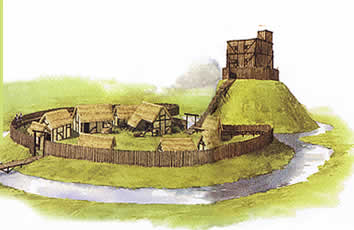
The first castles built had
to be built simply and quickly. They were built of wood and were known as Motte
and Bailey Castles . Look at the diagram below. It shows a Motte and Bailey
Castle:
The Motte is the mound. This would be man made. Saxons workers would be forced to move earth to make the mound. A Keep (as shown in the diagram) would be placed on top of the mound (motte). This is where the lord would live and the stores kept. It would also be where people would take shelter if the castle was attacked.
The Bailey is the courtyard below. Here would live the soldiers and other people, as well as the animals.
The castle would be protected with a wooden fence called a palisade. This would be vulnerable to fire.
Once
William had established control, the Normans began replacing these castles with
strong ones made of stone.
(d)
How did the builders of
castles try to defend them?
The castle builders needed to make sure that they were as well defended as possible. They included aspects that would make it difficult to attack a castle.
Below are some examples:
n
Arrow-loops or arrow-slits were narrow openings
or crosses set inside walls and towers enabling defenders to launch arrows at
potential
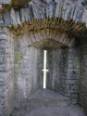 attackers
from outside.
attackers
from outside.
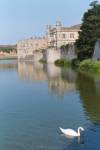
n A moat was a deep defensive trench usually filled with water that surrounded the castle. A moat without water is referred to as a "dry moat".
n
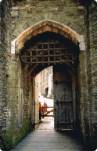
A portcullis was a heavy grilled door that dropped
vertically down through slots or guides, and most often protected the main
entrance of the castle. It could be made of many different materials, but almost
all were made of oak, then plated with iron. On the bottom were spikes. The
raising of the heavy portcullis was sometimes assisted with counter weights,
pulleys, and rope. Often times a quick release device was used to quickly lower
the portcullis. When the castle came under attack, a guard could take a sledge
hammer and hit the release latch. The portcullis would quickly drop closed.
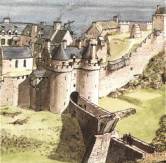
n A drawbridge was a wooden bridge leading to a gateway, capable of being raised or lowered to either accommodate or prevent entry into the castle, and often spanned a ditch or moat.
n
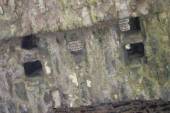
Murder holes
are openings in a floor through which the castle defenders could drop missles or
liquids upon the attackers. Stones were the most often used missile. Boiling oil
was not used, as it was a precious commodity to waste. More than likely, if any
boiling liquid was used, it was water. Murder holes were most often located in
the vaulting over the gate passage.
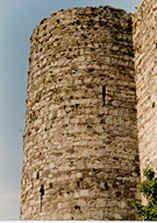
n Round towers assisted defence as it was believed that any form of missile thrown or catapulted at the castle would deflect off of a rounded surface. Also if the enemy tried to dig under a castle to undermine a weak corner, they would not find a corner on a round tower ! So this form of attack was useless against a castle with rounded towers.. Rounded towers could also contain a spiral staircase.
n
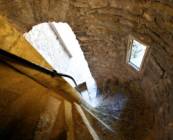
Spiral stairs
in castle towers were designed to ascend clockwise, to make the attackers expose
more of their body in order to use their swords in their right hands.
(e)
How did attackers try to capture a castle?
Attackers would have a hard job to attack a castle. They would use various devices to try and capture the castle. Below are several examples.
n
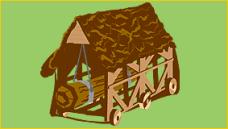
Siege armies used a battering ram to break down
a gatehouse door or even smash a castle wall. To shield themselves from attack,
they built a covered shed, in which they hung a thick tree trunk on chains
suspended from a beam above. Carpenters tapered the trunk into a blunt point and
capped it with iron. The slow forward movement as the battering ram was wheeled
toward the castle wall earned it the nickname "tortoise." Soldiers
swung the hanging trunk back and forth, and the forward end of the trunk moved
in and out of the shed like a tortoise's head, battering its target.
Castle defenders tried to burn the shed down with flaming arrows, though
attackers responded by covering the shed with animal pelts or earth to make it
fireproof.
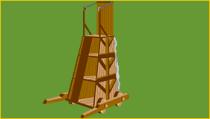
n Siege Tower. Attackers sometimes built a siege tower to scale castle walls. Soldiers lay in wait inside the structure as others wheeled it to the castle. Once there, the soldiers lowered a drawbridge at the top of the tower onto the castle wall. Some towers were almost 100 feet high, and in the siege of Kenilworth Castle, fully 200 archers and 11 catapults were crowded into a single tower. Siege towers were difficult and time-consuming to build, however, and castle defenders could burn them down with fire arrows or firepots (launched pots filled with flaming liquids such as tar). Sometimes castle knights launched surprise raids on a tower to destroy it during construction. To protect their siege engine, attackers draped it with rawhides of mules or oxen.
n
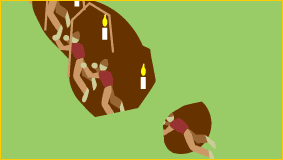
Tunnel.
Men called sappers sometimes dug tunnels to gain
entrance to a castle and thereby launch a sneak attack, but more often, these
miners dug tunnels beneath a castle wall to destabilize and topple it. They
supported their tunnels with timbers, which they then burned to collapse the
tunnel—and, hopefully, the wall above. To defend themselves, castle dwellers
put out a bowl of water and watched for ripples that might indicate digging.
Sometimes the castle's garrison built counter-tunnels; if the two tunnels met,
fierce battles ensued underground.
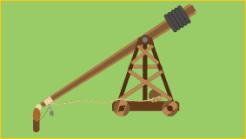
n Trebuchet During a siege, these missile launchers were one of the most fearsome weapons of medieval times. Early trebuchets were powered by muscle, but later versions relied on a huge counterweight that swung a long arm. When the counterweight was dropped, the device launched a missile from a sling at the end of the arm. Trebuchets could launch missiles hundreds of yards in large, lobbing arcs at or even over a castle wall. The best trebuchets fired stone missiles weighing up to 400 pounds—big enough to do serious damage to a castle wall. Attackers also used them to launch dung or dead animals into the castle with the intention of spreading disease. Sometimes they even shot out the severed heads of enemy soldiers or even messengers who delivered unsatisfactory peace terms. If a trebuchet was set up too close to a castle, archers would harass its builders with arrows shot from bows or bolts from crossbows. Castle defenders also would try to destroy rising trebuchets with catapults shot from the castle wall or with sneak attacks to burn it down.
n
Scaling ladders. Long
ladders would be placed against the walls and men would try to climb into the
castle.

n
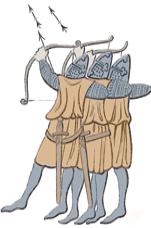
Archers. They would shot
arrows to stop defenders from protecting the castle, so that when men were
climbing the walls, the defenders were unable to stop them as they would be hit
by the arrows. Also sometimes fire arrows were sent to set fire to parts of the
castle.
n Starvation. The attackers would surround the castle and make sure that supplies could not reach the castle. They would often wait months until the enemy was forced to surrender through starvation.
THOMAS BECKET
(a)
Why did medieval Kings want to control the Church?
n
There were several reasons
n
The Church was extremely
wealthy. It controlled large areas of land and had fabulous riches. People often
left it land and money in their wills and it rented out land to tenants. Kings
were always in need of money but the Church did not have to pay taxes. The King
had to ask for money from the Church. If the King controlled it, he would have
access to its wealth.
n
People in medieval times
were very religious. They believed in Heaven and Hell and many believed that the
Church controlled the Keys to Heaven and could help people go to Heaven. This
led many to fear the Church and to obey it. If the King controlled the Church,
he could use it to make sure people obeyed him.
n
The Church was under the
control of the Pope and obeyed him rather than the king. Kings resented the fact
that the Church did not obey them. If they controlled the Church they could
ensure that they obeyed them and were no longer a place of opposition to the
King.
n
The Church had its own laws
and courts. Kings did not like the fact that members of the church were excluded
from the laws of the kingdom.
(b)
Why was Becket appointed Archbishop of Canterbury?
n
Henry II became king of
England in 1154. He was from France and so did not know people in England. He
needed men to serve him in England. He needed a Chancellor to control the
country for him. The Chancellor was like a Prime Minister. Henry did know the
Archbishop, Theobold, and so asked him to recommend someone. Theobold
recommended Becket. Becket was a clever man who knew Latin and had served the
Archbishop well. Henry appointed him as Chancellor. Becket served Henry well and
they became great friends. Becket helped Henry in his quarrel with the Church
and was able to get the Church to give Henry money to fight his wars. Henry came
to regard Becket as a great friend and as someone who would serve him well.
n
When Archbishop Theobold
died, Henry decided to appoint Becket as the new Archbishop. This would allow
him to control the Church, he believed, as he was sure Becket would do as he
asked. Henry was convinced that he now had control over the Church.
n
Becket told Henry not to
appoint him, saying that he could not serve two masters, but Henry ignored
Becket and appointed him.
(c)
Why did the two men come to quarrel?
n
As soon as Becket became
Archbishop he changed. He gave up his wealthy lifestyle and began to wear plain
clothes. He also wore a hair shirt and spent most of his time in prayer. Becket
was taking his job as Archbishop very seriously.
n
He soon annoyed Henry by
giving up the job as Chancellor. Henry came to realise that Becket was not going
to simply do as Henry wanted. He was not pleased.
n
The Church had its own
courts, called the Church Courts. Henry hated these as they tended to be far
more lenient than were Henry’s courts. The Church courts tried members of the
church, such as priests. One priest, called Philip, was accused of murder but
was found innocent by the Church Court. Henry was furious and demanded that
Philip be tried again by his court. He was found guilty but Becket refused to
allow this, saying Henry had no right to try him. Becket then personally tried
Philip. He found him not guilty of murder, but guilty of offending the King and
ordered him to be whipped naked. Henry was furious.
n
Henry summoned Becket to
meet him at his hunting lodge at Clarendon. He ordered him to sign a document
called the Constitution of Clarendon (or the Clarendon rules). Becket signed
them as he feared for his safety. They effectively gave Henry control over the
church.
n
As soon as Becket had left,
he regretted what he had done and asked the Pope for advice. The Clarendon Rules
said that nobody could appeal to the Pope, so Becket had broken the law. Henry
summoned him to a trial before the nobles of England. Becket refused to accept
their verdict of guilty and stormed out. He knew that Henry had a fierce temper
and so fled to France for safety where he stayed for several years.
(d)
Why did Becket excommunicate the Archbishop of York?
n
After six years an agreement
was reached that allowed Becket to return to England.
n
Becket returned to find out
that Henry had had his eldest son, also called Henry, crowned joint King of
England. The crowning of a king was the job of the Archbishop of Canterbury, but
Henry had asked the Archbishop of York to do it whilst Becket was in exile in
France.
n
Becket was furious and
excommunicated the Archbishop of York and those who had helped him. This meant
that they were no longer members of the Church.
n
When Henry heard of this he
was furious.
(e)
Why did the knights go to Canterbury and kill Becket?
n
Henry heard the news about
the Archbishop of York whilst he was dining with his knights. Henry had had a
lot to drink. He is said to have cried out : “Will no one rid me of this
turbulent priest?” Whether he meant it or not we can never know.
n
Some knights overheard this
and thought that they could gain the king’s favour by acting. So they went to
Canterbury and stormed into the cathedral to see Becket.
(f)
Why was Becket killed?
n
Becket was told that the
knights had come, but ordered that the doors be left open. He also refused to
flee.
n
The knights demanded to see
him and called him a traitor. He denied that he was a traitor. The knights
killed him.
n
Historians are divided over
Becket. Some think he was a hero who died defending the Church against Henry.
They see him a martyr, someone who dies for their faith. Other historians
believe that Becket simply wanted power and glory. He wanted to be remembered by
future generations and so deliberately allowed himself to die to achieve fame.
(g)
How did Henry and people react?
n
People were horrified at the
death of Becket and blamed Henry.
n
Henry tried to show that he
had not intended this by visiting Canterbury. He walked into the city bare
footed and walked to Becket’s tomb. Monks then whipped him to show he was
sorry and wished to make amends.
n
Henry banished the knights
but took no further action against them
n
Henry did not get control of
the Church
n
People came to regard Becket
as a saint and stories soon began that visiting his tomb led to miracles. His
tomb became a centre of pilgrimage.
KING JOHN
(a)
Who was King John?
n
King John was the youngest
son of Henry II. In 1189 Henry had died and been succeeded by his son Richard
the Lion-Heart. In 1199 Richard died and John, his brother, became king.
n
However, the rules about who
should become king were not clear in 1199. John had a nephew who was the son of
another elder brother, Geoffrey. Today, the son of an elder brother would become
king and so John’s nephew, Arthur, would have been king, not John. Arthur
claimed the throne, but John was crowned. This, however, caused problems for
John as many in France felt Arthur was the rightful king and so supported him.
The King of France wanted to push the English out of France and so decided to
support Arthur in the hope of weakening King John and making it easier to defeat
him.
(b)
Why do some people regard John as a bad king?
n
Many things happened during
John’s reign that led lots of people to regard him as a bad king.
n
When Arthur declared himself
king, civil war broke out in John’s empire. However, John organised a
brilliant military campaign that led to the capture of Arthur. John had him
imprisoned and he was never seen again. Rumours soon spread that John, in a
drunken rage, had castrated his nephew, then strangled him and thrown his body
into the river. This shocked many people. John never explained what had happened
to Arthur and so people believed it.
n
John also needed money to
fight wars in France against the French King. He asked the nobles for money, but
they were reluctant. He, therefore introduced new taxes, forced the barons to
lend him money and took part of their wealth. This annoyed the barons as they
felt the king had no right to seize their wealth.
n
When John asked his barons
to go to Normandy to help him defend Normandy against the French king, most
barons refused. John fought bravely in Normandy but lost. The barons called him
Softsword (someone who is not a good fighter) and Lackland (as he lacked land).
John blamed the barons for the loss and never trusted them again. In future he
demanded that barons hand over their sons and wives as hostages. Most were
treated well, but one case led to John being condemned. William De Braose. His
wife and son were handed over, but he then fled and John had his wife and son
starved to death in Windsor Castle. This angered the barons and made them more
determined to resist John.
n
When John was in southern
France he fell in love with Isabella of Angouleme. However, she was betrothed to
one of John’s barons. John took Isabella and married her, even though she was
only 12 at the time. This annoyed the baron who had been engaged to her and he
then sided with the French king, which ensured John lost control of this area of
France.
n
John quarrelled with the
Pope over who should be Archbishop of Canterbury. John refused to accept the man
selected by the pope. In return the Pope placed an interdict over England – he
refused to allow any church services. This meant people could not get married,
baptised or buried. People believed that if you died without being baptised you
would go to Hell, so many people were horrified at what had happened. Many
priests and monks lost their jobs and so blamed John.
(c)
Why do some people disagree?
n
John does have his
supporters.
n
They point out that John was
a brilliant commander. He defeated the Welsh, he captured Arthur and he
organised a brilliant campaign against the French king. If his barons had not
betrayed him, he may well have defeated the French king and kept his French
lands.
n
Kings had always raised
taxes and forced loans from the nobles. John was doing nothing new.
n
John travelled round his
country, ensuring justice was given to his people. No king had ever travelled so
extensively and ensured there was justice.
n
John was just unlucky and it
is the fault of the monks that he is regarded as a bad king as they hated him
and wrote hostile accounts.
(d)
Did the Magna Carta give rights to people?
n
In 1214 the barons finally
rebelled against John and civil war broke out.
n
In 1215 John agreed to the
Magna Carta (the Great Charter). This was designed to limit the power of the
king and was said to guarantee people certain rights.
n
However, both sides broke
their word and civil war broke out again. The barons asked the French King to
send his son over to replace John. John died whilst the civil war was
continuing.
n
Some people claim that Magna
Carta was a great charter of freedoms and some of the clauses seem to suggest
this.
Important points that the Magna Carta covered
were:
|
"The
Church is free to make its own appointments." |
|
Meaning: The Church had the final say who was
appointed to Church positions of power. |
|
"No
more than the normal amounts of money can be collected to run the
government, unless the king's feudal tenants give their consent." |
|
Meaning: The King was not allowed to demand more and
more money from his nobility. |
|
"No
free man shall be seized or imprisoned, or stripped of his rights or
possessions... except by the lawful judgement of his peers." |
|
Meaning: Everyone has the right to a fair trial. |