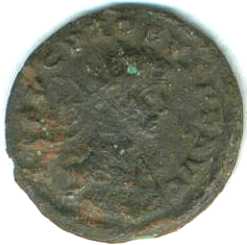
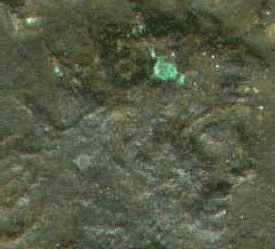
Bronze Disease on an Antoninianus of Probus. A close up.
Part II- What does it look like?
Once you've seen it, bronze disease is pretty easy to spot. Until you've
seen it, it's not unheard of for collectors to become extremely paranoid
about any green stuff on their bronzes, and for those of us who can only
afford cheap bronze most of the time this can be a very very bad thing
indeed. It's a very very bright green powdery stuff on the surface of the
coin, that can be brushed or washed away but will "grow" back within a
few days (it's not really organic...the reaction will continue and produce
more). To save other collectors the panic that I stupidly went through,
I've put up a few scans of a nicely diseased coin in my collection awaiting
treatment.
Bronze Disease on an Antoninianus of Probus.
A close up.
It's pretty hard to mistake this stuff for any type of patina, it's usually very very bright and has a clearly powdery texture that one just doesn't find in patina.
Part III- Eeek! What do I do about it?
It's tought stuff to
cure. By far the best technique is to soak the coin (only one at a time
mind you) in a sodium sesquicarbonate solution for about 2 months (changed
monthly), and then a week in distilled water (changed daily) to stop the
reactions and clean the sodium sesquicarbonate residue off of the coin.
A five percent solution was recommended to me by several people, and it's
worked out well for me. About one teaspoon per 4 oz. of distilled water
will do it. The only problem with this solution (ha! no pun intended) is
the result it has on the patina. In theory this can be controlled by changing
the strength of the solution and such to do minimum damage but still cure
the disease. I'm experimenting, but I'm not too good at it yet. Make sure
to start on your lowest grade coins!
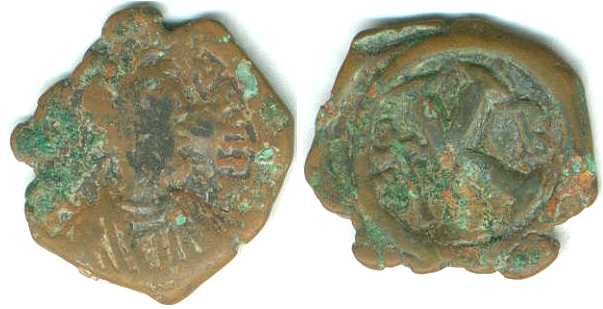
A formerly diseased half-follis
of Justinian I. Yucky, eh?
Sodium Sesquicarbonate can be obtained cheaply from www.chemistrystore.com (follow this link). Also, e-mail me if you are looking for some because I've got more than I'll ever use (I hope!) and I'll send you a half pound for the price of shipping (about $5) if I've still got some. Also feel free to e-mail me with questions, and I'll do my best to answer them.