 |
|
|
|
|
|
|
|
|
|
|
|
|
|
|
|
|
|
|
|
|
|
|
|
|
|
|
|
|
|
|
|
|
|
|
|
|
|
~HIMALAYAN~ |
|
|
|
History & Character |
|
|
|
HISTORY |
|
|
|
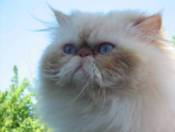
The Longhaired Himalayan resembles the Persian, with a short, heavy body that is
low to the ground. Pampered pet or successful show cat, the Himalayan is one of today's most popular breeds with its distinctive "pointed" coat pattern and pretty blue eyes. |
|
|
|
 |
|
|
Himalayans have the Persian body type with the color pattern of the Siamese cat. They were developed by breeding Persians to Siamese to combine the Siamese point coloring with Persian type. Offspring were bred back to Persians to keep the Persian look while maintaining the color points. The name comes from the color pattern found on rabbits and goats originating in the Himalayan Mountains of Asia. |
|
|
|
|
|
|
The Himalayan is the offspring of genetic engineering. The creation of the Himalayan was discovered and bred by Dr. Clyde Keeler and Miss Virginia Cobb (USA), who, as early as 1930 realized the genetic potential in such a breed. |
|
|
|
In 1931 a Siamese Female was mated to a Black Persian Male and three shorthaired Black kittens were born. A black male with a wavy coat, Newton's Bozo was selected to sire the new breed. He was bred to Newton's Bitzie, a shorthaired hybrid, in 1933 and produced a longhaired black female named Newton's Babbit. When Babbit was mated back to Bozo the offspring produced included two standard pattern Siamese, two black longhairs and a kitten with Siamese pattern and long hair, named Debutante. |
|
|
 |
|
|
|
|
|
|
The technical information necessary to produce Himalayans was applied further by Mr. Brian Sterling-Webb in Britain and by Marguerita Goforth in the U.S.A. to create the different colorpoints. The existence of the Himalayan is largely attributed to the British cat fancy with the world's first official "Colorpoint Long Hair" being approved by Britain's Governing Council of the Cat Fancy (GCCF) in 1955. |
|
|
|
Mr. Sterling-Webb began by crossing a pure Siamese with longhairs to produce a series of short-haired, black and blue self-colored "hybrids". Hybrid was then mated with Hybrid and from these litters came a few special kittens. They had Siamese patterned points, long fur and blue eyes. Nothing like it had ever been achieved before. There was no other variety of longhair or semi-longhair with this coloring at this time. These were Himalayans or "colorpoints", the term used in the United Kingdom. |
|
|
|
CHARACTER |
|
|
|
Like the Persians, the Himalayan is also a longhaired cat with a long, flowing coat sometimes measuring 6 to 7 inches long. The breed is said to be easier to groom than its Persian cousin. With a topcoat inclined to silkiness and a undercoat somewhat not as wooly, the Himalayan is much less prone to matting. |
|
|
 |
|
|
|
|
|
|
Nevertheless, like all longhairs, the Himmy requires regular grooming to help rid the coat of dead hair and ensure it is kept tangle free. A bristle brush and a wide-toothed comb are part of the essential grooming kit, with a fine-toothed comb for the grooming of ear tufts and facial fur. Bathing with a tearless shampoo is essential for the show cat to keep the coat in flowing condition. |
|
|
 |
|
|
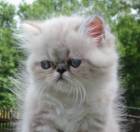
In personality, the Himalayan is a friendly, affectionate and mischievous cat. Easygoing,gentle and friendly with humans and other pet animals, an Himmy makes an adaptable pet. They are extremely playful cats, always in the middle of all human activities, and express themselves with a wonderful melodious voice. Thier quiet disposition, sweet pansy-faced expression and |
|
|
|
|
|
appealing blue eyes have made the Himmy one of the most beloved of all pedigree cats. Himmy owners find the breed irresistable and usually have more than one Himalayan in thier household. |
|
|
|
 |
|
|
|
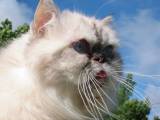
The Himalayan is found in a variety of point colors including Blue, Lilac, Chocolate, Seal, Red(Flame), and Cream, as well as Tortie and Lynx versions of these colors. Point color is restricted to the extremities (face,ears,legs,tail), with a light body of various shades of usually white to fawn. Eye color is vivid blue. |
|
|
|
|
|
Links: |
|
|
|
Examples of Himalayan Colors |
|
|
|
History of Lynx Point Himalayan |
|
|
|
REMEMBER:
Of all God's creatures there is only one that cannot be made the slave of the leash. That one is the cat. If man could be crossed with the cat it would improve man, but it would deteriorate the cat.
Mark Twain 1894
|
|
|
|
 |
|