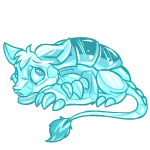
| This is Glacier my Petpet Gruslen. We love hiking in the mountains and tundra which is why I named him Glacier; glaciers are formed near mountains and such. Also, it's good alliteration, eh? |
 |
Back to top
Tour of Canada
Canada In General|
The Provinces|
The Territories
Welcome to Kanata's Canada, my Tour of Canada. Here you can learn about Canada's capital cities, confederation dates, symbols and other things about the country.
Please keep in mind though that Tiamat's research may be incorrect. It is always safer to do you your own research if you want to learn about something; so don't assume that everything is right on this page. Tiamat tries to be as accurate as possible but she can still make mistakes with her research.
If you have any comments, corrections, or suggestions on this page please neomail Tiamat.
Canada In General
Capital: Ottawa, Ontario
Confederation Date: July 1st, 1867
Symbols: Beaver, sometimes the Moose, Maple Leaf
Other Facts:
~Canada is the world's second largest country with an area of 9,970,610 km� (3,851,809 sq. mi.)
~The language breakdown is appoximately 66.8% English, 15.8% French, 16.2% other languages.
~The population distribution is about 77% urban and 23% rural.
~The highest point is Mount Logan at 5,959 m in the Yukon.
~Great Bear lake is the largest lake in Canada with an area of 31 326 km2.
~The longest river is the Mackenzie River flowing 4241 km through the Northwest Territories.
~Some natural resources are: iron ore, nickel, zinc, copper, gold, lead, molybdenum, potash, diamonds, silver, fish, timber, wildlife, coal, petroleum, natural gas, and hydropower.
Back to Tour Menu
The Provinces
British Columbia (BC)|
Alberta (AB)|
Saskatchewan (SK)|
Manitoba (MB)|
Ontario (ON)|
Quebec (QC)|
New Brunswick (NB)|
Nova Scotia (NS)|
Newfoundland and Labrador (NL)|
Prince Edward Island (PE)
British Columbia

Capital: Victoria
Joined Confederation: 1871
Population: 4,141,300
Area: 944,735 square km
Symbols: Steller's Jay, Pacific Dogwood, Jade, Western Red Cedar.
Resources/Industries: Trees from forests are converted into lumber, newsprint, pulp and paper products, shingles and shakes. There are parklands, the Rocky Mountains, and beaches for tourism. Mining for copper, gold and zinc are the leading metals and coal, petroleum and natural gas are also found. Agriculture and fishing are also major industries.
Geography: Most of British Columbia is in the Cordilleran Region, which has several subdivisions. East of the Coastal Mountains rolling upland forests, as well as natural grasslands and lakes predominate. The BC Interior is a series of high plateaus, rolling ranchland, and lush and fertile valleys that produce fruits and vegetables.
Back to Tour Menu
Alberta

Capital: Edmonton
Joined Confederation: 1905
Population: 3,113,600
Area: 661,848 square km
Symbols: Great Horned Owl, Lodgepole Pine, Wild Rose, Rocky Mountain Bighorn Sheep, Petrified Wood.
Resources/Industries: Petroleum and natural gas are Alberta's greatest mineral resources. Petrochemicals and plastics, forest products, metals and machinery and refineries. Business and financial services, transportation, retail trade, health and education services, and tourism.
Geography: Roughly half of the southwestern section of the province is dominated by the Rocky Mountains and their foothills. The remainder of the province forms part of the interior plain of North America. The plains include the forested areas that dominate the northern part of the province and the vast stretches of northern muskeg that overlay much of Alberta's oil and gas deposits and oil sands.
Back to Tour Menu
Saskatchewan

Capital: Regina
Joined Confederation: 1905
Population: 1,011,800
Area: 651,036 square km
Symbols: Sharp-tailed Grouse, Potash, White Birch, White-tailed Deer, Western Red Lily
Resources/Industries: The principle industries are agriculture, mining, construction, manufacturing, oil and petroleum, and tourism. The service-based sectors such as finance, insurance and real estate are also significant. Northern forests are the province's most important renewable natural resource. Softwoods (coniferous trees) are the focal point of forestry development. Also rich in minerals, potash, uranium, coal, oil, natural gas, and potash.
Geography: Known for its flat southern plains, over half of Saskatchewan is covered in forests. The northern third of the province is an extension of the great Canadian Shield. The southern part of the province is relatively flat, with occasional valleys created by erosion from the glacial era. Rolling sandhills are found in southwestern Saskatchewan.
Back to Tour Menu
Manitoba

Capital: Winnipeg
Joined Confederation: 1870
Population: 1,150,800
Area: 647,797 square km
Symbols: Great Grey Owl, Crocus, White Spruce
Resources/Industries: Primary and fabricated metals, electrical goods, clothing and textiles, printing and publishing, hog production, grain and potatoe farming, important metals are nickel, copper and zinc, also produces petroleum and a number of industrial minerals
Geography: Southwestern Manitoba is flat prairie lands, the north-easternmost extension of the great western plains. Before settlement, a large area of southern Manitoba was flood plain or swamp. The northern 3/5 of Manitoba is Precambrian Shield. The northern topography is heavily glaciated and covered in forest, dominated by pine, hemlock and birch. In the northernmost portion of Manitoba the land is composed of tundra and permfrost. Is rich in spring-fed lakes, pristine northland and untouched wilderness.
Back to Tour Menu
Ontario

Capital: Toronto
Joined Confederation: 1867
Population: 12,068,300
Area: 1,076,395 square km
Symbols: Common Loon, White Trillium, Amethyst, Eastern White Pine
Resources/Industries: Leading producer of poultry, eggs, vegetables, lamb, fruit, corn, tobacco, soybeans, nursery plants and flowers. It's also a major source of winter wheat, dairy products, hogs, and beef cattle. There is forestry, manufacturing of automobiles, gold, nickel, copper, uranium and zinc.
Geography: The land base of the province is divided into three main geological regions: The Hudson Bay Lowlands are narrow coastal plains bordering Hudson Bay and James Bay; the land is largely 'muskeg' wet lands covered by scrub growth. The Great Lakes-St. Lawrence Lowlands make up the remainder of southern Ontario. They contain most of the population, industry, commerce and agricultural lands. The Lowlands include the Windsor-Thousand Islands-St. Lawrence Valley triangle, an area of temperate climate and fertile soils. This is one of Canada's major agricultural areas, containing more than half of Canada's best agricultural land.
Back to Tour Menu
Quebec

Capital: Quebec City
Joined Confederation: 1867
Population: 7,455,200
Area: 1,542,056 square km
Symbols: Snowy Owl, Blue Flag (a flower), Yellow Birch,
Resources/Industries: Forest industry (printing, lumber and paper), mining (aluminum and iron ore) and transportation equipment manufacturing. Electricity, electronic products and telecommunications equipment. Traffic control equipment, software, subway trains, helicopters, compact disks, air purifiers and toys. Space and aeronautics, pharmaceuticals, telecommunications, energy and transportation and finance.
Geography: Known as 'la belle province' Qu�bec is the only officially French-speaking province in Canada and has over 400 years of history. From north to south Qu�bec takes in three main geographical regions:
The Canadian Shield covers about 60 percent of the land mass and is the world's oldest mountain range. The St. Lawrence Lowlands are dotted with more than a million lakes and rivers. The St. Lawrence River, the province's dominant geographical feature, links the Atlantic Ocean with the Great Lakes. The Appalachians extend from the shores of the Canadian Arctic to the Laurentians.
Back to Tour Menu
New Brunswick

Capital: Fredericton
Joined Confederation: 1867
Population: 756,700
Area: 72,908 square km
Symbols: Black-capped Chickadee, Balsam Tree, Purple Violet
Resources/Industries: Wood and wood products, fishing and agriculture, production of forage, milk and poultry, mines silver, bismuth, cadmium, coal, copper, natural gas, gold, oil, lead, potash, peat, tungsten, silica, salt and zinc, pulp and paper, sawmills, manufacturers of furniture and other wood-based industries, metal processing, transportation equipment and processing of non-metallic ores and primary metals.
Geography: The southern landscape is characterized by hills sloping down to tidal marshes at the edge of the Bay of Fundy, whereas the eastern and central portions of the province consist of rolling hills cut by river valleys. The highlands in the northwest are an extension of the Appalachian mountain chain.
ack to Tour Menu
Nova Scotia

Capital: Halifax
Joined Confederation: 1867
Population: 944,800
Area: 55,284 square km
Symbols: Osprey, Mayflower, Red Spruce, Agate, Fossil
Resources/Industries: Cod, haddock and pollock, as well as lobsters, scallops and crab, forestry sector with pulp and paper mills and several hundred sawmills, mining coal, salt, barite, crushed stone, peat and sand and gravel. Offshore oil and gas, dairy, horticultural crops, poultry, eggs, beef cattle and hogs, blueberries, apples and processed fruits, vegetables and juices, and tourism.
Geography: Nova Scotia is framed by the rocky Atlantic Uplands, the Cape Breton Highlands and the wooded Cobequid Hills. The agricultural areas of Nova Scotia are predominantly lowlands. When the glacial ice withdrew from coastal Nova Scotia 15 000 to 18 000 years ago, the ocean flooded ancient river valleys and carved out hundreds of small protected harbours which later became fishing ports.
Back to Tour Menu
Newfoundland and Labrador

Capital: St. John�s
Joined Confederation: 1949
Population: 531,600
Area: 405,212 square km
Symbols: Atlantic Puffin. Pitcher Plant, Black Spruce, Labradorite
Resources/Industries: Cod, flounder, redfish, capelin, shrimp and crab, mostly iron ore, other minerals mined are gold, asbestos, limestone and gypsum, nickel, copper and cobalt. Newsprint industry with pulp and paper mills. Offshore gas and oil, and hydro-electricity.
Geography: Thick boreal forests, broken by numerous lakes and swift-flowing rivers. Labrador is the easternmost part of the Canadian Shield, a vast area made up mostly of plutonic and metamorphic rock. Newfoundland represents the northeastern most extension of the Appalachian Mountain system in North America, and is much younger than Labrador. Northern Labrador is marked by the Torngat Mountains, which rise abruptly from the sea to heights of up to 1676 m. More than 8% of the area of the province of Newfoundland is occupied by lakes. This is slightly greater than the average for Canada. Artificial dams have enlarged other lakes. Besides lakes Newfoundland and Labrador also have many rivers.
Back to Tour Menu
Prince Eward Island

Capital: Charlottetown
Joined Confederation: 1873
Population: 139,000
Area: 5,560 square km
Symbols: Blue Jay, Red Oak
Resources/Industries: Agriculture, tourism and fishing are the economic mainstays, soil is ideal for growing potatoes, food processing, high-technology in the medical, electronics and agricultural fields. Lobster, cultivated mussels, herring, bluefin tuna and Malpeque oysters.
Geography: Prince Edward Island is noted for its 'red' rich soil, sand dunes and 800 km of beaches. It has numerous lakes and rivers, most of which are quite small. The rich soil and a temperate climate make PEI ideal for mixed farming. Half of its land is under cultivation, earning it the nickname "the Garden Province."
Back to Tour Menu
The Territories
Total Population: 100,000
Yukon (YT)|
Northwest Territories (NT)|
Nunavut (NU)
Yukon

Capital: Whitehorse
Year of Creation: 1898
Symbols: Raven, Fireweed, lazulite, Sub-alpine Fir
Resources/Industries: Mining, tourism, forest industry, fur trade, small fishing industry for salmon, and other commercial fisheries supply local consumers.
Geography: The Yukon is a land ranging from snow and tundra to deep forests and mountain meadows and includes a pocket desert. Mount Logan, Canada's highest peak, at 6050 metres, is located in southwestern Yukon. The Yukon can be divided into two broad geographical regions: Taiga, the boreal forest belt that circles the world in the subarctic zone, including most of the Yukon. Tundra, the vast, rocky plain in the Arctic regions, where the extreme climate has stunted vegetation.
Back to Tour Menu
Northwest Territories

Capital: Yellowknife
Year of Creation: 1869
Symbols: Gyrfalcon, Gold, Mountain Avens, Tamarack, diamond.
Resources/Industries: Fishing, hunting and trapping, mining, oil, gas, and diamond mining. Sports fishing and big-game hunting, adventure tourism.
Geography: The Northwest Territories, "the Land of the Midnight Sun" can be divided into two broad geographical regions: Taiga, a boreal forest belt that circles the sub arctic zone, including most of the Northwest Territories. Tundra, the vast, rocky plain in the Arctic regions, where the extreme climate has stunted vegetation.
Back to Tour Menu
Nunavut

Capital: Iqaluit
Year of Creation: 1999
Symbols: Rock Ptarmigan
Resources/Industries: Hunting, trapping, gathering and fishing. Increasingly carving and artistic pursuits, arts and crafts. Mining for lead, zinc, silver, and gold.
Geography: Nunavut is a land of rock, snow, ice, and sea It is a land of forest, plains, glacial rock and frozen seas. Nunavut can be divided into two broad geographical regions: Taiga, the boreal forest belt that circles the world in the subarctic zone. Tundra, the vast, rocky plain in the Arctic regions, where the extreme climate has stunted vegetation.
Back to Tour Menu
A lot of the information stated here is from:
http://www3.sympatico.ca/goweezer/canada/canprovs.htm
http://www.thecanadapage.org/Canadian_Facts.htm
http://educationcanada.com/facts/index.phtml
Back to top
|

Galaxy Gallery List
This list has been moved here from my shop blog because I ran out of room. ^^; From now on I'll be continuing it here. People that have given more than one item go on here. If you have done this but are not on the GG List, I must have forgot to add you for some reason... Please neomail me stating which items you have given me (I do have light memories on who has given me what).
tiahawk (aka fellow tia)
dragon_rider673 (aka tomk)
roxroxkewl (aka mike)
waterbaby161 (aka sammi)
flick4321 (aka flick)
cyclone__303 (aka cyclone)
steelvisions (aka steel)
cole005 (aka nikki)
firewind641 (aka fire)
Many Members of NDR
firefox63 (a "real-life" friend)
firedragon3366 (another "real-life" friend)
ratfish (firedragon's dad)
|
Back to top


mbif.net
Back to top