Kryptonite figures prominently in countless stories in the past, most notably in
Superman, No. 149 in 1962, in which the Man of Steel dies from its poisoning, in a deeply moving "imaginary" tale, which young readers are relieved to know is just a story (naturally one could contend that all of Superman's stories are just imaginary). Mostly appearing in the '60s and '70s, there are several of these full comic-book length stories, called "novels," not following the regular continuity, with hypothetical plotlines like what if Superman were a criminal.Among the "what-if" situations are various stories showing what might happen if Superman marries
Lois. The outcome usually has Lois leaving her job to raise one or two children who inherit their dad's superpowers, but one darker entry has her dying after being kicked by a developing super-embryo (Adventures...Annual 1991, No. 3). Aside from his ability to procreate, however, Superman's sexuality is not really addressed until the '78 movie.As the star reporter for The Daily Planet, interviewing the Man of Steel after his first public deeds in Metropolis, Lois Lane (Margot Kidder) is obviously mesmerized by his striking appearance and fabulous abilities. She provides the Superman saga with its first double entendre when she asks, "...and how big are you?" Immediately realizing her Freudian slip, Lois quickly adjusts the adjective to "tall." (He also impresses her with his honesty.) In the next day's newspaper she writes, "He's 6'4, has black hair, blue eyes, doesn't drink, doesn't smoke, and tells the truth."
Over the past fifty years there has been conjecture about Superman's sexual experience. The former consensus is he must be a virgin so that, as a pure hero, he can be recognized as special, more iconographic, a better role model for children. In the 1940s newspaper strip, Clark and Lois are wed, but the marriage turns out to be a dream story (different, in the DC Comics universe, from an imaginary story). Similarly, in a 1955 episode of the TV show--"The Wedding of Superman"--Lois (Noel Neill) has a dream she is his wife. In this television series from 1951 through 1957, Clark and Lois address each other in a formal or friendly manner. There is no sexuality though Lois does have a crush on the Man of Steel. However, in 1978 they do, in fact, get married--on Earth-2. They remain wed and in the last Crisis on Infinite Earths in 1986 move on (with Superboy of Earth-1, no less) to a final haven in an other-dimensional world.
For the movie Superman II, Hollywood decides audiences do not expect another chaste love story, so Superman and Lois sleep together in his private place of meditation in the North Pole, the Fortress of Solitude--after she has discovered his identity, but not before he agrees to the spirit of his dead mother to relinquish his superpowers. (The film maintains there is an ancient Kryptonian rule prohibiting relations with Earthlings.) He complies, somehow conveniently becomes unsuper, and, therefore, is not really Superman when they first have sex (before the plot soon requires him to get those powers back). Lois and Clark are emotionally unable to go back to work after what has transpired, and he ends the film with a super kiss so literally breathtaking that Lois forgets everything, including Clark's alias. Then, the well-known triangle returns: to both his and our amusement, Lois treats Clark like a nuisance and loves Superman like a god.
In the next movie sequel, Superman again has off-screen sex, this time with the brainy mistress of one of his enemies, but Superman has just turned bad due to some defective Kryptonite. His "one-night stand" does not really "count" since, once again, he is not himself when it happens (though he does remain super). Inevitably sex enters the comic-book version too (this time he is both good and super): in the reinvented Superman stories, Lois and Clark have been engaged since Superman, No. 50--December 1990 in real time, a few months prior to his death in comic-book chronology. They spend the night together sometimes (infrequently, with their busy journalistic careers and his saving the world from certain destruction every few issues). Yet their relationship is so tasteful and discreet, the sexual aspect may be unbeknownst to younger, more innocent readers.
In Superman, No.81, many days after four other Supermen have mysteriously appeared following his funeral, the real but still recovering Superman attempts to convince a skeptical, distraught Lois that he has returned from the dead. He tells her personal things: we learn Clark's favorite movie is To Kill a Mockingbird (part of the realistic history writers like Dan Jurgens, Jerry Ordway, and Louise Simonson are providing for Superman). He talks of giving her Martha Kent's engagement ring and asks: "Did [the the other Supermen] tell you about the time I admitted being Clark? Or the time we flew to the mountains to talk? Or about that rainy night in July when we first...." Lois' tears interrupt him, apparently before he can say "made love" (19).
Then in
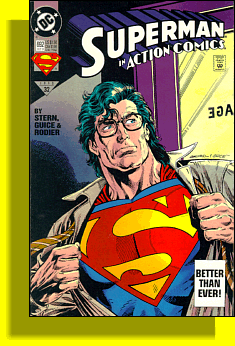
Adventures..., No. 505, fully restored to health, he appears at Lois' window like a magnificent angel (his hair having grown during the month since his death). He flies her outside into the night sky and they kiss repeatedly. The next panel, in Lois' apartment, shows Superman happily showering while she applies her morning makeup, rumpled bedsheets depicted in the background. (Throughout Stern's novel, Lois calls Clark "lover.") When Clark reveals his identity to Lois in ...Action, No. 662 in 1991, she has trouble responding--neither of them knows how his alien physiology will impact on their lives. They have considered having children after they marry and presently are uncertain if their genes are even compatible. Either way, they discuss each other's feelings with tenderness.The innocence of the Superman/Lois/Clark triangle of yesterday's comics has given way to a more mature sensibility. Contemporary comic-book demographics include, primarily, adolescents growing up in the more sexually frank 1990s, as well as college students and adults who continue to enjoy their childhood hero. Obviously, making Superman more realistic provides a more satisfying read (and removes any "guilt" attached to grown-ups buying comic books). Those decrying this tampering with Superman's purity may, perhaps, appreciate that his relationship with Lois reflects the prevailing liberal media's view of morality, and (despite the predominantly male readership) is filled with sensitivity and romance.
The current TV series, on the other hand, follows still a different continuity wherein Clark and Lois are not engaged, and are not lovers, though playful, humorous innuendoes (as well as dramatic self-discoveries) are weekly occurrences. Attracted to both Clark and Superman, she does not realize they are the same man. Clark's need to hide his secret from her has restored much of the humorous tension between them which has been lost from the latest comic books because, ironically, the comics now have more serious themes (and Lois knows his secret identity).
When Clark first starts work at the Planet, in all versions his chief (and presumably only) rival for bylines is Lois Lane. Affected by the social climate, she goes from being an "impetuous girl reporter" to today's assertive working woman. Beautiful Lois--herself an inspiration to young female audiences--has always been independent, but in her own comic book, Superman's Girl Friend, Lois Lane (from 1958 to 1974), the stories revolve around her quest to stay attractive to Superman and to get "scoops." Before her comic is done in by the changing sensibilities of the Women's Movement, in one 1970 story (...Lois Lane, No. 106), she "scientifically" transforms herself, with Superman's help, into an African American to write empathetically about ghetto poverty. Superman is understanding for he, an alien, an outsider, identifies with minorities (though Lois reminds him that being a white man has enabled him to assimilate).
This story is among the first to incorporate serious social issues into the entertaining adventures. The present interconnected Superman comic books in recent years have tackled subjects like drunk driving, with Clark as teenage passenger (in Adventures..., No. 474); wife beating, Clark as outraged neighbor (in ...Man of Steel, No. 16 and Superman, No. 72); sexual harassment (...Action No. 694); alcoholism, and racism (Adventures..., No. 507). Reflecting actual urban conditions, the supporting cast has become integrated and multicultural to give Metropolis verisimilitude. There are now Jewish, Catholic, and Hispanic characters, and a lesbian police inspector. While Superman is dead, he is replaced by, among others, an African-American construction worker who is a high-tech weapons designer, and a cocky, leather-jacketed 16-year-old clone with superpowers, a teenager's libido, and an African-Asian love interest.
Their relationship is presently platonic. A more miscegenetic relationship is, oddly enough, the one between Lex Luthor and Supergirl. She is not Superman's late cousin, but a shapeshifting artificial life-form fallen to Earth and nursed to health by Ma and Pa Kent (Superman, second series No.21). She assumes the likeness of the original lovely blond Supergirl and has come under the spell of possessive, manipulative Luthor. She amuses him by changing her appearance into different international beauties. (She can even look like Clark to help hide Superman's identity, about which Luthor is unsuspecting.) Supergirl, till recently, has been blind to Luthor's criminality.
In today's accounts, Luthor is a billionaire industrialist who hates Superman for stealing the limelight from him as Metropolis' most celebrated citizen. In his youth Luthor pays to have his shiftless parents murdered because they embarrass him (Lex Luthor: the Unauthorized Biography 18). He also fakes his own death as his health deteriorates (in ...Action, No. 660). His brain is now in the biogenetically grown body of a strapping young Australian (No. 678), purporting to be Lex Luthor II, Luthor's love-child. Lex II is, of course, his own father--a blackmailer and murderer who owns much of Metropolis.
In contrast, Superman has a sterling code of ethics. He does not lie (though he lives a double life) and he does not kill. He lets the police deal with the criminals he captures. Nevertheless, once, in a several-issue story arc, he executes three escaped Phantom Zone criminals who have destroyed an entire populated planet (Superman, second series, No.22). Ashamed by this violation of his oath to preserve life, Superman banishes himself for weeks, and temporarily stops wearing his famous costume. Eventually, in Adventures..., No. 455 (July 1989), he encounters a Kryptonian learning device and energy source, the Eradicator (which is instrumental in his return to life in 1993), does much soul searching, and realizes his killing the mass murderers is morally justified (Superman, No. 33).
Other familiar characters have been touched by far more realistic problems: Jimmy Olsen, staff photographer for The Daily Planet, goes through a period of joblessness and homelessness (Superman, No. 57 and Adventures..., No. 486), too proud to seek help from his friend, Superman. Pre-revamp when something preposterous occurs, like Jimmy mutating into a giant reptile (Superman's Pal, Jimmy Olsen, No. 53 in 1961), he becomes normal again by the story's last page, the status quo restored with Superman's assistance. Now a problem arises, and it does not always get resolved. Instead, we read to see how the newest events will affect the characters in upcoming issues. For example, Clark's managing editor, Perry White, discovers in 1991 his teenage son (who dies of a drug overdose) is the illigitimate son of Luthor and Perry's wife, Alice (Adventures..., No. 470). Certain predicaments even Superman cannot fix. (The Whites are still reconciling, without his intervention.)
Perhaps to justify that the obviously fictitious Superman cannot end our wars or cure our diseases, he has been given instructions (in the 1978 film) by Jor-El: "You are forbidden to interfere with human history," but--strongly motivated by love, and unwilling to remain helpless as with Pa Kent's passing--humanly, Superman disobeys, and superhumanly he spins the Earth backwards reversing time to save Lois from an earthquake death.
During World War II Clark attempts to enlist, failing the army physical when he reads the wrong eye chart (an unillustrated editor's note in Superman, No. 25 from 1943 says his X-ray vision shows the one in the next room), but Superman often brings aid and provisions to our troops. Four decades later, in 1986, he goes to Ethiopia (in a special issue: Heroes for Hunger) to help the hungry and learns famines do not change overnight. In 1991, politically correct, he halts some damage to the Brazilian Rainforest and motivates Metropolis residents to clean up their own environment (in another special comic: Superman for Earth). Clark even assists Lois in recycling her garbage.
Today's Superman is allowed melancholia over being the only survivor of a dead planet and introspection over his inability to help everyone in trouble. (The streets of Metropolis are lined with the disenfranchised, just as in any big city.) In a 1993 TV scene, unwittingly Lois (Teri Hatcher) comforts Clark, who is concerned that Superman is not accomplishing enough:
Not even Superman can be everywhere at once....What he can'tdo, it doesn't matter. It's the idea of Superman--someone to believe in, someone to build a few hopes around. What he can do, that's enough.
--October 3,1993 episode, "Neverending Story"
Click on the glowing dot
 .to hear Ms. Hatcher's words...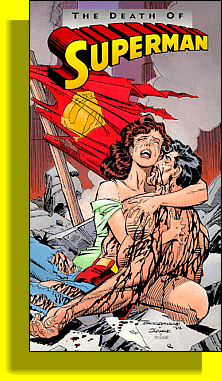
Superman never made any money
For saving the world from Solomon Grundy
And sometimes I despair the world will never see
Another man like him
"Superman's Song"
--by Crash Test Dummies
Click on the glowing
 .button to hear more of the lyrics ...
(The Death of Superman 1993 graphic novel cover art by Jon Bogdanove, Dennis Janke, and Reuben Rude.)
In the American folk tradition of tall tales about inspiring men like Paul Bunyun, moving mountains; Pecos Bill, lassoing tornados; and John Henry, outracing railroads, folk hero Superman can outdo all of them, yet seems more real than they because his mythology is a living and changing one, reflecting the very society he can motivate people to improve. Superman may never die as long as his exciting, idealized persona makes us strive to be better--to be like the man in Superman.
(Above right: Clark Kent resurrected. Art from 1993 by Kerry Gammill and Jackson Guice.)
_____________________________________________________________
WORKS CITED AND UNCITED
Andrea, Tom, et al. "The Birth of Superman: The Jerry Siegel and Joe
.............Shuster Interview." Nemo: The Classic Comics Library Aug. 1983: .............6-19.Austen, Beth and Janice C. Simpson, "Up, Up and Awaaay!!! Time 14
..............Mar.1988: 66-74.Bridwell, E. Nelson, ed. Superman from the Thirties to the Seventies. New
................York: Crown, 1983.Bryne, John and Dick Giordano. The Man of Steel. New York: DC Comics,
.............Inc. 1986.Clarke, Gerald. "The Comics on the Couch." Time 13, Dec. 1971: 70-71.
Crash Test Dummies, "Superman's Song," The Ghosts that Haunt Me.
.............Arista ..ARCD-8677, 1991.Dooley, Dennis, and Gary Engle, eds. Superman at Fifty: The Persistence
.............of a Legend. New York: Collier.Books, 1987.Fleisher, Michael L. The Great Superman Book. New York: Harmony
.............Books, 1978.Grossman, Gary. Superman: Serial to Cereal. New York: Popular Library,
.............1976.Hudnall, James D. and Eduardo Barreto. Lex Luthor: TheUnauthorized
.............Biography. New York: DC Comics, Inc., 1989.Jones, Clyde. "The Powers of Kal-El." Fantastic Films Jun. 1978: 29-30,
.............43-44, 64.The Kinks. "(Wish I Could Fly Like) Superman." 1979. Come Dancing with
.............the Kinks. Arista A2CD-8428, 1980.Levine, Dan. "Neverending Battle," Lois & Clark: The New Adventures of
..............Superman. Developed by Deborah Joy Levine. ABC 2 Oct. 1993.Lowther, George. Superman. 1942. Los Angeles: Kassel Books, 1979.
Maggin, Elliot S. Superman: Last Son of Krypton. New York: Warner
............Books, 1978.________. Superman: Miracle Monday. New York: Warner Books, 1981.
Maggs Dirk. Superman Lives!. New York: Time Warner Audio Books, 1993.
Petrou, David Michael. The Making of Supeman, the Movie. New York:
............Warner Books, 1978.Puzo, Mario, et al. Superman: the Movie. Dir. Richard Donner.
"Special Superman Issue." Amazing Heroes No. 41, 15 Feb. 1984.
Stern, Roger. The Death and Life of Superman. New York: Bantam Books,
............1993.________. Superman for Earth. New York: DC Comics,
.Inc., 1991."Wizard Superman Tribute Edition." Wizard Apr. 1993.
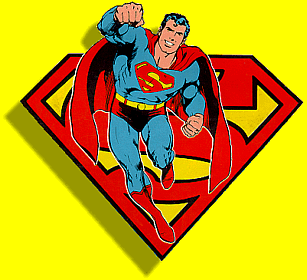
(Illustration adapted from dust cover of The Great Superman Book, 1978 art by Jose Garcia-Lopez)
Please note: In the five years since the publication of this article, much has happened in the Superman Universe. For a thorough update (marriages, births, deaths, etc.) please see the comic book,
Superman: Secret Files and Origins.
New York, DC Comics, Jan. 1998. 
|
|
All Superman related names and images are
© DC COMICS
|

Click on the Superman cover gallery graphic
(above), for a selection of his comic book covers spanning nearly 60 years.After you see the gallery...
home |
|
World's Finest: press here or I |
Superboy: press here or L |


(You are on page
A [left] 2. Click on A[left] for the start of this article.)
Blue
letters mean you haven't been there yet. Red ones mean you have.There is so much more to this web site. Each letter is a different section!
This page hosted by
 Get your own Free Home Page